

While recent reforms to the Reserve Bank of Australia are to be applauded, significant issues remain around the bank’s independence, accountability and transparency
Between the idea
And the reality
Between the motion
And the act
Falls the Shadow
T.S. Eliot, The Hollow Men
Australia is facing unprecedented structural challenges. Productivity is low, inflation is high—and persistent—and the world is a more volatile place than it has been for many a year. In this environment our central bank, the institution that has primary responsibility for medium-run economic stability, needs to be working effectively.
Doubts about whether the RBA was up to these challenges led to the commissioning of a review in 2022. The final report, titled “An RBA fit for the future”, reflected the review panel’s hopes that its reforms might get an RBA that had grown complacent and indolent, match fit.
Three years on from the report being handed down, and eighteen months since the most significant changes were implemented, how’s it all going?
The short answer is that, while the bank is much improved, it still has a way to go. Moreover, weaknesses in the review’s recommended model are becoming apparent.
To see this, it is helpful to start with a discussion of the basic principles that underpin effective central banks. That is, to answer the question: what does a match fit central bank actually look like?
INDEPENDENCE, ACCOUNTABILITY AND TRANSPARENCY
While the first central banks were founded in the 17th century, modern inflation-targeting central banks are a relatively new evolution. Their birth is generally dated to 1989, when the Reserve Bank of New Zealand (RBNZ) Act radically reformed the RBNZ. That act made the RBNZ independent of the government and gave it a single mandate—controlling inflation. It also introduced significant transparency and accountability measures: it gave the bank a clear, measurable target; it required the RBNZ to publish reports on monetary policy and to appear before government committees to defend its actions; and it made the governor of the RBNZ accountable for meeting the inflation target.
Independence solves the inflationary bias inherent in letting politicians control monetary policy.
The core elements of independence, transparency and accountability that the act implemented—rather than their particular expression in the RBNZ Act—form the bedrock of modern central banking.
So, why do central banks need to be independent? Why is it necessary that they transparently explain the reasons for their decisions and be held accountable for any failures to hit their targets? Can you be both accountable and independent?
Let’s take them in turn.
The core argument for central bank independence is that you need someone with a long horizon to set monetary policy. Governments, with their short electoral horizons, have repeatedly demonstrated their inability to resist a pre-election cash splash, at the cost of higher inflation later. The quintessential example of this lack of impulse control was the stagflationary experience of the 1970s.
The solution was for governments to tie their own hands by delegating responsibility to someone at arms-length; someone better able to resist the temptations of short-term economic stimulus. (It is frequently likened to Odysseus being tied to the mast to resist the Sirens’ song.) Independence solves the inflationary bias inherent in letting politicians control monetary policy.
But simply making central banks independent doesn’t guarantee they will deliver on their mandate. They need to be held accountable for their results; otherwise they could just go for a long lunch and call it a day.
It is, however, almost impossible to hold someone accountable for something vague like “the stability of the currency” or hitting a target “on average over time”. For that reason, modern central banks have explicit inflation targets.
This logic would be familiar to anyone who has sat through an HR talk on why managers should set SMART (specific, measurable, achievable, relevant and time-bound) goals for employees—it allows you to hold them accountable. It is the same for central banks—inflation targets are SMART.
There are, however, many reasons inflation may not hit the target. Interest rates are an imprecise tool for controlling inflation at the best of times. And, sometimes, things happen. A foreign war, a natural disaster, a global pandemic. All these and more can affect inflation and don’t reflect on the central bank’s competence.
To work out whether a miss of the inflation target is due to avoidable errors or bad luck, the central bank needs to be transparent. It needs to explain its thinking, its analysis and its strategy. Setting out its plan ahead of time allows the central bank to be held accountable for the quality of its plan rather than the quality of the outcome.
There is, however, an inherent tension between accountability and independence. Independence can easily be undermined if the accountability mechanisms make it too easy to influence the central bank.
Given that, formal accountability mechanisms are usually reserved for only the most significant failures by the central bank. But, because formal mechanisms are almost never invoked, informal accountability mechanisms—like public embarrassment—become much more important. These don’t undermine independence but, for them to operate effectively, genuine transparency is essential. You can’t hold someone accountable for something you can’t see.
AN ASSESSMENT OF PROGRESS
It should be no surprise, then, that the RBA Review had a significant focus on independence, accountability and transparency. It recommended strengthening these obligations but, because it viewed the RBA’s independence as relatively secure, had less to say about independence.
The key recommendations of the review, insofar as they relate to independence, accountability and transparency, were:
Accountability
- Publish unattributed board votes
- Board members give at least one public speech per year
Transparency
- The RBA should explain how it is balancing the sustainable full employment and inflation elements of its mandate
- The RBA should publish its assessment of key economic quantities, like the full employment level
- The governor should give a press conference after each board meeting
- Board papers should be released after 5 years
Independence
- Remove the Treasurer’s power to override the board
- Clarify that the Secretary of the Treasury serves in their individual capacity
- Require board members to have greater expertise (as a necessary foundation for them exercising independence)
Some of these recommendations contribute to more than one objective. For example, board member speeches contribute to both transparency and accountability. The override power was ultimately retained, and the release of board papers was delayed for seven years rather than five. But, otherwise, all the recommendations were accepted.
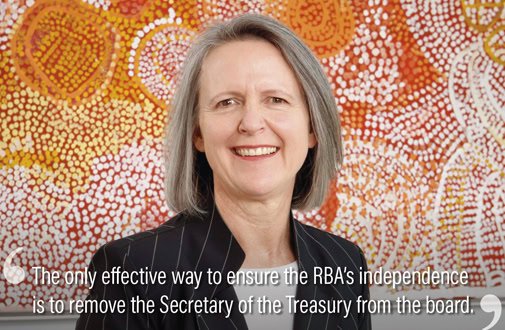 Current Secretary of the Australian Treasury, Jenny Wilkinson PSM.
Photo: © Commonwealth of Australia (CC BY 4.0)
However, while the majority of the recommendations were formally adopted, what really matters is how they have been implemented in practice. So, how’s that going?
TRANSPARENCY AND ACCOUNTABILITY
Transparency has improved with the release of unattributed votes. We can now see when decisions are contested, when we couldn’t before. We can hear a summary of the reasons for dissenting votes, rather than only hearing the case for the chosen path.
Furthermore, because the post meeting statement is now approved and issued by the entire board, rather than just the governor, dissenting members have greater scope to ensure that their reasons for disagreement are recorded accurately.
As such, board members who disagree with a decision now have the opportunity to be heard. This provides them with a greater incentive to challenge the dominant view and maintain that position in the board room and on the record. Under the old consensus model there was no record.
It is also to be hoped that, even though votes are unattributed, board members might, nonetheless, feel greater accountability for their votes given there is now at least some record.
The RBA has been less forthcoming on how it is balancing the full employment and inflation parts of its dual mandate. For the most part it has suggested that it can get inflation to target without unemployment ever rising above full employment—no balancing required.
More recently though, as inflation has remained stubbornly high, it has said it is putting more emphasis on inflation. In May the governor explained that the RBA changes its emphasis depending on its assessment of the risks.
That’s all well and good, but vague statements about emphasis are little more than empty rhetoric. To give them substance they need to be operationalised. It is strategy that reveals the tradeoffs the bank is willing to make. It is strategy that makes the weights concrete. And it is strategy that the governor has adamantly refused to discuss at her press conferences.
It is strategy that the governor has adamantly refused to discuss at her press conferences.
When asked about strategy she responds “I don’t do forward guidance”. But explaining your strategy, which is the embodiment of how you balance your mandates, is not forward guidance. It is a basic requirement of transparency and accountability, and a fundamental expectation of the review.
Another key accountability and transparency measure, the requirement that board members give at least one speech a year, has not been honoured. Of the eight external members who have sat on the board since its formation, only three have given a speech so far. And those speeches all occurred more than a year after the member’s appointment.
While it is unclear how much transparency the Review expected, what we have heard falls well short of the transparency necessary to hold them accountable. The speeches repeated information on how the RBA assesses the state of the economy, provided information on the process of a board meeting, and discussed the likelihood of a wage price spiral. There was, however, almost nothing on the monetary policy views of those board members.
This is, perhaps, to be expected given that the RBA’s external communication policy states: “When commenting on monetary policy, public comments by external members will typically convey the Board’s collective position and should respect the Board’s deliberations and policy decisions.” But it means there is, at best, corporate accountability rather than individual accountability. And, by merely repeating the RBA’s assessment of the economy rather than adding their own, there is little additional transparency.
Another important element of the reforms was the requirement for the RBA to provide more information on the way it sees the economy. In particular, its assessment of key quantities, such as the sustainable level of employment, that underpin its decisions.
In contrast to board member speeches, where there is a dearth of information, here there is an unhelpful surfeit. Instead of publishing one measure of the state of the labour market, the RBA publishes at least 15. Depending on which one you choose, the labour market is either too hot, too cold or just right.
Not only does the RBA publish a plethora of measures, it changes between updates with little explanation—like a multitude of snowflakes gyrating in the wind. Its estimates of the neutral rate have changed dramatically over the course of the past year and the list of labour market indicators keeps growing and growing. While some changes are to be expected, making them without explanation merely obscures and confuses.
Most importantly, this mountain of indicators doesn’t answer the key question—when you set interest rates, what was your judgement about the stance of policy? We get hints of the RBA’s assessment. The May 2026 Statement on Monetary Policy, for example, stated “Labour market conditions are still judged to be somewhat tight”. I suppose “somewhat” is more than “a touch” and less than “modestly”. But, really? In any case, to set interest rates, board members must have a number in mind. If they are to be transparent and accountable they need to share that number. As US President Lyndon Johnson once said, “Ranges are for cattle. Give me a number”.
So, the RBA is publishing more information than it did in the past—for which it should be applauded—but, by doing it in a way that obscures rather than reveals, they forfeit the applause.
The bottom line on transparency and accountability is that the RBA has improved, but is still falling short of the expectations, and particularly the spirit, of the review.
INDEPENDENCE
By and large the review felt that the RBA’s independence was secure. As such, the review essentially maintained the status quo and there is little to comment on here.
The review recommended removal of the Treasurer’s override power, but didn’t think it would affect the RBA’s de facto independence. So dropping that recommendation during parliamentary negotiations was no great loss.
The panel acknowledged that the presence of the Secretary of the Treasury on the board presents a perceived conflict of interest, but they felt it could be handled by “clarifying” that the Secretary serves in their “individual” capacity rather than at the direction of the Treasurer. That clarification was duly added to the Statement on the Conduct of Monetary Policy.
Finally, the review panel recommended “implementing an open and transparent appointment process for the RBA’s Boards. It agrees with comments received during the consultations that the current process is opaque, with limited accountability and safeguards against bias.”
As with the role of the Secretary of the Treasury, however, the specific recommendations the panel made did not fundamentally change the process. The decision remains the Treasurer’s, the process remains opaque, and there is limited accountability and safeguarding against bias.
The review’s recommendations on independence have mostly been implemented. The problem, in this case, is that their recommendations did not go far enough. I turn to this next.
THE NEED FOR FURTHER REFORM
As we’ve seen, the RBA is falling short of the expectations of the review. But even if the review recommendations were implemented in full, there would still be problems.
The most glaring is that of independence. There are persistent questions about whether the RBA is actually independent of the government. People wonder whether votes for or against particular decisions were made by partisan appointees. This is fuelled by limited transparency about the views of the board members and the justification for their decisions—in the absence of an explanation, observers infer partisan motives. This lack of transparency also means that board members remain effectively unaccountable—another big problem.
Further reforms are necessary.
While many central banks have the Treasury as an observer, most central banks do not have the Treasury on their boards. Having the Secretary of the Treasury as a full voting member is vanishingly rare.
It presents a major conflict of interest given the sometimes competing objectives of the monetary authority and government of the day. Indeed, the rationale for an independent central bank is precisely to keep it isolated from the short-term pressures of government. Placing the Secretary of the Treasury on the board undermines that independence. Regardless of whether an individual can effectively wear two hats (they can’t) the perception is that they are conflicted—which, for an institution that relies on credibility for its effectiveness, is just as bad.
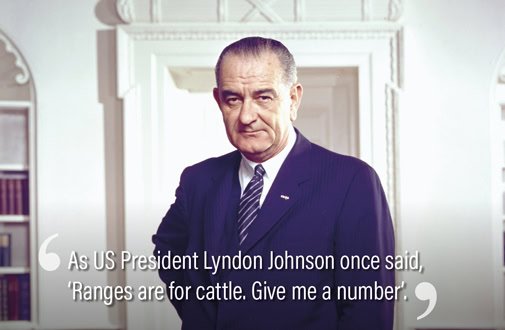 Official portrait of President Lyndon B. Johnson in the Oval Office, 1964.
The review panel attempted to thread the needle by “clarifying” that the Secretary of the Treasury would operate in their individual capacity. But the conflict of interest cannot be waved away with a few polite words. The contradictions involved are inherent, and multiply as soon as you probe them even a little.
If they are there in their individual capacity, why are they not assessed against the skills matrix? If they are there in their individual capacity, why don’t they publicly discuss their views on monetary policy, like all other members should? And are we comfortable with someone who argues one view in public—the government’s line, as all departmental secretaries must—yet might vote against it in private?
The only effective way to ensure the RBA’s independence is to remove the Secretary of the Treasury from the board.
Another area that raises questions about the RBA’s independence is the appointment process.
There is nothing to stop the current or future Treasurers from appointing partisans.
Board member expertise has certainly improved since the reforms were introduced. And split votes suggest that the board is operating more independently of, at least, the governor. But the appointment process itself—being neither transparent nor protected against bias—didn’t deliver this.
We don’t know who the candidates are, we don’t know how they stack up against each other, we don’t know anything about them until after the Treasurer has announced their appointment. There is nothing to stop the current or future Treasurers from appointing partisans. Given that board members have more power through publicly recorded formal votes than they did in the past, it is imperative that their independence be unquestioned.
In the US, hardly a paragon of independence these days, at least the candidates have to go through a public Senate approval process before being confirmed. The existence of that hurdle has helped to eliminate some plainly unqualified candidates. In Australia there is nothing.
While we don’t need to adopt the US processes, we need more transparency to provide protection against partisan appointments. A panel independent of the government should prepare a short-list. The short-list should be made public. The candidates should have to demonstrate some expertise in monetary policy before their appointment, not after, and certainly not never as is currently the practice.
Finally, the accountability of board members remains limited even though accountability is the quid pro quo for their independence. As long as votes remain unattributed and board members present collective views in their speeches—or don’t give any speeches at all—it will remain that way.
Sharing individual views in speeches would be an improvement, but talk is cheap. The true measure of what someone believes is seen in their actions—their revealed preferences as economists would say. As such, votes need to be attributed and explained in public. Without this the accountability of board members will only ever be partial.
And let’s be clear—this is not a radical proposition. The RBNZ adopted attributed voting in May this year and many other central banks have done so for some time.
A CHOICE TO BE MADE
The RBA Review made real improvements to the way the RBA operates. It has increased the transparency and accountability of our central bank—to our benefit. But its implementation has only been partial, and there are structural weaknesses in the reform model. A shadow has fallen between the idea and the reality.
The bank’s independence, accountability and transparency are all compromised. All these could be fixed. Indeed, most of the problems could be fixed tomorrow if the RBA wanted to. But, until that happens, there is insufficient transparency to determine if it has been doing the best possible job. That means that the only way to hold it accountable is to judge it by its outcomes.
But its outcomes have been poor. It hasn’t hit its targets for nigh on a decade. While it might seem unfair to judge the RBA on its outcomes—maybe it really was bad luck and its strategy was sound—it is entirely within the RBA’s power to provide the necessary transparency so we don’t have to.
The bank and board thus face a choice. We judge them on their outcomes—and find them wanting—or they increase their transparency so they can be held accountable for their strategy.
Choose wisely.
John Simon is an economist with a PhD from the Massachusetts Institute of Technology. He worked for more than 30 years at the RBA and the International Monetary Fund. He led the RBA’s Economic Research Department for a decade.
This article from the Spring 2026 edition of the IPA Review is written by economist, John Simon.
