
This issue’s cover image and caption poke fun at those who summarily dismiss the idea that the sun may in fact be the major determinant of climate change, over geological time, and through to the present day.
It references a review by Tim Duncan on page 60 of a new book by Nicola Scafetta, whom the IPA published nearly ten years ago, in Climate Change The Facts 2017. He is apparently as frustrated now as he was then by the determination of the climate-industrial complex—most notably but not only the IPCC—to place responsibility for climate change at the feet of us humans. Cynics might observe that to admit the sun rather than humans is the predominant driver of climate change would put quite a lot of ‘climate scientists’ out of work.
According to Google, the IPCC claims the sun—the only known fusion reactor currently operating in our solar system, and a very large one at that—has been responsible for only 1 per cent of the warming that records indicate has occurred since 1850. Scafetta does not deny a human influence, whereas the IPCC asserts that we can safely ignore the sun. Scafetta backs up with physics what can simply be deduced: his working hypothesis is plausible, that of the IPCC is not.
The most topical article in this issue is of course that by Margaret Chambers who, along with the director of our law and freedom program Dr Andrew Bushnell, has literally been working overtime to expose the dark underbelly of the Albanese government’s Digital Duty of Care legislation.
For my part, I was hearing mention of sock puppets around the office as they began their work, and naively assumed that this was a disparaging reference to the bureaucrats being given powers to articulate the official government line.
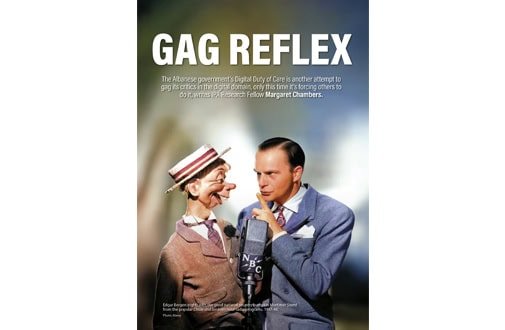
Imagine my incredulity when I discovered that the legislation itself explicitly authorises the eSafety Commissioner to set up so-called sock puppet accounts with which the office could pretend to be ordinary Australians posting offensive material, in order to test the safety regimes of digital platforms and inevitably snoop on those Australians who may respond to the posts. You can read Margaret’s article on page 16.
Faced with such measures is it any wonder that we are witnessing the so-called populist revolt. That ‘populism’ and ‘populist’ are words seen as inherently pejorative tells you something about the tenacity and defensiveness of the elites threatened by the movement. This is the reason to read Cian Hussey’s review of another fine book by former IPA guest speaker Frank Furedi on page 66.
Given the role that activist courts play in licencing government overreach, and indeed lawfare by activists, it is entirely appropriate the aforementioned Dr Bushnell on page 30 examines the role of activist judges and muses on the importance of judicial appointments in ensuring that future courts hew to the traditions of our Commonwealth system and the conception of the founders who produced our Constitution more than 125 years ago.
On page 8 economist Saul Eslake plumbs the depths of Victoria’s financial crisis and provides a broad outline of what must be done. He probably would not remember this, but I first met Saul 35 years ago when he was providing advice of an eerily similar nature to then shadow treasurer Alan Stockdale, as the ALP Cain-Kirner Government entered the final stages of its destruction of Victoria’s financial and economic base. Twenty years ago—after a period of painful recovery had restored the balance—I would never have thought we might one day have to repeat the exercise. The price of liberty is eternal vigilance, and the same could be said of fiscal rectitude.
On page 44 we have an important article by maritime consultant Peter Court on our shameful lack of sovereign capability in merchant shipping. He makes a convincing case that this is no niche issue but one central to Australia’s national security.
Of course to have national security one must have a nation, and this consideration is what drives IPA Senior Fellow Dr Kevin You on page 38 to examine the importance of Australian values, to criticise the facile praise of diversity for its own sake, and to emphasise the crucial role of the English language in the task of nation building.
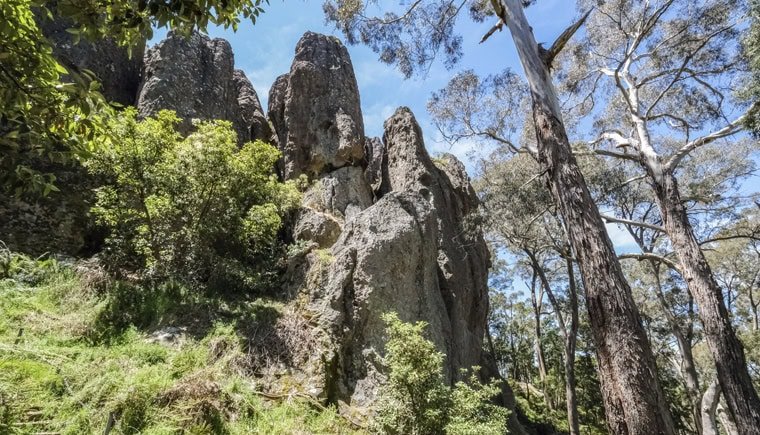
On page 52 you will find the latest instalment in the IPA’s work to buttress that sense of nationhood by highlighting the great works of literature and the arts that have captured, and in some cases shaped, our national culture and memory. Elder statesman of Australia’s literary critics, the inimitable Peter Craven examines director Peter Weir’s unforgettable film Picnic at Hanging Rock with reference to the equally momentous source novel by Joan Lindsay. The continuing interest in the book and the movie encourage us to continue our work with the IPA’s Genius of Australia project.
Recently the interview conducted by our chief economist Adam Creighton with former RBA governor Philip Lowe created tremendous interest amongst the media and opinion makers. On page 22 you will find an excellent complement to that interview in the shape of John Simon’s studied evaluation of the bank and a series of recommendations for change.
I note that former head of the Socialist International António Guterres will soon step down from his more recent role as Secretary-General of the United Nations. Perhaps one day an enterprising journalist will ask him whether he saw any actual distinctions between the two roles. To mark this moment, Michael Barrett reflects on the decade of activism Guterres inflicted upon the world.
As this issue of the IPA Review amply demonstrates, Australians face some profound challenges to our security, our freedoms and our values. But as we confront these threats, we can and should seize every opportunity to celebrate our unique national culture and the Australian Way of Life.
This article from the Spring 2026 edition of the IPA Review is written by Editor of the IPA Review and Executive Director at the Institute of Public Affairs, Scott Hargreaves.
