

If the Coalition forms government in Victoria this year, it will need a clear program of productivity-enhancing reforms alongside a confidence-building commitment to budget repair.
If the Liberal and National Parties succeed in forming a coalition government following the Victorian election, to be held on 28 November this year, they will face a Herculean task, similar in some ways but in others more challenging than that which confronted Jeff Kennett and Alan Stockdale in October 1992.
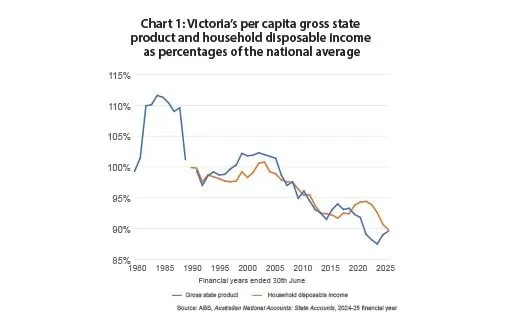
At the beginning of the 21st century Victoria was still a relatively rich and prosperous state. Both its per capita gross state product and its per capita household income were above the corresponding national averages—albeit not by as much as in the middle decades of the 20th century. But over the ensuing two-and-a-half decades, Victoria has become a relatively poor state by both of these metrics, alongside the perennial ‘cellar dwellers’ of South Australia and Tasmania, as shown in Chart 1.
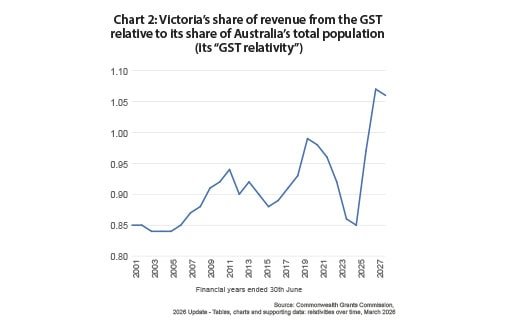
Victoria’s relative economic decline is further illustrated by the fact that, as shown in Chart 2, in the past two years, Victoria has received a larger share of the revenue from the Federal Government’s GST than it would have done had that revenue been distributed on an equal-per-capita basis—as Victoria, along with New South Wales, had traditionally argued that it should be. In other words, Victoria has become what Western Australians nowadays like to call a “mendicant state”. (This is a label which contemporary Western Australians like to attach to other states despite the fact that for almost seven decades after the establishment of the Commonwealth Grants Commission in the mid-1930s, Western Australia received a larger share of ‘untied’ federal financial assistance than it would have done had that assistance been distributed in accordance with each state’s share of the national population.)
The decline in Victoria’s economic fortunes relative to the rest of Australia over the past twenty-five years is of course partly the mirror image of the extraordinary prosperity which nature, and China, have conferred on Western Australia since the turn of the century, which has seen that state’s per capita gross state product exceed the national average by a vastly larger margin than for any other state since Federation.
But the decline in Victoria’s per capita gross product relative to the national average, of 12.1 percentage points since the turn of the century, exceeds that of New South Wales (9.0 percentage points) and South Australia (6.4 percentage points)—whereas Queensland, Tasmania and the two territories have all experienced an increase in their per capita gross product relative to the national average over the past quarter-century. The same is true of Victoria’s per capita household disposable income relative to the national average, compared with that of other states and territories.
The biggest single ‘underlying’ cause of Victoria’s relative economic decline … has been its sub-par productivity performance.
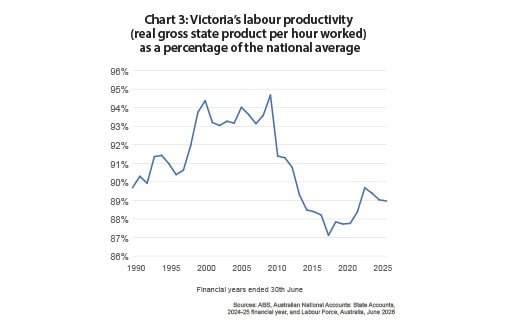
The biggest single ‘underlying’ cause of Victoria’s relative economic decline over the past two-and-a-half decades has been its sub-par productivity performance. Labour productivity (as measured by real gross state product per hour worked) increased at an average annual rate of just 0.75 per cent over the first twenty-five years of this century—lower than in any other state or territory except New South Wales (which, unlike Victoria, was able to obscure the adverse effects of slow productivity growth through ‘terms of trade gains’), and 0.2 percentage points per annum below the national average labour productivity growth rate.
Put differently, as shown in Chart 3, labour productivity in Victoria declined from 6 per cent below the national average in 2004-05, to more than 12 per cent below the national average just before the onset of the Covid-19 pandemic, and was still 11 per cent below the national average (and lower than in any other state except South Australia and Tasmania) by 2024-25.
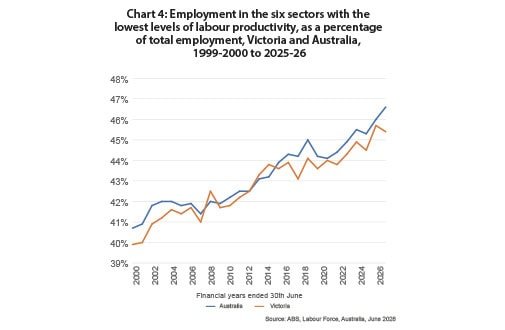
One of the reasons for Victoria’s relatively poor productivity performance is that its economic growth has become increasingly dependent on intrinsically low-productivity industries. Since the turn of the century, the proportion of the Victorian workforce employed in the six industry sectors with the lowest levels of measured labour productivity (education and training, health care and social assistance, retail trade, art and recreation services, accommodation and food services, and other services) has risen from 39.7 per cent—one percentage point below the national average—to 47.4 per cent—1.1 percentage point above the national average (Chart 4).
Conversely, the proportion of the Victorian workforce employed in the six highest-productivity industries (mining, finance and insurance services, utilities, information media and telecommunications services, rental hiring and real estate services, and wholesale trade) has fallen from 13.4 per cent—0.6 of a percentage point below the national average—in 1999-2000 to 11.1 per cent—0.9 of a percentage point below the national average—in 2025-26 (Chart 5).
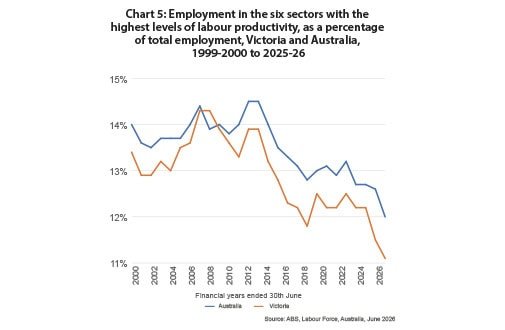
Put differently, 57.4 per cent of the growth in employment in Victoria since the turn of the century has been in the six industries with the lowest level of labour productivity.
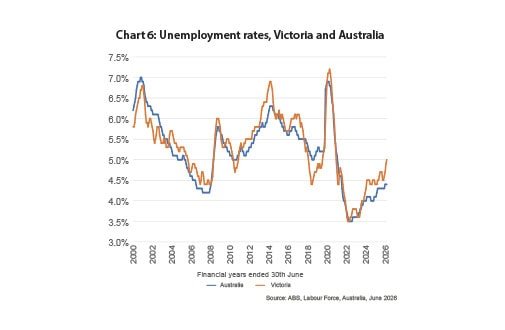
For some time, that more rapid growth in intrinsically labour-intensive industries contributed to Victoria recording faster growth in employment than most other states and territories.
But that’s no longer the case—for the past two-and-a-half years, Victoria’s unemployment rate has been higher than the national average (Chart 6).
So one of the most important tasks confronting Jess Wilson and her colleagues, should they form the next Victorian Government, will be to reverse the slide in Victoria’s relative economic performance which has occurred over the past quarter of a century.
Meeting that challenge will be made more difficult by the other major task which Ms Wilson and her colleagues will confront, that of putting Victoria’s public finances onto a sustainable trajectory.
Victoria’s ‘general government’ net debt has risen by $143 billion, to $165 billion, over the past 11 years, and according to the most recent state budget will increase by a further $34 billion, to $199 billion, by the end of the 2029-30 financial year. That would be equivalent to 24.4 per cent of Victoria’s forecast gross state product (GSP) —well above the previous peak of 16.5 per cent of GSP in 1992-93, at the end of the Cain-Kirner years (Chart 7).
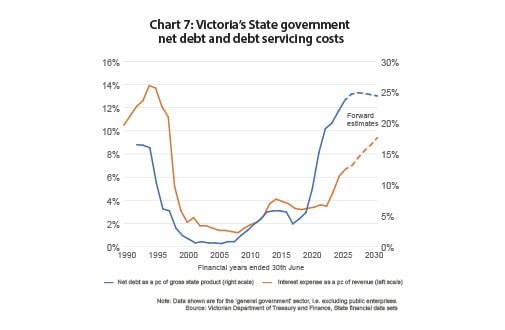
Victoria is fortunate that interest rates are much lower today than they were then—so that despite a much higher level of debt, interest payments will be consuming ‘only’ 9.4 per cent of Victoria’s revenue, compared with 14.6 per cent of revenue in 1992-93—although that previous peak could be reached again some time in the 2030s if net debt continues to climb or interest rates on government bonds continue to rise.
Jeff Kennett and Alan Stockdale paid down a large portion of the debt which they inherited from their predecessors by selling over $25 billion of assets, in particular the former State Electricity Commission and Gas and Fuel Corporation. Dan Andrews and Tim Pallas sold off a further $20 billion, including two of the largest asset sales ever undertaken by an Australian state government (the Port of Melbourne and the Motor Vehicle Registry).
As a result, the Victorian Government has very few readily saleable assets left, even if there were a political appetite for further privatisations.
The only way a future Coalition Government can begin to pay down the debt which it will inherit—indeed the only way it can stop accumulating more debt—is to run cash surpluses, as Jeff Kennett and Alan Stockdale did in their second term in office (and, for that matter, as Steve Bracks and John Brumby did throughout their first two terms in office) but which has only happened twice since 2007-08. Merely running ‘operating’ surpluses—as Jacinta Allan and Jaclyn Symes promised to do—isn’t good enough, because the ‘operating’ balance so beloved of all state Treasurers nowadays excludes capital expenditures.
The most recent State Budget projected that the Victorian Government will incur cash deficits totalling $30 billion over the four years to 2029-30. In order to achieve cash surpluses by the end of its first term, if it gets one, a future Coalition Government will need to institute some combination of revenue increases and reductions in both ‘operating’ and infrastructure spending.
The Victorian Government has very few readily saleable assets left.
Although tax increases—in particular the $100 ‘deficit repair levy’ imposed on every property—did form part of Jeff Kennett’s and Alan Stockdale’s ‘budget repair’ menu, there would be very little scope for a future Coalition Government to go down a similar path. State taxes already amount to 6.2 per cent of Victoria’s gross state product—up from 4.8 per cent when the Andrews Government came to office—a higher percentage than in any other state or territory (the corresponding figure for New South Wales is 5.7 per cent), and well above the average for all states and territories of 5.0 per cent.
Victoria already has the highest payroll tax rate of any jurisdiction except the ACT, as well as the lowest threshold at which employers become liable for payroll tax; the highest rates of stamp duty on land transfers of any state or territory; and the highest rates of land tax on holdings in excess of $5 million of any state or territory.
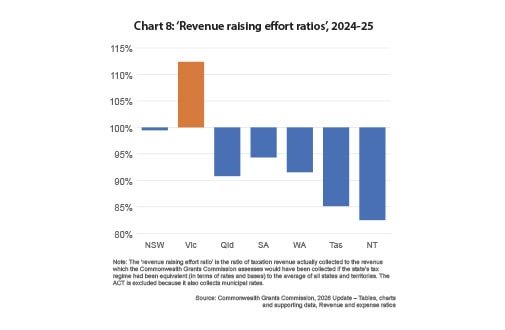
The Commonwealth Grants Commission calculates that Victoria raises 12.4 per cent more by way of tax revenue than it would if its tax regime were similar to that of the average of all states and territories—the highest ‘revenue raising effort ratio’ of any jurisdiction except the ACT (Chart 8).
However, there would appear to be ample scope for, at the very least, curbing the growth in ‘operating’ expenses, and for reducing infrastructure spending.
The Grants Commission’s assessments—which these days Victoria would be ill-advised to dispute or ignore, given that they provide the basis for Victoria now receiving a larger share of the revenue from the GST than its share of the national population—suggest that the Victorian Government is spending some 7 per cent more than it ‘needs’ to in order to provide Victorians with a similar range and quality of public services at a similar level of efficiency to the average of all states and territories (Chart 9).
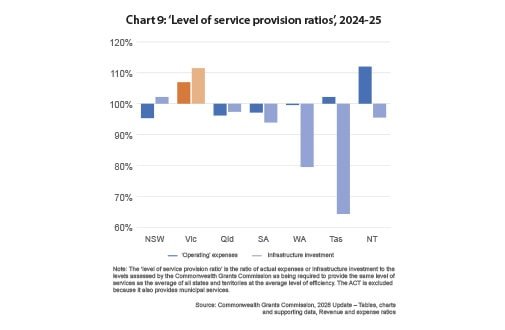
That’s the highest ‘level of service provision ratio’ of any jurisdiction except the two territories (and the figures for the ACT are inflated by the fact that the ACT Government is also, in effect, the Canberra City Council, so its spending includes functions that are undertaken by local governments in the other jurisdictions).
That ‘excess’ spending by the Victorian Government, relative to what the Grants Commission assesses would be required to provide Victorians with the same levels of services as the average of all states and territories at the average level of efficiency, amounts to $772 per head, or a total of $5.4 billion (in the 2024-25 financial year).
The Grants Commission’s assessments also suggest that the Victorian Government was spending 11.5 per cent (more than any other jurisdiction except, again, the ACT) —or almost $1.8 billion—more on infrastructure investment than would be required to provide Victorians with the same level of infrastructure services as the average of all states and territories, at the average level of efficiency (Chart 9).
In total, therefore, the Grants Commission’s assessments suggest that there’s scope for the Victorian Government to reduce its total annual spending by up to $7.2 billion without Victorians having to accept a lower range or quality of public services than other Australians, on average.
Indeed, to the extent that Victoria’s ‘above-what’s-required’ spending is the result of inefficiency in service delivery as opposed to ‘better-than-average services’—something which can’t be readily ascertained from the Grants Commission’s calculations—it may be possible to reduce spending whilst still delivering above-average quality public services to Victorians.
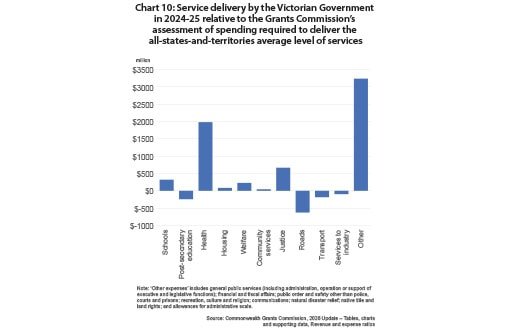
The Grants Commission’s assessments also provide a starting point for thinking about where, and by how much, ‘operating’ expenses could be cut without requiring Victorians to accept lower standards of public services than the average of all states and territories. Chart 10 shows how much the Victorian Government spent in each of ten different functional areas in 2024-25, compared with the Grants Commission’s assessment of how much it would have needed to spend in order to provide Victorians with the same level of services in each area as the average of all states and territories, on the assumption that those services were provided with the same level of efficiency as the average of all states and territories.
The numbers depicted in Chart 10 should be interpreted as suggestive, rather than definitive, given that they can be influenced by differences among the states and territories in the way that various expenditure programs are categorised under the headings used by the Grants Commission in its assessments. But particularly where the Grants Commission’s assessments point to very large divergences between actual spending and the level of spending required to provide the all-states-and-territories average level of services, there are strong grounds for thinking there is scope for savings to be made.
Another useful starting point for considering how it might deliver public services to Victorians more efficiently and at lower cost is in the form of the Independent Review of the Victorian Public Service by Helen Silver (who was Head of the Department of Premier and Cabinet under John Brumby), which was presented to the Allan Government in June 2025. Ms Silver’s Final Report made 52 recommendations which she estimated would save around $5 billion over the four years to 2028-29. However, the Allan Government accepted only 27 of those recommendations in full and three in part, resulting in savings barely more than half of what Ms Silver estimated could have been achieved.
Ahead of the election, the Coalition should be frank with the Victorian public about what needs to be done in order to put Victoria’s public finances onto a sustainable footing.
While it would be unreasonable to expect it to lay out in detail where and how it would seek to make expenditure savings, ahead of being in a position to undertake a thorough assessment of how those savings could be made—which it can’t do from the Opposition benches—it shouldn’t seek to kid the electorate that significant expenditure savings won’t be required. That would be repeating the mistake which the Federal Coalition made ahead of the 2013 election, which in turn fatally undermined its efforts at ‘budget repair’ in its 2014-15 Budget.
Nor should the Coalition pretend—either to itself, or to the electorate—that it is possible to ‘grow our way’ out of the fiscal hole in which Victoria now finds itself. Given the size of the task, that’s the equivalent of, to recall an old joke about economists, assuming you have a can-opener when stranded on a desert island with only canned food.
There are strong grounds for thinking there is scope for savings to be made.
On the contrary, the best fillip a newly elected Victorian Coalition Government could provide to prospective growth in the Victorian economy would be to come to office on a clear program of productivity-enhancing reforms (including a heightened focus on higher-productivity industries) paralleled by a confidence-building commitment to budget repair.
The difficulties entailed in putting together and then implementing such a program shouldn’t be under-estimated. To that end, it would be preferable for the Premier to appoint a trusted and competent colleague as Treasurer rather than seek to do that job herself, in addition to leading the government as Premier. Although ‘good economic and fiscal policy’ is almost always ‘good politics’ in the long run, in the short-term there can be tensions and trade-offs between the two. And those tensions and trade-offs are best resolved by a Cabinet which can hear both sides of those arguments, rather than having them decided inside one person’s head.
Tasmania’s finances—which relative to the size of Tasmania’s economy and population are arguably in a worse condition than Victoria’s—experienced their greatest deterioration whilst Peter Gutwein was holding down the jobs of both Premier and Treasurer. When Steve Bracks first came to government in Victoria, he briefly also held the role of Treasurer, before handing it over to John Brumby.
Fixing Victoria’s economic and fiscal problems is a formidable task. It will take at least two people to do it.
Saul Eslake is one of Australia’s best-known economists. He began his career working for the Australian Treasury and was Chief Economist for the ANZ Banking Group between 1995 and 2009. He was Chief Economist (Australia and New Zealand) for Bank of America Merrill Lynch between 2011 and 2015. He was also CEO of the Victorian Commission of Audit established by the Kennett Government in 1992–93.
 Saul Eslake
This article from the Spring 2026 edition of the IPA Review is written by economist, Saul Eslake.
