
The Albanese government’s Digital Duty of Care is another attempt to gag its critics in the digital domain, only this time it’s forcing others to do it.
According to American journalist and academic Michael Shellenberger, “The last time we checked in with Australia, you were all wrestling crocodiles. Then we check in again, and you’re trying to protect grown adults from mean tweets.”
Shellenberger was talking about the Albanese government’s Digital Duty of Care legislation. And he is right: our international reputation used to be one of larrikinism and rugged individualism. Now, we are known as a testing ground for bad ideas and a global exporter of censorship.
While the cultural seeds of safetyism and compliance may have existed in our country long before I was born, I have watched their rampant growth across my life. My childhood was largely spent outdoors, climbing trees with scraped knees. As a teenager, I competed in performing arts and was fortunate enough to travel internationally to do so. As the Australian team, we had a reputation for outrageous fun, creativity, and mischief. Wherever there was laughter, an Australian was usually at the centre of it.
Michael Shellenberger is right to ask what on earth has happened to Australia.
I was in school when Daniel Andrews first became Premier. Over the next decade I watched as the Welcome to Country replaced prayers in assembly. Almost at the same time, cancel culture began in earnest. While this was happening, I really just wanted to talk about ideas and history, so I enrolled in a history course at the University of Melbourne. In my first year, I discovered the microwave in the women’s room was clean, and used it for many weeks on campus. I eventually stopped doing so when I was asked to leave the women’s room, because an intersectional event was being hosted, and I was clearly not intersectional enough.
About a year later, the lockdowns began. When I wasn’t participating in my mandated one hour of exercise, I was inside, or talking to my neighbours over the fence. On one occasion, someone called out to berate me for hugging an anxious friend on the sidewalk because I was not socially distancing. On another occasion, a stranger almost burst into tears during a rant at me for not wearing my mask properly.
So Michael Shellenberger is right to ask what on earth has happened to Australia. Australians are meant to be the people of Crocodile Dundee, Steve Irwin, and Darryl Kerrigan. Now we are banning words and legislating against hurt feelings.
It seems safetyism is what happened, and it has largely been driven by our political class. I remember distinctly during Covid watching press conferences, where politicians would berate Australian parents, including for allowing their children to use playgrounds and go to the beach, because obviously Covid is spread at the beach.
Fast forward to the National Press Club Address I attended with Shellenberger, where I watched a government minister seriously liken her censorship laws to physical safety innovations, including toy makers testing for choking hazards.
THE DIGITAL DUTY OF CARE
The Digital Duty of Care will accelerate Australia’s cultural decline. It is a symptom of our broader cultural decay, yes, but it will make it so much worse. If left unchallenged, it will not just stifle our productivity but our creativity too. Worse, it risks corrupting our nation’s soul.
We will have more explaining in the weeks and months to come. The story about what has happened to our country, and what we did about it will be an important one. I earnestly believe this story can be one of triumph, about how we overcame this cultural toxin and changed not only political debate but culture. Australia’s decline is not a foregone conclusion, and resisting it is the real duty of care.
At the time of writing, Labor’s Digital Duty of Care has progressed from a promise to an exposure draft to a bill tabled in the Parliament. It is the government’s intention to pass it by Christmas 2026.
If it passes, internet services will be compelled to provide a “safe online environment”, as defined by the government. Part of that “safe online environment” is an internet where “public officials” are not censored, and only professional journalists are protected under the banner of “professional news material” (see section 25F). While a “public interest” content exemption exists in the bill (s 25(1)(i)), ask Andrew Bolt or Pauline Hanson how helpful a “public interest” defence was to either of them when they were pursued under section 18C of the Racial Discrimination Act 1975.
The historically unaccountable eSafety office … will now gain powers of surveillance.
The bill will also allow the eSafety Commissioner to operate fake accounts online, referred to in the legislation as “sock puppet” identities. While the government says these accounts are about monitoring compliance, the bill clearly allows for these accounts to generate content online and to “observe, download, or make a record” of any material accessed on an online service. More concerningly, the bill makes eSafety an “enforcement body” under the Privacy Act 1988, allowing it to gather “sensitive information”. The historically unaccountable eSafety office, which has a track record of exceeding its already vast powers, will now gain powers of surveillance.
An idea like this is a characteristic feature of a totalitarian government, not a liberal democratic one. One does not have to be too cynical to think that the real objective of the legislation is to immunise the Albanese government from criticism, and that the language of “safety” and “protecting children” is being used to achieve this.
When my colleague Dr Andrew Bushnell and I first read about the Digital Duty of Care, we quickly realised it was a plan to reintroduce the failed misinformation laws and sterilise public debate. In early June, I wrote on Substack:
The Digital Duty of Care model risks creating a system of pre-emptive censorship by proxy, where platforms must act to remove “harmful content”, outsourcing censorship to social media companies while shielding the regulator from accountability and removing appeal rights for Australians. A similar censorship proposal to combat misinformation was pulled before it reached the Senate in 2024. The proposed bill originally sought to compel social media platforms to remove “misinformation” that could cause serious harm through the threat of enormous penalties, but was abandoned when it became clear that it would not make it through the Senate. But the Digital Duty of Care provisions may resurrect the spirit of the misinformation proposal, disguising it using the language of protecting children.
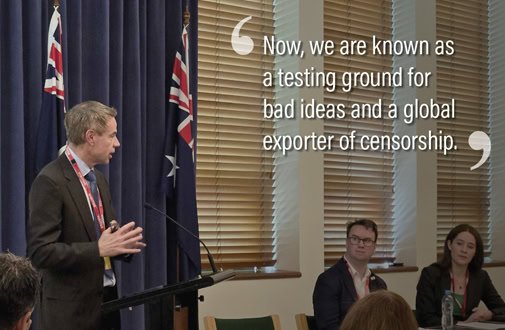 Michael Shellenberger addresses the Coalition party room in Canberra,
with the IPA’s Andrew Bushnell and Margaret Chambers.
Dr Bushnell made a similar point in his research, arguing that “The duty to eliminate intangible harms will allow the government to smuggle its abandoned misinformation laws in through the backdoor.”
For this reason we approached Shellenberger about the proposal. Michael Shellenberger is a journalist, founder of the news site Public, and CBR Chair of Politics, Censorship, and Free Speech at the University of Austin (UATX). He is one of the journalists that broke the story on how Twitter, now X, had been pressured by the government to censor certain types of speech. He has millions of followers online.
I first met Shellenberger in 2024, when the IPA brought him to Australia to amplify our research on the government’s misinformation laws. He rightly explained then that what the government was really trying to censor were opinions it did not like. Earlier this year, I met Shellenberger again, in London at a gathering of free speech advocates, where I was sharing my work on the expansion of eSafety’s office and power.
I could hear the alarm in his voice on the phone as we told him about the exposure draft of the bill. As he recalled in a recent conversation with me on the IPA’s Australia Censored podcast:
We were reading it together on the phone and particularly we saw this clause that said that essentially the government would be allowed to censor anything that “may cause serious harm”. Well, I mean, you don’t have to be an expert in censorship to know that that means that anything can be labelled as serious harm. And not only that, but there’s actually a very large amount of research, academic research, other research showing that the way people define harm has increased significantly. If you think back to
our grandparents, harm was being physically assaulted … Now people describe their feelings being hurt as serious harm, and that’s not a joke.
While the powers to expand the definition of “serious harm” by legislative instrument have since been removed, it remains true that much of the detail of the bill will be worked out after it has passed parliament, through government-issued regulation.
AUSTRALIA AS A TESTING GROUND
Australia has become the Petri dish of the Western World. The under-16s social media ban, foolishly passed without a viable mode of implementation, has already inspired more than 20 countries to implement or consider similar laws.
This is at least partly the point, because eSafety’s aspirations are global. In 2022, eSafety co-founded the Global Online Safety Regulators group to build the foundations of a global network, which now includes a host of equivalent regulators including from the United Kingdom, Fiji, South Africa, France, and Ireland. Australia has become a testing ground for the most radical internet censorship ideas in the Anglosphere.
Shellenberger understands this, and that is why he is so concerned about what is happening in Australia. I met him in Brisbane for the Conservative Political Action Conference, before travelling to Canberra to brief politicians on the legislation. In walking to the convention venue, I filled him in on the political context, hurrying him across the road at a flashing red pedestrian light.
“Oh, red means go in Australia?” he asked me.
“Yes,” I said, “Because everything is upside down in Australia.”
Over the next week, this seemed increasingly true. Things are upside down in Australia. The government says one thing when it clearly means another. It waxes lyrical about children’s safety in promoting a bill clearly designed to regulate the internet for adults. It talks at length about going further to protect children on social media, while never addressing the fact it supposedly banned children from having social media accounts.
As we briefed representatives from across the political spectrum in Canberra, it seemed clear to us that without the IPA, many would not have received a briefing at all. We explained how the idea was conceptually flawed and how the sock puppet provisions effectively allow the government to set up fake accounts to spread disinformation.
In Sydney, Shellenberger and I travelled between interviews and media engagements. His commentary on social media and outlets like News24, 2GB, news.com.au, and The Australian transformed the debate. Politico separately asked Minister for Communications Anika Wells to respond to Shellenberger’s claim that the bill was a “sinister plan for mass censorship”.
On the last day, when we returned to the National Press Club, the scene played like an absurdist comedy. Wells tried repeatedly to assure the public and the journalists that she was not censoring material, but rather the “machine” of the internet. At the same time, her speech was littered with examples of types of speech she wanted to censor.
“We are controlling …” she said, then stopped. “We are not controlling free speech”. Sometimes it is difficult to catch the quiet part before it slips out loud.
After her address, News24 journalist Cam Reddin specifically asked the Minister to respond to Shellenberger’s critique of the sock puppet accounts. Her response was nothing short of absurd.
I don’t accept the premise. I do not accept the premise of this argument … Yes, these people claim to know what is deep within my heart, better than myself or the government or the eSafety Commission or the Office of Parliamentary Counsel—that’s their right.
My conversations with people from the media and industry led me to conclude that most people were equally disturbed and confused by the updated bill, which is before the Parliament at the time of writing. In hushed tones, they told me that they too thought the drafting had been rushed and they did not understand the logic of the same duty applying across the internet.
It has been rushed. The urgency to pass the laws is compounded by the fact that Albanese is actively positioning himself as a global leader, attempting to secure a United Nations Security Council position for Australia. He is building a legacy for himself.
The Albanese government would prefer not to have a debate.
In September 2026, Albanese, the Atlantic Council’s Global Citizen Award winner, used his United Nations General Assembly address to spruik the Digital Duty of Care and social media ban, positioning his government as a world leader. But Australia is not really leading the world, so much as the Albanese government is caught up in a global push for internet censorship.
Back home in Australia, though, a debate was waiting for him, led by the IPA and Michael Shellenberger. And it is a debate we must win.
Every time the Albanese government has put its ideas to public debate, it has come out for the worst, including on the Voice to Parliament referendum, the misinformation laws, and the vilification provisions contained in what became the hate group laws. That is why it usually tries to bypass the debate, and partner with the Greens to pass unpopular laws (such as the recent changes to capital gains tax and negative gearing).
Given its track record, the Albanese government would prefer not to have a debate. So there must be one. We will bring it to them.
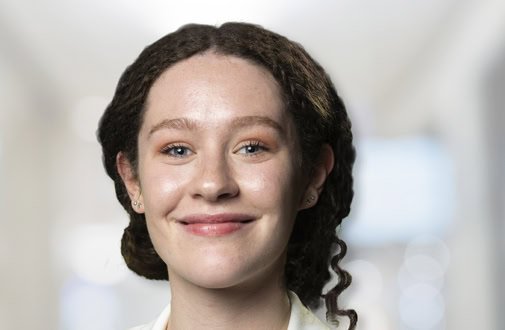 Margaret Chambers is a Research Fellow at the Institute of Public Affairs.
This article from the Spring 2026 edition of the IPA Review is written by IPA Research Fellow, Margaret Chambers.
