

Lessons learnt from Australia’s fight against communism last century echo through to political battles today, writes IPA Executive Director Scott Hargreaves.
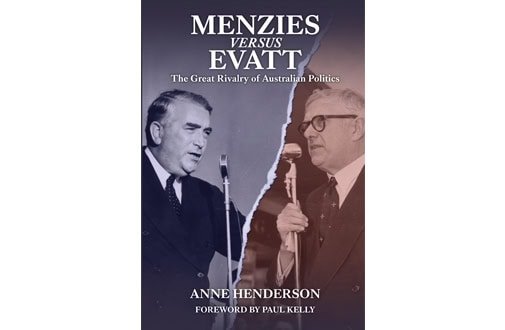
Anne Henderson
Connor Court Publishing, 2023,
236pp
This fine book by Anne Henderson works at a number of levels. By exploring the similarities and contrasts of two very talented scholarship boys who made their names in law and politics, it works first of all as a study of character. Each had their successes, but while Robert Gordon Menzies (1894-1978) ended his career as the unchallenged master of the Australian political scene, Evatt’s misjudgments did lasting damage to his own career and caused decades-long harm to the ALP.
Herbert Vere ‘Doc’ Evatt (1894-1965) was appointed to the High Court when only 36 (the youngest ever Justice) but resigned to enter federal parliament and, in time, served as Attorney-General and Minister for Foreign Affairs during the terms of the Curtin and Chifley Labor governments (1941-1949).
Henderson’s book also works at a second level as a chronicle of the tumultuous 10 years after World War II, when Australia had to adjust from fighting a battle against fascism to the emerging battle against communism. While Menzies is presented as having erred in his attempt to outlaw communism in Australia, his leadership and establishment of foreign alliances ultimately set up Australia to defend its sovereignty during the Cold War, and beyond. In its third dimension the book shows how the tracks for the rails on which our national politics still seem to run were laid 70 or even 80 years ago. Evatt and Menzies established certain dichotomies for their respective parties:
- Evatt, whose chosen epitaph gives precedence to his role as president of the United Nations’ General Assembly, reflects the ALP’s perpetual preference for deferring to international institutions and describing our ‘obligations’ to them. Menzies, on the other hand, reflects a more hardheaded approach dominated by considerations of the national interest, with a deliberate preference in foreign affairs to work with like-minded allies (particularly in the Anglosphere).
- Evatt was not a communist but personified the faction or tendency in the ALP which is reflexively anti-anti-communist. He was deeply suspicious of those who spoke of communism as a menace and sought to nullify its adherents’ activities. He literally drove himself mad and damaged his own party by attempting to prove that Menzies had staged the defection of Soviet embassy staff (and spies) Vladimir and Evdokia Petrov in 1954 to secure victory in that year’s election. Ascribing the Liberals’ anti-communism to base political motives unsupported by evidence has a long pedigree for the left of the ALP. Not long after, he forced the expulsion from the ALP of those MPs and party members who had successfully wrested back control of the major unions from the communists, somehow believing the ‘Groupers’ were the greater threat. The result was the split in the ALP and the formation of the Democratic Labor Party, whose preferences to the Liberals kept the Coalition in office until 1972.
- The Liberal Party (via preference deals with the DLP) was ultimately able to bring over the conservative Catholic middle class to the non-Labor parties, which to this day makes it electorally viable at the national level. The ALP, meanwhile, has over time weaved a series of narratives that gloss over the failings of Evatt and others, by ascribing its failures to dirty tricks by the Liberals or indeed extra-political forces including the CIA. Henderson quotes former Evatt staffer, and later biographer, Allan Dalziel, asserting this of the Petrov affair without evidence, and the meme was repeated ad nauseam after the dismissal of the Whitlam Government in 1975.
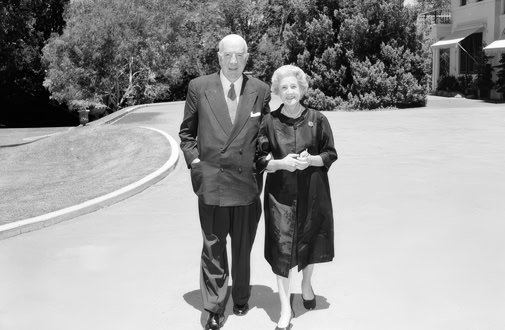 Sir Robert Menzies and his wife Dame Pattie, 1969.
Copyright: National Archives of Australia
On the last point, Henderson writes “as with the legacy of former Labor Prime Minister Gough Whitlam years later, the tendency to revere such a brilliant mind among more mundane Labor operatives, clouded perspectives”.
Anne Henderson is deputy director of The Sydney Institute and an accomplished biographer and historian. She and her husband Gerard Henderson singly and together have done invaluable service to Australia over many years, marshalling the evidence to rebut the mythologies of left-wing historians who endlessly recycle conspiracy theories first developed by the likes of Evatt many years before. In the acknowledgements, Henderson writes:
I have been advantaged for decades by living amongst a vast collection of books, journals, magazines and primary sources from the 1920s to modern times, collected by my long-time partner, policy analyst and commentator Gerard Henderson. His dedication to a life of examining and analysing Australian politics, especially the Labor Split of the 1950s, contribute invaluable resources – on tap.
Thus, in this volume Henderson can quickly summarise the real story of the Petrov defection and refer to the work of historians who have exhaustively rebutted the myth that their defection was staged. As she points out, the explanation is simpler. They were aligned with the head of the NKVD, Lavrentiy Beria, and when he was overthrown and shot following the death of Stalin (as portrayed in the darkly humorous movie The Death of Stalin directed by Armando Iannucci), they realised that upon their return to the Soviet Union they most likely also would be shot.
Thank goodness we have the ABC to let us know what the left is thinking!
Similarly, Henderson draws upon the knowledge gleaned from the Petrovs—whose intelligence was valued across the West—and the Venona project transcripts (from US intercepts of Soviet communications), to establish the full breadth of Soviet penetration of the Australian Department of External Affairs, Evatt’s private office, and the labour movement. Ben Chifley as Prime Minister established the pattern of doubting such accusations, and only established ASIO under some duress from the British in particular, but the fears turned out to be well grounded.
 Herbert Vere Evatt with his wife Mary (Sheffer) and son Peter, returning from a trip to England aboard RMS Makuria in 1926.
Beyond the actual spies were those who resolutely refused to acknowledge the threats identified by Liberals and the anti-communist left. Henderson quotes from British Foreign Office official, Esler Dening, who was shocked at the behaviour and attitude of John Burton, head of Evatt’s Department of External Affairs from 1947 to 1950:
Along with his boss Bert Evatt, Burton had an almost evangelical belief the United Nations could create a new world order where
peace would replace war through trust between east and west … Burton believed communism was what underdeveloped nations needed, saying “the spread of Communism in China, Korea and throughout other Asian areas must be regarded as inevitable”.
The parallels to today are in those who see any attempts to push back against the ambitions of the Communist Party of China or to reorganise militarily as ‘provocative’. There is a touching faith in the power of diplomacy, and a naïve belief that the blandishments of Chinese officials in their occasional charm offensives reflect a newfound spirit of amity towards the world. China’s rise is ‘inevitable’ (that word again) and it is up to Australia to simply adjust. Efforts to work with the US are derided.
This gives context to current IPA work. In August 2024 we released a paper authored by our research partners from Strategic Analysis Australia, Peter Jennings AO et al titled The Defence of Australia: A Blueprint For The Next Government – Paper 1: National Security And Australia’s Northern Defence. I did quite a number of media interviews, and Peter Jennings was also interviewed on ABC radio. After an introduction, the interviewer’s questions were in this vein:
Okay, so is part of our tension or the perceived tension with China our closeness with countries like America? …
Australia is involved obviously in AUKUS, which sees us in an alliance with America and the United Kingdom. Is making the decision to be involved in alliances like that, is that likely to cause issues with China?
Should we be, I don’t know, trying to make more alliances with China? Is that a smarter move? …
There’s a lot of complexities when it comes to international relations, so do you see any potential challenges or some diplomatic repercussions that might arise if we do increase foreign military presence on our soil?
As Jennings pointed out, the root cause of the issue, the one which prompted the research paper, is that:
… the People’s Republic of China (is) becoming a much more powerful country, but also a much more aggressive one going through the biggest military build-up really of any country since the end of the second World War. That is the thing which focuses the minds of Australian defence planners.
Thank goodness we have the ABC to let us know what the left is thinking!
The ALP Split of 1955 was far from inevitable.
Henderson covers the conflict between Evatt and Menzies over the Chifley government’s efforts to nationalise the private trading banks, which became the making of the modern Liberal Party. This turned out to be just a prelude to an even more intense battle, which became bitter and very personal: the proposal by Menzies as Prime Minister to ban the Communist Party via a referendum to change the Constitution (after an earlier rebuff in the High Court).
Evatt is fairly given the credit for an exhaustive campaigning effort which whittled back early public support, and ultimately the referendum was defeated in three States and did not gain an overall majority. Evatt had presented himself as upholding traditional liberal values of civil rights against an ‘authoritarian’ power grab. He quoted Milton to the effect that if truth and falsehood are left to grapple, whoever knows falsehood to emerge the victor? It was his high-water mark in politics. He expected Menzies thus brought low would not survive the following election. How wrong that was.
Menzies, incidentally, learnt his lesson, and never proposed another referendum in his time in office. Unlike the leftist mythologist, Henderson is scrupulously fair to Menzies’ motivation: there really was a communist menace on the world stage, with adherents working away in the darkness in Australia. But, she concludes, the defeat was ultimately for the best, for Australia and for Menzies, who remained Prime Minister until retiring of his own volition in 1966:
The outcome also, ironically, saved Menzies from having to enact legislation which almost certainly would have been as divisive and unsettling to civic order as the hearings in the USA in the late 1940s and 1950s, conducted to determine accused (declared) individuals’ loyalty or otherwise to communism. Known as the McCarthyist hearings, they left a legacy that undermined the notions of liberty in a democratic community for decades.
Nevertheless, that such hearings were not held in Australia has not stopped endless recitation of the smear of ‘McCarthyism’ any time someone raises well-based concerns about the activities of communist countries or avowed leftist radicals within Australia.
Evatt controversially appeared before the Petrov Royal Commission (without consulting his own party) in his capacity as a King’s Counsel and made every attempt to malign its integrity. Thus, Henderson quotes Menzies in Parliament addressing Evatt during a debate on the Petrov Royal Commission report in late 1955:
If the right honorable gentleman could get through 10 minutes in this House without referring to McCarthy and smears, it would be a wonderful thing. However, as I propose to show with studied moderation, the right honorable gentleman, in this matter, has sought to smear every decent person associated with this inquiry. He has now thought fit, no doubt with the approval of those who sit behind him, to develop a series of charges, all of which he made directly or indirectly before the royal commissions, and on all of which the commission has found against him.
And yet it is easy to find literature such as a 1998 article by Laurence W Maher in the Anglo-American Law Review in which the possibility of an actual threat is downplayed while the Machiavellianism of the Liberals can be safely assumed:
The success of the Chinese communist revolution in late 1949 heightened the climate of hysteria in Australia. The threat of the downward thrust of Asian communism and the CPA’s complicity in international communism’s plan for the subjugation of Australia was to be a theme which Menzies and dissident ALP elements [i.e. those whom Evatt had actually driven out of the party] exploited to enormous political advantage for the next 20 years.
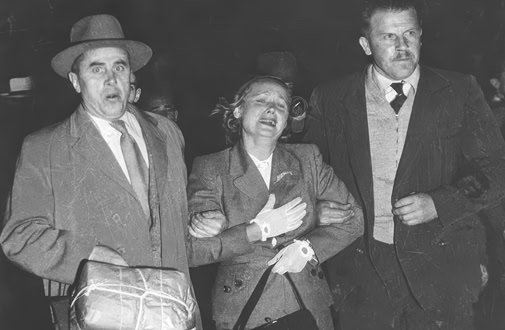 Doc Evatt drove himself mad and damaged his own party by attempting to prove that Menzies staged the defection of Soviet embassy staff (and spies) Vladimir and Evdokia Petrov in 1954 to secure victory in that year’s election.
Photo: National Archives of Australia
Henderson thus had cause to describe, once again, the circumstances of the ‘Split’ of 1955 which sundered the ALP. It was not initiated by dissidents. It was not undertaken by the anti-communist B A Santamaria (whom Evatt had unadroitly courted before the 1954 election), and neither was it ordered by Archbishop Daniel Mannix. It was fomented by Doc Evatt and the proximate event was a chaotic caucus meeting at which he announced his intention to expel those he believed were disloyal, somehow, to the ALP. Henderson quite reasonably believes the Split was far from inevitable, and writes feelingly of the tragedy it entailed:
Evatt’s attack on the Santamaria Groupers, seen many decades on, is hard to understand for a party pledged to social justice and democratic values. How could a group of political activists, loyal members of the Labor Party, who had stood against communist disruptions of commerce and government in the Chifley years, at the risk of their own promotion or livelihoods on many occasions, and which believe in Christian fundamentals that supported a capacity based on fairness for the working family and family-oriented policies, be labelled as traitors inside the Labor Party?
Readers familiar with the narrative of the 1940s and ’50s will still find much to enjoy in this finely delimited character study of Menzies and Evatt. But younger readers will derive even greater value by being introduced to a truthful account of momentous events, which still echo through the intervening years to the political battles of today.
This article from the Spring 2024 edition of the IPA Review is written by IPA Executive Director Scott Hargreaves.
