

As we approach another federal election there has been some speculation about the scenario whereby the ALP is forced to rely on the support of the Greens for a majority in the House of Representatives, and that perhaps a formal ALP/Greens government may be formed.
Saxon Davidson’s article on page 8 is a reminder that whatever happens at the election, the broader green movement already wields significant power in the community, including through its ability to use the courts to stymie investments. Saxon explores how eNGOs (environmental non-governmental organisations) have accumulated the financial resources and been given the legal standing to wreak havoc on formal approval processes, which are already onerous enough. While theatrical ‘zombie activists’ like those featured on this issue’s cover capture fleeting attention, the serious attack on our economy and therefore society as a whole is being staged by judicial activists.
On page 48 you will find an analysis of recent elections in the UK and in the EU by David McGrogan and Lana Starkey. As we are part of the Anglosphere there is perhaps a disproportionate amount of our news coming from the UK, and in recent years most of that has not been very good at all. Those looking for a revival in free market ideas, a commitment to secure borders, and a confident engagement with the world, have been disappointed. The UK election appeared to show a significant shift to the left, with a landslide result for the Labour Party. But beneath the surface the result was not what it seemed, and across the English Channel elections in Europe revealed a trend that was very much away from the centre-left consensus that has mired that continent in so many troubles over so many years.
The analysis is also a necessary corrective to the mainstream media’s ceaseless portrayals of any party expressing concern about illegal immigration as ‘far right’ or even ‘Nazi’. We should indeed be alert to any revival of actual Nazism on the continent, but for the most part the matters these parties are raising are legitimate questions, and it is corrosive of the political process to pre-emptively declare them out of bounds and engage in ad hominem smears.
Australians are being sold a fiction.
As this IPA Review goes to the printers, the number one issue on our minds is the ‘Misinformation’ legislation proposed by the Albanese Government. On page 22 you will see a speech I gave to the Cook Society in March, contrasting the censorship regime inherent in the Bill with the institution of free speech as it has been practised in the West for 2,500 years. We at the IPA have devoted much of our resources towards research and discussion of the Misinformation regime as the stakes could not be higher: without the ability to debate and discuss important issues in the public realm we could no longer call ourselves a free society.
In this edition there are two important works by IPA researchers synthesising the significant body of work published by the IPA in their respective fields. Dr Bella d’Abrera, Director of the IPA’s Foundations of Western Civilisation Program, has over a period of years analysed every level of education in this country, literally from early childhood through to the universities. She has catalogued the pernicious focus on ideology that has such harmful social and educational consequences. Her article on page 16 is a philosophical review and recap of the most significant aspects of that research, and makes an eloquent case for change.
In a similar vein, Dr Kevin You, on page 30, surveys a number of recent IPA publications in the energy space, showing how they fit together, and locating them among the broader questions about climate policy. As he says, if you are going to obsess about carbon emissions then you cannot argue for a continuing prohibition against nuclear. It demonstrates the bad faith of those ceaselessly promoting wind and solar while fighting against rival low emissions sources.
This is very nicely complemented by an important book review by Research Fellow Lachlan Clark, on page 64, examining a stunning book called The Rare Metals War. That book, as Lachlan points out, establishes that the so-called ‘green’ and ‘clean’ sources of energy are anything but. In their production massive environmental harm is done and energy consumed, and significant emissions generated; but Australians are being sold a fiction, enabled because it all takes place far from here. Out of sight, out of mind.
On page 56 I review the latest book by that fine historian of Australian politics, Anne Henderson. Her works are a pleasure to read, providing a very necessary corrective to the leftist tilt of so many of the books purporting to cover key periods of Australian politics. In this case the framing device is a contrast between the leader of the ALP, H. V. ‘Doc’ Evatt, and the two-time Prime Minister who established the modern Liberal Party, R. G. ‘Bob’ Menzies. The battles they fought reflect fissures in our body politic, and obsessions of our intellectuals, that resonate down to the present day. Read about the past, to understand our present.
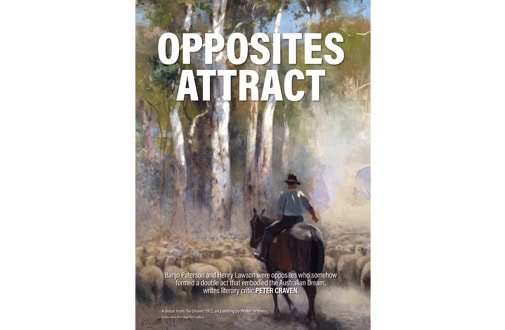
On page 38 the doyen of Australian literary critics, Peter Craven, provides another instalment in the series examining key works in the Australian Canon proposed by the IPA. In this case two great bards of colonial Australia, Banjo Paterson and Henry Lawson, are discussed, and some of their more memorable works examined.
Against the disregard of the globalists we continue to assert that Australia is something pretty special, and that as an independent nation-state it should be preserved and defended. On page 70 you will find Andrew Mathieson’s review of the important work by Dr Sherry Sufi—who contributed so much to the IPA during a tenure as a Senior Fellow—offering a very balanced corrective to both triumphalist and ‘black armband’ accounts of our history.
In our closing article Michael Barrett circles back to the strange persistence of Confucius Institutes in our universities, in contrast to their virtual eradication in the USA. Strange Times, indeed.
This is the editorial from the Spring 2024 edition of the IPA Review by Editor of the IPA Review, Scott Hargreaves. Articles once loaded online are listed here. IPA Members receive a print edition and online versions of articles are progressively released in the months following publication. To join/subscribe see here.
