

The British heritage from which Captain Cook and our freedom came is yet again under siege, warns IPA Executive Director Scott Hargreaves.
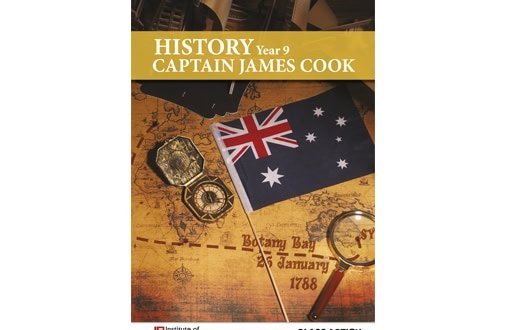
I was delighted to accept the invitation to present to the Cook Society. At the Institute of Public Affairs, we are very interested in honouring Captain James Cook. We have produced curriculum materials for schools so that students can have a sensible conversation about the so-called coloniser and racist imperialist, Captain James Cook, as well as videos and booklets.
I will begin our story with the long tradition of freedom of speech in Ancient Greece, the original democracy. For the Greeks, freedom of speech was a fundamental part of being a citizen. If you were going to be called into an assembly, you needed to be able to speak frankly. It was therefore more about preserving Athenian democracy than expressing individual conscience; a right shared by the community rather than held by the individual. It was to speak free of deception and to uncover truths for the betterment of Athens. Their word for it was parrhêsia. It meant being able to call a fig a fig.
Ancient Rome was different. To be a citizen of Rome was to have libertas and the right to speak freely was essential to that. By that stage, Rome had developed a sophisticated state apparatus. Citizens could rightly be concerned about the instruments of state power being used to oppress them. Libertas was therefore conceived as a negative liberty, a freedom from harm by the state. The philosophic foundation of free speech in Rome was thus closer to our modern conception of an individual right than the parrhêsia of Athens.
I’m going to skip through the Christian era, which had some great innovations in free speech, but not always positive. I will fast forward towards the Renaissance and the Enlightenment. The Dutch Republic, after they had relieved themselves of their Spanish overlords, pioneered much of the thinking around freedom of speech. Benedict Spinoza put not just freedom of speech, but freedom of thought at the heart of the matter. For Spinoza, all speech—even harmful speech—was to be tolerated. To crush speech was to crush thought:
How many evils spring from luxury, envy, avarice, drunkenness, and the like, yet these are tolerated – vices as they are – because they cannot be prevented by legal enactments. How much more then should free thought be granted, seeing that it is in itself a virtue and that it cannot be crushed!
Across the North Sea, John Milton argued against the Licensing Order of 1643, which prohibited any book from being published without the authority of the Stationers’ Company. Unlicensed printing presses were to be hunted down and seized. For Milton, the process of understanding the world was inherently messy. Those seeking to regulate or license publishers were ultimately acting to prevent the discovery of truth. In the public battle of words, truth would ultimately triumph over falsehood. So goes the famous quote in Areopagitica (1644):
Though all the winds of doctrine were let loose to play upon the Earths, so Truth be in the field, we do injuriously by licensing and prohibiting to misdoubt her strength. Let her and Falsehood grapple; whoever knew Truth put to the worse in a free and open encounter?
This is part of what we need as a society today. The open grappling of truth and falsehood in the public square. The liberty of the press has been a part of the British tradition ever since. I put it to you today that many of the precedents that have been established in the analogue world of publishing should be extended to the new public square of social media. It is not an adjunct to our real, serious world where people debate issues; it must be seen in the same light.
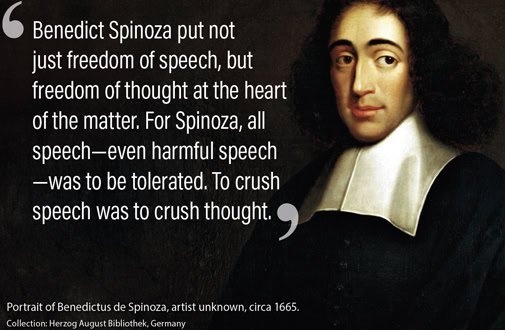 Portrait of Benedictus de Spinoza, artist unknown, circa 1665.
Collection: Herzog August Bibliothek, Germany
In America, free speech has always been integral to the conception of liberty. The First Amendment did not arise from nothing. It was very much in the tradition of Locke, of Milton, and popularised by the two Whig journalists John Trenchard and Thomas Gordon in Cato’s Letters, a compilation of articles published in England between 1720 and 1723 and published under the pseudonym of Cato, the stiff-necked, Roman republican and foe of Julius Caesar. Yet the letters were far more popular in America than in England, whose populace did not wish to revisit the upheaval of the previous century. Cato became a hero for many of the founding fathers.
The IPA has been very involved in various free speech debates.
The message that Gordon imparted to the colonials in Cato’s Letters was that freedom of speech was the essential attribute of individual liberty. In colonial America, freedom of speech did not need any other justification; liberty itself was its justification. A society without freedom of speech was by definition tyrannical:
Without freedom of thought, there can be no such thing as wisdom; and no such thing as publick liberty, without freedom of speech: Which is the right of every man, as far as by it he does not hurt and control the right of another; and this is the only check which it ought to suffer, the only bounds which it ought to know. This sacred privilege is so essential to free government, that the security of property; and the freedom of speech, always go together; and in those wretched countries where a man cannot call his tongue his own,
he can scarce call any thing else his own. Whoever would overthrow the liberty of the nation, must begin by subduing the freedom of speech; a thing terrible to publick traitors.
Nowhere else in the world do we find anything like the First Amendment. Certainly, we have no constitutional protections for speech in Australia. To the extent that we have anything, the High Court mumbled something some years ago about an implied right of political communication. To this day, no one really knows the extent to which the High Court is ever likely to enforce that, if indeed one could ever make it to the High Court.
Until recently, John Stuart Mill’s version of classical liberalism—that is, a rights-based liberalism built on utilitarianism—was really the governing philosophy of Australian life. David Kemp’s monumental five-volume history of liberalism in Australia convincingly establishes that this was the dominant position. To be a so-called conservative in Australia simply meant this was the tradition you valued and sought to keep. It was not a reactionary conservatism. It was simply the belief that this was a philosophy that had served Australia well, preserved our freedoms against an overweening state, and produced prosperity. And of course, it had required free speech, the ability to contest ideas in government and in society. As Mill says, if you deny people that opportunity, you are actually robbing the human race:
The peculiar evil of silencing the expression of an opinion is, that it is robbing the human race; posterity as well as the existing generation; those who dissent from the opinion, still more than those who hold it.
The IPA has been very involved in various free speech debates over the years. Some people in this room will recall the case of Andrew Bolt, a News Limited journalist and commentator, who was prosecuted under Section 18C of the Racial Discrimination Act 1975, which criminalises offensive speech based on race, colour, or national or ethnic origin. We argued this was an instance in which the law went too far. I am raising the Bolt case to establish that in Australia, we live within a framework where we understand human rights, and hence an institution called the Australian Human Rights Commission. In its title it honours, at least formally, the idea of human rights. The legislation also includes defences for speech under Section 18D, including if the comment was in the public interest, as well as other exemptions. Even to this day, Senator Pauline Hanson is being sued by Greens Senator Mehreen Faruqi utilising the provisions of 18C, while Senator Hanson has—so I understand—invoked defences under 18D.
Australia has long seen the trend towards increased regulation of the media. We came extremely close to seeing an Orwellian regime of media regulation in this country introduced under the Gillard government, which commissioned the Finkelstein Review. Finkelstein essentially recommended the licencing of journalists and news organisations, as well the use of the regulator to enforce standards of fairness and accuracy.
Free speech is absolutely precious.
Finkelstein’s proposals got a lot further than they should have because the mainstream media organisations were interested in how they would be treated. And as is always true in discussions of rights, the rights of the ordinary citizen were missing. The IPA was very vocal about it. And thankfully, Stephen Conroy as Minister just announced one day that it was being scrapped. One day it was on stage, the next day it was off. But it was a temporary relief, as it turns out. The war on misinformation was waiting in the wings.
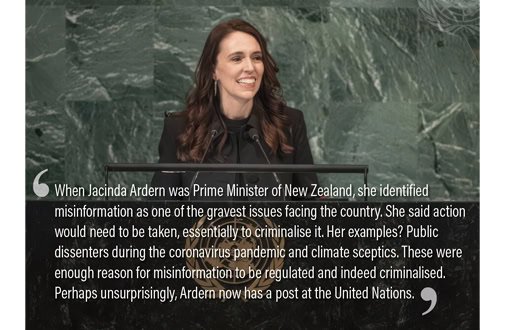
When Jacinda Ardern was Prime Minister of New Zealand, she identified misinformation as one of the gravest issues facing the country. She said action would need to be taken, essentially to criminalise it. Her examples? Her government’s health advice had been undermined by public dissenters during the coronavirus pandemic, who consistently quoted different medical opinions and research. Another example she raised was climate sceptics, who by their nefarious actions were undermining public confidence in the plans of governments, plural, to save the global environment. For her, these were enough reason for misinformation to be regulated and indeed criminalised. Perhaps unsurprisingly, Ardern now has a post at the United Nations.
Not long after, the Albanese government took up the former Coalition’s mantle by introducing a bill to regulate misinformation and disinformation online. You would be forgiven for thinking that this bill would be concerned with the accuracy of information, but that in fact would be misinformation, because it instead deals with a melange of issues under the banner of so-called harm. The bill introduces a regulation regime for social media platforms. It has broad carve-outs for anything produced by academics, governments, ‘professional journalists’, and entertainers, who are as far as I’m concerned, super spreaders of misinformation. The bill would operate by compelling online platforms to develop codes of practice that detail their processes for combatting ‘seriously harmful’ misinformation and disinformation, or indeed, have one imposed upon them by the Australian Communications and Media Authority (ACMA). The bill would effectively outsource censorship to online platforms by stinging these platforms with astronomical fines for failing to appropriately enforce their own codes of practice. ACMA is an authority which is completely ill-equipped to consider any questions of free speech and human rights. So, immediately a regulator is introduced that has no interest in the issues that we would be interested in.
So where would the incentives be if there was a post online that was problematic? We already live in a world where our government intervenes in social media content moderation. During the lockdown, the Department of Home Affairs demanded the removal of a Tweet that called Daniel Andrews a “dick”, showing him wearing a mask inscribed with the words, ‘This mask is as useless as me.’ The Department also requested the takedown of 4,200 other social media posts. Even if their motives were pure, social media companies would clearly be given the terrible incentive to over-censor.
In practice, social media organisations outsource the problem of identifying what content to censor to the so-called fact-checkers. It was revealed also, not through any admission but through an FOI request, that the Minister reserves the authority to order investigations of anything that she may be concerned about, over and above anything ACMA might initiate. This comes back to the definitions of misinformation and disinformation not being what one would expect.
They sound very authoritarian indeed.
‘Harm to the integrity of Australian democratic processes’. The next person to say, ‘It’s no use voting, it only encourages the bastards,’ better not say it on social media.
‘Harm to the health of Australians’. How dare any one of us criticise lockdowns in a State like Victoria, with the most locked-down city in the world.
‘Harm to the environment’, which includes any expression of doubt about climate change.
Or ‘economic or financial harm to Australians or the Australian economy’. Goodness knows what that means and I do not want to find out.
And then there are the ‘fact-checkers’. These exist all over the world. They are pestilential. Bjorn Lomborg recently brought light to a Harvard survey which showed that misinformation experts overwhelmingly lean to the left. Fact-checking organisations are by no means impartial organisations.
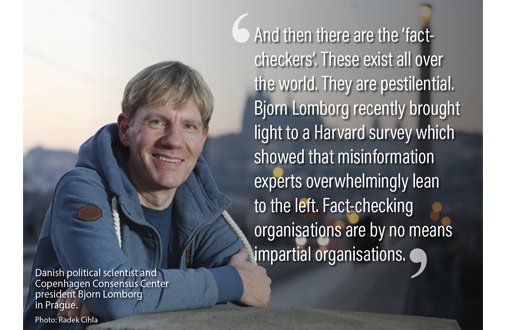 Danish political scientist and Copenhagen Consensus Center president Bjorn Lomborg in Prague.
Photo: Radek Cihla
Misinformation experts overwhelmingly lean to the left.
RMIT and ABC, until recently, had been in a cooperative arrangement to fact check in Australia. They, alongside AAP Fact Check, have been given a prominent position to play as arbiters of truth on social media through their partnership with Meta’s fact-checking arm. The body that accredits these organisations, the International Fact Checking Network, claims they must be compliant with five principles, including a commitment to non-partisanship and fairness, which includes the obligation they not “concentrate their fact-checking unduly on any one side”. An IPA report found that in the lead up to the referendum, these three organisations overwhelmingly targeted proponents of the ‘No’ case. If these fact checkers were given an enhanced role in overseeing compliance with the government’s proposed laws, the consequences would be grave. As the report found:
The fundamental problem with censoring ‘misinformation’ is deciding who determines truth and falsehood. In the case of the referendum, organisations that purported to be neutral, and to whom responsibility was given to
determine truth and falsehood, acted in a demonstrably one sided and biased manner. If organisations like these were empowered to censor online communications, the damage done to free political debate in this country would be profound.
So this arrangement involves ACMA using astronomical penalties to compel social media platforms to censor content, and weaponising fact checkers to investigate particular issues. This would have the effect of supercharging the culture of online censorship. This trend is global. We have seen it in countries with a similar legal context to ours, like the United Kingdom of course. But we also have Russia and its fake news laws. And hundreds of journalists and ordinary citizens are sitting in gulags as we speak for posting things online. I think we underestimate how quickly things changed after the Ukrainian invasion.
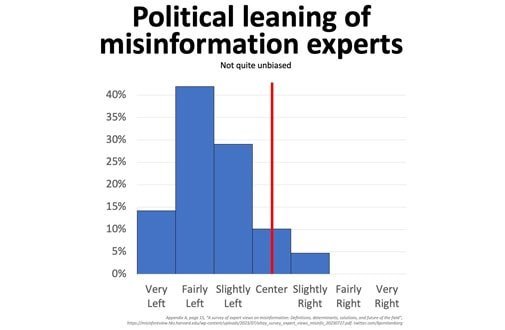
Bjorn Lomborg on X, 17 February 2024
So, the IPA has been on the frontline of opposing this bill. We made our submission to the Public Consultation for the bill, where we argued:
Every Australian has the right to express their opinion, even if that opinion is considered controversial by the powers that be at the time. The human progress enabled by the institutions and culture of Western Civilisation has often been propelled and accelerated by those who challenged the received wisdom of their age, and, in doing so, enlightened humanity. This Bill, though, is reflective of a common practice of the Dark Ages which weaponised censorship to protect established interests, chief among them, the main governing institutions of the time.
As you can see, we are very much sticking to the view that free speech is absolutely precious. It is part of our heritage. And if we let this bill through, then we’ve just discarded that. It’s a rupture in the continuity that we can trace all the way back to Ancient Greece.
It is also something that once in, is extremely capable of being extended. It establishes a dangerous precedent. The Greens in the federal parliament and some of the crossbenchers have already said that their only issue with this bill is that it applies only to social media and it should also be applied to the traditional media, by which of course they mean anything published by Rupert Murdoch, because they are not worried what the ABC might say, or The Guardian, or anyone else like that. And again, what we have to be aware of is that getting carve-outs for news journalists is not the answer.
I will leave you with something you might be interested in. We have always explicitly located our rights and freedoms within the British heritage, from which Captain Cook came. If you do want to follow up the curriculum materials on the great Captain Cook, there is a website for our Class Action program, www.class-action.org.au, which puts such materials into the hands of teachers and pupils across the country. It is our mission that we do not forsake this heritage, as well as the broader liberal democratic tradition, and that we continue to emphasise its importance in Australia today.
This is an edited version of a speech given to the Cook Society of Victoria in Melbourne on 14 March 2024, drawing upon notes and slides prepared with the assistance of IPA Research Fellow Margaret Chambers, and which in turn were informed by the IPA publication, ‘In Defence of Free Speech’ (2012), by then IPA Senior Fellow Dr Chris Berg.
The Cook Society was founded in 1968 by former Prime Ministers of the United Kingdom and Australia respectively, Sir Alec Douglas-Home and Sir Robert Menzies, to provide a platform for leaders in business, government, the voluntary sector, culture, academia, and science.
This article from the Spring 2024 edition of the IPA Review is written by IPA Executive Director Scott Hargreaves.
