
Peta Credlin:
Welcome back. A new report from the Business Council of Australia has ranked Victoria as the worst state in the country to do business in for the third year in a row. It found Victoria needs to fix land tax, stamp duty and planning efficiency. But it also says businesses are dogged by the rate and threshold of payroll tax, licencing, and regulatory requirements. Joining me now, my panel News 24 host, Jamie Rogers, and the deputy executive director at the IPA, Dan Wild. Well, not only that, Jamie, news today that 60% of the state’s record, $200 billion of debt, and it’s 25 million a day on interest. Well, that’s held by foreign investors.
Jaimee Rogers:
And Peta, that’s up from the historic average of 27%, which is a huge jump. But to your point in your opening statement is why would a business want to operate in Victoria? There are so many high taxes and red tape. And within that AFR article that was just shown on the screen, it says that in order to even open up a cafe in Victoria, you need 34 different licences before you can even pass over a cup of coffee. Now, Ben Carroll is coming out saying that he is fiscally conservative, but you’ve got to remember, he’s been part of this government for so many years now, and I think that that’s going to really stick with him. It’s going to be hard to shake it. Jess Wilson has certainly come out and said that she’ll be able to get the budget back to a cash surplus within six years. And that’s the sort of thing that I think Victorians want to hear because you were once an economic powerhouse and it’s just devastating to see what’s happened in the state.
Peta Credlin:
Basket cases, you’ve got to love these Labour MPs or leaders, don’t you, Dan? Kevin Rudd was an economic conservative too until he blew the budget when he took over from John Howard. We had no debt in Australia then. He went crazy in the GFC. And of course now suddenly he’s an economic conservative too when he wants to win an election, says Ben Carroll. The gas crisis in Victoria. There’s a linked government briefing note that’s making it plain. We’ve talked about it, you and I, the IPA and I was warned about it, that the state faces critical gas shortages, which mean bills will be higher and higher and blackouts are likely unless there’s billions spent in new infrastructure.
Daniel Wild:
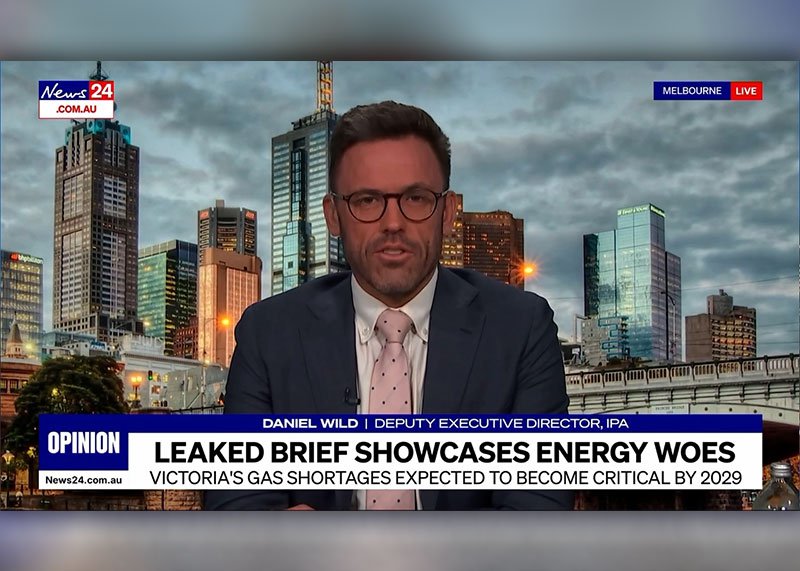
Yeah, you’re right. We have been warning about this for a very long time and sadly this day was always going to come. And we’ve also had warnings, by the way, from the energy market operator. This is not just the IPA or News 24, this has come from the institutions that are there to oversee the actual energy system saying that we’re going to have what they call demand side management. You know what that means? That means blackouts. It means you’re going to have to turn off your fridge, you’re going to have to turn off everything that’s running in your house to stop the system collapsing. And we’ve seen actually large industrial players over the last couple of years being told they have to load shed, which means they have to turn off the power for a certain amount of time. So this is what happens. This is the inevitable result of policies like net-zero.
When you’re prioritising costly, inefficient power sources purely for ideological reasons over coal and over gas, you’re going to get shortages, you’re going to get higher prices. Businesses, as you’ve just discussed, are going to the wall. This is one of the major issues facing any business here, energy costs, let alone when you’re talking about industrial and manufacturing players. So look, sadly this day has been long coming. I hope that we don’t get blackouts, but it’s going to be difficult to avoid.
Peta Credlin:
You’ve got taxpayers, of course, paying the power bills, the gas bills of a lot of industry to keep them in Australia, in Victoria too. You’ve got an enormous supply of gas in the ground in Victoria that they’re too green and too woke to get out of the ground. I mean, we are a laughing stock internationally, aren’t we, Jamie?
Jaimee Rogers:
Peta, I’m glad you actually said that to me because I came across an article a few days ago and it was in the Japan Times and you’re not going to believe what the headline was. Australia’s energy transition offers a warning to the world. And as I read through this article, it’s what you’ve all been saying and we’ve been calling for is that you don’t turn off your base load power until you’ve got a reliable substitute of which we have not. And this article was saying Australia is filled with resource-rich minerals of which we are choosing not to use like uranium and coal. And the entire article, it said, this is a warning to the world. Have a look at Australia and do everything opposite to what they have done. We are literally a joke.
Peta Credlin:
Dan, if you stuffed up, if you were accused of wasting and hiding $260 million of COVID payments, you’d be out in your ear or maybe you’d be in court charged with a crime. Well, not so if you’re a Victorian bureaucrat. The story today in the age that two such bureaucrats accused of covering up COVID grants that should not have been paid to businesses that were not eligible, well now they’ve been promoted into top jobs with the NDIS.
Daniel Wild:
Well, this is not good enough. And looking at the numbers, they’re staggering. I think something a bit over a hundred million of that was actually given to businesses that had ceased operating some six months before the pandemic even kicked off. So this is insane what happened. And as you suggest, the coverup is worse than the crime, as they often say. And so to me, this gets down to an issue of trust. The NDIS is one of the single biggest spending programmes in the nation’s history. It is the fastest growing spending programme that we have on the books. It is eating up a larger and larger share of the economy, yet many people are not even getting the help that they need. We’re spending an insane amount of money, but people aren’t actually getting what they need out of it. It is a failure of a system and the public doesn’t trust it.
The public already has a very low regard for public servants and bureaucrats, especially in Victoria because of how they became politicised throughout COVID. So what needs to happen is there needs to be a restoration of trust and you’re not going to get that by pointing people to these very important positions that have a history of failure, and I would say a history of having gone along with the politicisation of the public service. So I think this spells more trouble for a public service in Victoria that is unfortunately held in pretty low regard as it is.
Peta Credlin:
Well, you’re taking the Victorian disease and you’re making it national with steroids on it actually because you’re going from a couple of hundred million to hundreds and hundreds of millions, billions of dollars on the NDIS. I honestly think it’s criminal. I honestly think this stuff has got to be stamped on and you’ve got to wonder who these individuals are. They’re not named in the article, what collection they have to politicians. If IBAC says these two players are responsible for this amount of loss and I’ll call it corruption, they should not be getting a job anywhere in the country, let alone be promoted to the public service in Canberra. I’ll leave you there, thank you.
This transcript with Daniel Wild talking on Credlin News24 from 28 October 2026 has been edited for clarity.
