
James Morrow:
… without the help of One Nation. Joining me now to discuss this in a lot more is deputy executive director of the Institute of Public Affairs, Dan Wild and News Corp senior writer Patrick Carlyon. Patrick, I’ll start with you down there in Melbourne. This is quite interesting, these poll results. Does this mean now just Wilson, they don’t have to worry about doing deals with One Nation, they will win this in their own right? Is that what these polls are saying?
Patrick Carlyon:
Look, that’s what they’re saying, James. And it’s interesting. I mean, if you look at the longer term picture down here, it’s been 12 years of essentially the same government, which has provided world-class corruption, world-class death, and world-class potholes. It rained over the weekend, and driving around Melbourne and Victoria, there are more and more holes. And I think people just want an alternative. They want this government out.
And I think it has sort of coalesced, as you suggest, and as this poll suggests, towards actually having a strong alternative government rather than that Coalition with the One Nation sort of crowd. It’ll be interesting. So look, they’re still a month away. We’ve still got plenty of time to think about this and people to change their minds. But I think pushing out of Labour is the highest priority for all Victorians, I think, at the moment.
James Morrow:
Dan Wild, we know that Victorians tend to vote in Coalition governments or conservative governments only after all other options have failed and under the most grudging of circumstances. How is Jess Wilson going to cope with the incredible mess that will have been left for her by Labour? And when that starts meaning having to make difficult choices and trade-offs, is there a danger that Victorians say, “Oh no, it’s all too hard. We’d rather just live in corruption and squalor, please”?
Daniel Wild:
No, I don’t think so. I think those days are over. The worm has clearly turned for Victorians. I think it’s become pretty apparent how broken the state is everywhere you turn. I mean, Patrick mentions the potholes, which are a day-to-day manifestation of a broken government that doesn’t have any more money and that has run the state into the ground. Obviously the switch to a new leader has failed.
And also what’s interestingly, when you look at the numbers, I think if you add Coalition and One Nation together, you’re at about 53 or 54% primary, which I think is astonishing for the two centre right parties or the three centre right parties, if you add the nationals, to be well over 50% primary vote is quite extraordinary. So look, I think it’s lights out for Labour. People have had enough. It’s been there for 12 years. They’ve done a lot of damage to the state and Victorians are looking for change.
James Morrow:
Yeah, no, they absolutely are. And it’s got a long way to go, but we all hope Victoria does make it because it’s a beautiful state and it deserves a lot better than what it’s been getting lately. Hey, this story here guys, this really, really annoyed me this morning when I read this in the non-newspapers.
Treasurer Jim Chalmers has challenged those who are angry about the government spending, saying those advocating for more cuts should nominate what they would slash. He said the government is facing more pressure to lift spending on industries like defence and the care economy. Dan Wild, this just struck me as, well, a load of rubbish because we know there’s a lot of things that you could cut very easily and nobody would have noticed them except for the bureaucrats maybe who won’t keep their jobs.
Daniel Wild:
Well, you’re exactly right. Look, this is an abdication of leadership by Jim Chalmers. Can you imagine someone like Peter Costello saying that? Can you imagine someone like Paul Keating saying that? Jim, it’s your job to balance the books. At the moment, the economy is moribund. Spending is growing far faster than the economic growth rate of our country, meaning that spending is eating up more of our entire economy. It is your job as treasurer to be responsible and to outline to Australians how it is that you propose you’re going to pay down the debt and get the budget into order, not fob this off onto other people.
It is reasonable for Australians to be saying government spending is going too fast. The Reserve Bank of Australia has made this clear in nominating government spending is a key driver of inflation. And if Jim needs a bit of a tip of where to go, why don’t you start with a net-zero bureaucracy worth tens of billions of dollars? That would be a great place. How about you end the rorts with the NDIS? There’s another place for you. So look, at the end of the day, this is, as I say, an abdication of leadership by Jim Chalmers who is just fobbing it off onto everybody else.
James Morrow:
Well, no, I think that’s right. I mean, why not add in the Department of Education when the federal government doesn’t run a single school? But Patrick Carlyon, does Jim Chalmers… Is Jim Chalmers sort of asked a little bit panicky here because I noted another interview he did today where he said, “Oh, well, sure, it’s true. I spent a lot of time in windowless rooms and maybe I need to talk to my colleagues more.” Is there an indication perhaps that Jim Chalmers might be one for the high jump?
Patrick Carlyon:
Look, I don’t think he spent enough time in windowless rooms, James. To be honest, if you look at this budget and all the unintended consequences, we’re still talking about it five months later. We talk about it every week, don’t we? We’re talking about the latest sort of take on the world’s most ugly budget of all time, and it wasn’t done thoroughly.
And from what I’m hearing from Canberra, Chalmers is just sort of being isolated within the cabinet and he is the face of frustration, both for those Labour ministers and for the rest of us who are suffering for a really poorly executed budget. And as Dan says, he should be accountable for it. He should be responsible for it. He should be owning it. And to sort of be passing it off, it does… Panicky I think is one of the words that you would reach for to describe what he’s saying at the moment.
James Morrow:
Yeah, no, it’s quite extraordinary. And one has to wonder, 18 months is an awful long time in politics. Whether or not he makes it as treasurer to the next election, my money is he doesn’t. But hey, let’s talk about small business here who are doing it really tough here. News Corp has relaunched the Back Australia campaign aiming to encourage Australians to purchase Australian goods.
It comes as small businesses are being strangled by complex award classifications, regulatory duplication, and so much else across all levels of government. But this new survey by the Growth Intelligence Centre found more than 7 in 10 people believe small businesses should receive larger tax breaks. Dan Wild, I’ll start with you here. Is this economically orthodox to say, well, if you stay under a certain threshold, you might do better on your tax? Or should maybe we be thinking about lower corporate taxes for all corporations?
Daniel Wild:
I think it’s a good idea to lower the small business tax rate. I think it’s something that needs to be done. It already has a lower statutory rate than big corporates. I think that’s probably fair enough given that most big corporates don’t like Australia, so why should they get a tax cut? I mean, half of these big corporates are woke, they run down the country. They don’t make the case for economic reform. I mean, I remember when there used to be titans of business that would actually engage in debate, arguing about why we need to fix the economy, not just for their bottom line, but for the betterment of the nation.
Now they all bang on about Welcome to Country, support a voice to parliament and everything else, and then they wonder why Australians don’t support them. So yeah, I think small business deserves a break. The other point that I’d make is that small business in many ways is sort of the enemy of the Labour Party because-
James Morrow:
Yes.
Daniel Wild:
… most people in a small business, they’re not easy to be unionised. They’re likely to be independently minded risk-takers. They’re out there having a go. They’re not collectivists by mentality. Now I’m not saying none of them vote labour or anything like that, but it’s sort of anti-ethical to the collectivist mentality. So it’s no wonder they’re getting steamrolled by a federal government that couldn’t care less.
James Morrow:
Yeah. And Patrick, I mean, it’s an interesting point that too, because also I’ve heard it suggested that big corporates don’t actually mind all the regulation and so on because they can work with government to shape that regulation and it’s all the better for keeping newcomers into the marketplace down. We know we have a huge problem with oligopolies in this country, but do you think, Patrick, that your businesses in Victoria could deal with a bit of at least tax relief, even if they’re not getting the regulatory relief?
Patrick Carlyon:
Absolutely. Look, they’ve been smashed on so many levels, James. And I thought the interesting statistic out of this latest research is that Australia’s regulatory burden on small businesses is 33% higher than the OECD average. That’s massive. And it is anti-growth, it’s anti-investment. And I look to Mike Schneider, the head of Bunnings, who’s been banging on about this for years. You got to cut the regulation. You got to get the investment going. And it should be one of the highest priorities for any government right now.
James Morrow:
I think it’s absolutely right. I think it’s spot on. I think these small businesses, they need to have a chance to become the big businesses of the future and they can’t do it under the current settings. Hey, I want to talk about, we’ve seen all of these horrific protests across France, across Europe now, but all these Australian radical student groups, well, they have decided they want to bring the mayhem here. And they’ve vowed to stage an anti-capitalism, anti-One Nation rally on November 11th, a.k.a. Remembrance Day.
Now this has drawn widespread condemnation from veterans, but state governments are tucking their tails between their legs and refusing to step in and say, “No.” Dan, while the students say the date’s just a coincidence, do you buy that at all?
Daniel Wild:
I actually do buy it given unfortunately how ignorant so many young people are. It would not surprise me to learn that they weren’t taught this at school. I mean, I don’t really like to get stuck into the kids because in many ways they are victims of a broken culture and a broken education system. So this is a much broader issue than just that. The other question I have is where are their parents? Surely their parents would say something about this. But no, I think the state governments should come in and say, “No, you’re not going to do the protest on the 11th of November.”
I’m a big fan of freedom. I think people should go out there and do what they want, but there are some days that are very, very sacred to our nation. I think the 11th of November, the 25th of April are two days where you don’t do this kind of stuff. So look, I take them at face value. I do think they’re probably ignorant rather than malicious in this, but these protests should not go ahead on that day. If you want to do this, guys, pick another day. Don’t do it on the 11th of November.
James Morrow:
Yeah, no, I think you’re sadly right about the ignorance there. But Patrick, I want to talk to you momentarily as well about something else sacred in the sacred days of Remembrance Day, what ties into next story, which is that thousands of people showed up at a rally here in Sydney to protest the sale by Richard Marles, the defence minister and the Albanese labour government of the historic and vital Victoria barracks in Sydney’s East. Labour, liberals, One Nation, Greens and Independents all rallied together. Among the speakers were John Howard and Tony Abbott. Here’s a little bit of what they had to say.
Tony Abbott:
Selling off Victoria barracks is regress and we’ve had too much regress in our country lately.
John Howard:
I haven’t come here to bag the government. I’ve come here to represent, I think, the feelings of many Australians. No point scoring. There won’t be any gloating about it backing down. It will not be a back-down. It will be a victory for common sense.
James Morrow:
Patrick, we’ve been running a big campaign at the Daily Telegraph about this and it seems like just about everybody is against the sale except for the defence minister. Why are they so bloody-minded about this?
Patrick Carlyon:
Look, it looks like a cash grab to me, James, to be honest. And you make the point, everyone is against it. If you can bring Greens and One Nation together, if you can unite them against something you’re going to do, then perhaps you might want to look at it and sort of say, “Hang on, this is wrong.” And I think you used the word before, James, vital. These barracks are vital.
If there is a security sort of incident in Sydney, if there’s a terrorist attack, these barracks are a starting point for the response and to shut them, to sell them off basically for a couple of billion dollars or whatever it is, it’s not a huge amount of money. It really makes no sense. And I like what John Howard said there, just do the right thing. It doesn’t have to be a back-down, just actually do the right thing.
James Morrow:
Yeah, no, I think you’re absolutely right. They need to stop because they say it’s not a huge amount of money. It’s maybe a couple of weeks worth of NDIS fraud. Guys, thank you so much. We’re going to have to leave it there though. Speak again real soon. Daniel Wild from the IPA and News Corps’ Patrick Carlyon. Thank you, gentlemen.
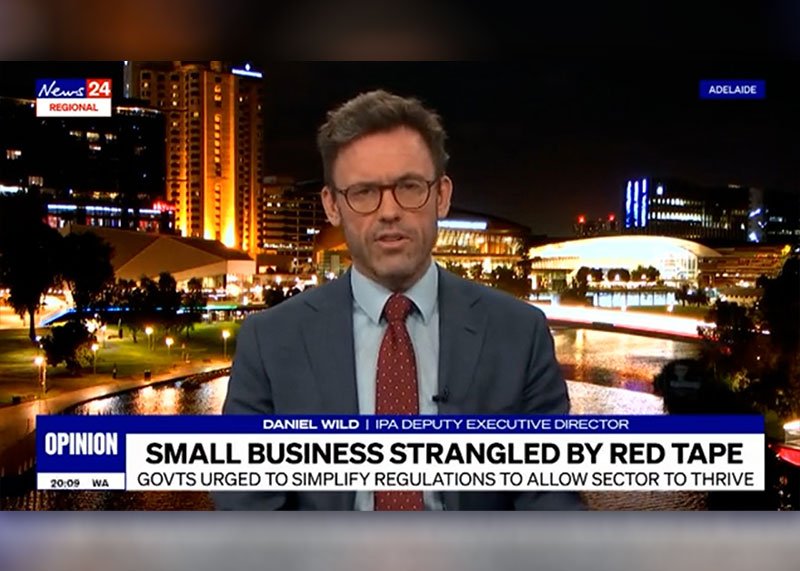
This transcript with Daniel Wild talking on The Rita Panahi Show – News24 from 26 October 2026 has been edited for clarity.
