
Peta Credlin:
All right, let’s bring in now my panel, senior fellow at the Menzies Research Centre, Nick Cater, and Deputy Executive Director at the IPA, Dan Wild. Well, welcome to you both. I’ll get into all of those issues in a moment, but I don’t want to miss Labor’s new trust tax legislation. I mean, concerns about restructuring costs for those with the trust now could result in a $13 billion hit to business. This is extraordinary. Have a listen.
Mary Aldred:
Today, the Sydney Morning Herald quoted one Labour MP saying, “Tradespeople were told for years to use trusts and are now being made to feel like the government is coming after them.” When will this Minister start listening to Australians who have a go, axe Labor’s toxic taxes impacting thousands of tradies and stop waging war on small business?
Peta Credlin:
There’s a whole lot of Labour MPs now, Nick, leaking to the newspapers, clearly unhappy, not just with this issue, with the broader carriage of the budget. And of course, you saw there from Cam Redden, the prime minister really at odds now with his treasurer. What do you make of things?
Nick Cater:
I think it’s astounding. The treasurer just seems to be an amateur, rank amateur in policymaking. And was there nobody in treasury, was there nobody in his own office who pointed out that if you make a change like this to a trust, which businesses and small businesses and families have used over the years in order to be able to set up their business and get the right return on the risk they’re taking, that it will have all sorts of ripple through consequences that you’re probably not even aware of? I just think that the amateur nature of way this policy was put in, they are now reaping the benefit of that. But from a small business point of view, of course it’s cumulative. Small business is resilient. I mean, they will work through the night to fill in their BAS if they have to, but you just get one after the other.
And with the tax office now coming down like a tonne of bricks on anybody who’s a minute late with their BAS statement and sending them a fine, all this adds up eventually. And of course the tax office changes on credit cards. And that is the point at which businesses start to say, “Look, this is too hard. We’re going to get out of this.”
Peta Credlin:
How do you think business feels, small business, Dan? There’s all of these pay rises, 25%, 30% for government employees that they are, small business are paying for in their taxes like we all are. You’ve got the IMF saying that our inflation risk in Australia is some of the worst in the world. We’ve got talk of high unemployment headed our way. We’ve got now reports today of a fifth rate increase. They were saying two before, then they said three. Now they’re talking about five. And yesterday when he was trying to G up caucus, the prime minister saying, “Don’t worry, we’ll be right. We’ll be kicking with the wind in the fourth quarter.”
Daniel Wild:
Well, the economy is not doing well. As you just pointed out, we have high inflation and now the risk of rising unemployment. There’s a term for that, which is stagflation. So this is a real issue. And we’ve talked about this a couple of times, but I want to sort of hammer it home, which is that the issue we have is a government that is not focused on actually growing the economy. It is focused on redistributing what is there. I could not name a single policy that this government has that is aimed at actually growing the economy and making all Australians better off, but I could name a hundred policies they have at redistributing what is already there. We have a situation where demand is very high because of all of this government spending. The RBA has made that very clear. We’ve had mass migration, so more people coming in spending more money at the same time as the productivity of our economy is flat or declining.
So our supply capacity, our ability as an economy to generate wealth, to produce wealth, is declining at the same time as demand is going up. So this is why we have the combination of rising prices, slow growth and rising unemployment. So this is a real issue. And I guarantee you if the economy keeps going backwards, the government is going to do stimulus, which means more demand on a weak economy, which will mean even higher prices. So I’m not confident that the government knows exactly how to deal with these issues whatsoever.
Peta Credlin:
One of the ways, Nick, you know well that we pay our way in the world is what we export in terms of resources, mining resources in particular, but also agriculture. We had that decision today that Tanya Plibersek’s very dubious push to block the $1.3 billion Blayney Gold Mine has been overturned in the federal court. The whole indigenous heritage order that she put on the project about the whole blue banded bee dreaming story, well, that was found to have lacked procedural fairness. You’ve got this whole issue with scope three emissions where Angus Taylor says, “We will take them out. We’ll not allow Australians to be punished for who burns our coal overseas or anything like that. It’ll be treated like every other export.” I think there’s a reckoning coming about the economy and the budget bottom line.
Nick Cater:
Yeah, you’re right, Peta. And look, the consequence of this decision is, well, it’s very welcome. It’s good to see the checks and balances kick in. It is open, I understand, to the federal government to appeal this decision. Let’s, for goodness sake, hope they don’t. But from the point of view of the activists who are driving this thing through lawfare and other means, a win for them is a bonus, but their real intention is to slow the whole process down, lock companies up in courts in green and black and red tape so that eventually they give up because they can’t afford to keep putting capital into a project that’s not producing any revenue. So I really hope the government just lets this one through now and doesn’t prolong it any longer because this is the way that we are going to drive this country broke and stop producing the wealth, which has benefited my generation and your generation, but won’t benefit the next generation unless we allow business to get on with what they’re doing.
Peta Credlin:
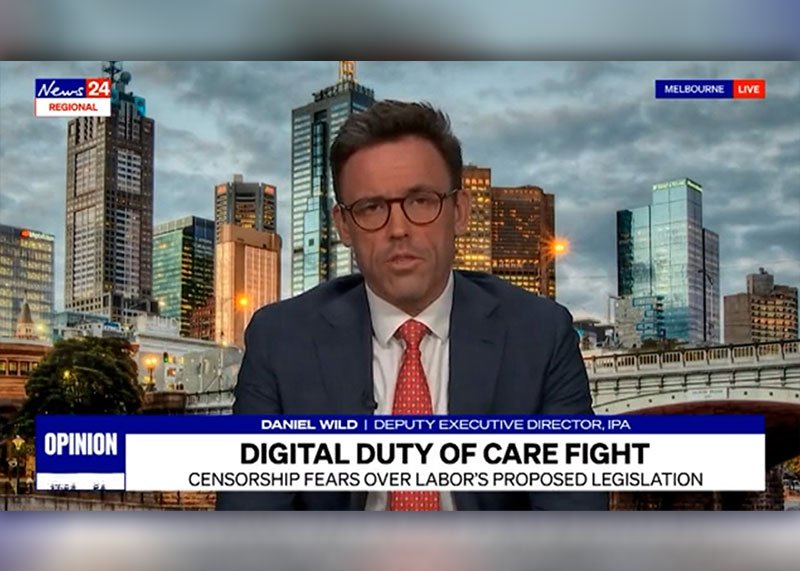
Dan, I want to go to the issue of this digital duty of care. And again, we saw Anika Wells, it’ll come into the parliament tomorrow, basically cloak it all in protection for children. While 16-year-olds aren’t on social media, the government’s already got a… Well, we know they are, but they’ve already got a law in relation to that. We know if it relates to pornography or child exploitation, we’ve got laws about that now. If it relates to terrorist propaganda, we already have laws in relation to that. They are all illegal content. This is about trying to regulate harmful content, not illegal content, just things that the government doesn’t like. All credit to the IPA. Thank you for getting Michael Shellenberger to Canberra the other day and briefing as many politicians as he can. Give me your honest assessment. Can we defeat this legislation?
Daniel Wild:
Well, the legislation can be defeated. Obviously, it won’t be defeated in the lower house. It’ll pass tomorrow. I assume it’s going to pass tomorrow unless there’s anything that changes, but it’s pretty sure it’s going to go ahead, but it can be defeated. Look, this is the third time that this government has tried to engage in widespread censorship. The first was the misinformation laws back in 2024, and they were ultimately defeated. In fact, they were so toxic that they weren’t even voted on in the Senate because they were going to be defeated. Earlier this year in the wake of Bondi, they tried to put in hate speech laws. Now they got the hate group laws through, but they tried to do hate speech laws as well. Now, they were so toxic that they didn’t go ahead either. So I am confident that this can be defeated, but it is going to take some public engagement to do so because the only way the government can pass this is if they do a deal with the Greens in the Senate.
Now, what’s interesting about this is the Greens used to be the party of civil liberties. When I was growing up, they were there to protect people’s freedoms and civil liberties and the right to protest and so forth. And to their credit, they did oppose the misinformation laws two years ago. I don’t know why they’re now supporting these laws. They’ve indicated that they will support the laws in some form, but I think a lot of pressure that is put on politicians from Labour and Greens will work because you’ve seen Albanese and Anika Wells, they can’t explain it. When they are subject to questioning, they cannot explain or defend these laws because frankly, they are indefensible. So yes, they can be defeated, but it is an uphill battle. We’ve got about five weeks to do so by the way, because it’ll be the last sitting week in November that they try to get it through the Senate.
Peta Credlin:
Yeah, they’ll try and ram it through with the guillotine. Dan, you’re a great campaigner. The IPA are great campaigners. How can people get involved?
Daniel Wild:
Well, I think it’s a matter of contacting your local member of parliament and doing it in a respectful way. I’m not saying go out there and beat them over the head, but just ask them questions like, “Are you aware of this law? Are you aware of the problems with it? Why is it that you support it?” Because if you put questions to your local member of parliament, I reckon 9 out of 10 of them are not going to be able to answer your questions. And as you know from your time in politics, Peta, if a local MP feels that their constituents are concerned about an issue, then that’s going to make its way to the top to Anthony Albanese and to others. So I would say again, do it in a respectful way and do it in a balanced way, but ask the question of your local MP about why they’re engaging in this widespread internet censorship.
Peta Credlin:
Dan Wild, Nick Cater, thank you.
This transcript with Daniel Wild talking on Credlin – News24 from 14 October 2026 has been edited for clarity.
