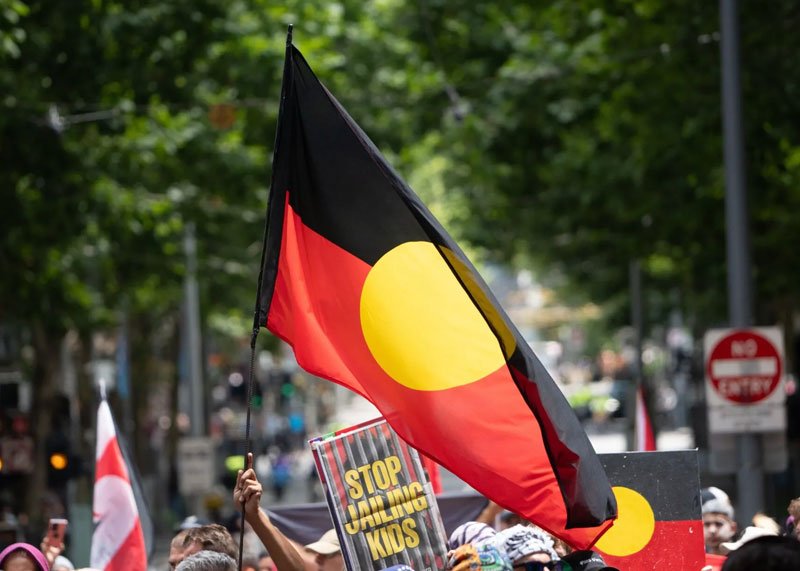
This Anzac Day should go down in history as the last Anzac Day dishonoured by starting with a Welcome to Country.
Many Australians stood in the bitter cold before dawn out of respect for our fallen servicemen, only to once again be greeted by a statement of division, one that shows contempt for the sacrifices of our Diggers.
The day we as a nation dedicated to remembering those who fought, died and continue to fight for us has too long been plagued by divisive ceremonies that are less about welcoming Australians and more about the agendas of a small number of activists to undermine the nation’s moral legitimacy.
And new research has found that most Australians agree.
The poll of 1,001 Australians aged 18 and older commissioned by the Institute of Public Affairs found that 49 per cent of respondents either agreed or strongly agreed that Welcome to Country ceremonies should no longer be performed at Anzac Day services.
Only 31 per cent wanted to see the practice continued.
Furthermore 60 per cent of respondents agree or strongly agree that Welcome to Country ceremonies have become divisive overall, with only 12 per cent of respondents disagreeing or strongly disagreeing.
It’s clear the majority of Australians no longer support Welcome to Country ceremonies.
What was once tacitly supported by Australians, out of a generous desire to encourage greater unity with indigenous Aussies has now turned into ceremony of division.
Now a small group of activists assert that our nation is fundamentally illegitimate, that our land is not our own, which is undermining Australia’s confidence in its story and the legacy of the men and women who fought for Australia.
At the Melbourne dawn service last Anzac Day, attendees were told by the Welcome to Country officiant that “my people have a deep spiritual connection to these lands, encompassing all of our rivers, our mountains, our coastal areas, and all of our beautiful bushlands”.
It’s clear that the intent was not to welcome us, it was to declare ownership.
To say the Australian soldiers and civilians who had risen before dawn to honour the dead, this is not your land.
These ceremonies have become a form of moral hectoring designed to make Australians feel bad about their nation and history, which is bad enough when done at sporting events or at the opening of Parliament.
But it is uniquely inappropriate on Anzac Day to tell Australians we are on stolen land, when we are celebrating the Australians who fought and died for our land.
Of course, Indigenous soldiers should be and are rightly recognised, but alongside and equal with our other servicemen.
This means no special treatment based on their race or heritage alone.
A person’s race should not be the focus of Anzac Day, the fact they have or are willing to bleed and die, to commit themselves to acts of heroism in defence of Australia, should be the only focus of our celebration.
This is the philosophical tension at the heart of the issue.
A nation cannot sustain itself if it is continually invited to doubt its own legitimacy.
Nor can it meaningfully honour its dead if the very idea of the nation for which they fought is implicitly called into question.
Anzac Day, above all, is about a shared national story, which is one that transcends ancestry and unites Australians through a common inheritance of sacrifice and service.
Clearly sentiment against Welcome to Country is growing, as more and more Australians are waking up to the fact this practice is pushing them further apart rather than bringing us together, they are waking up to the fact we should pull back from funding this moral hectoring towards Australians, which seeks to make us feel ashamed about our nation, history and traditions.
Institutions such as RSLs, governments, and corporate organisations now face a clear choice.
They can continue to endorse ceremonies that a growing number of Australians perceive as divisive, or they can restore Anzac Day to its original purpose: a day of remembrance, free from contemporary ideological hectoring.
After all, only when Australia is proud of its past can we be confident enough to build the future, and as a nation look onward to greater and higher peaks.