
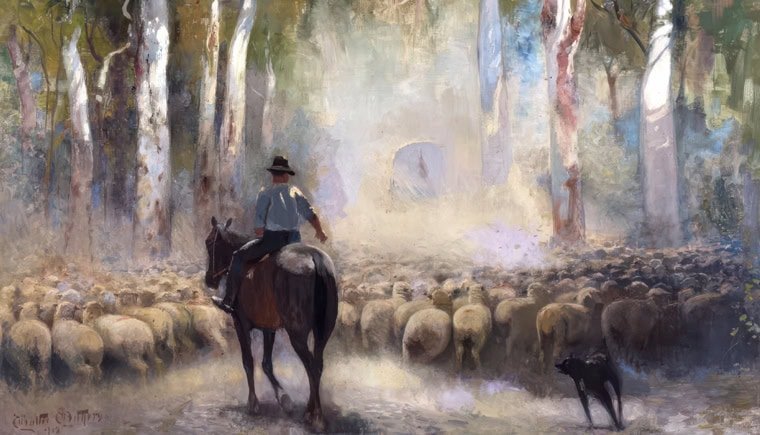
Banjo Paterson and Henry Lawson were opposites who somehow formed a double act that embodied the Australian Dream, writes literary critic PETER CRAVEN.
It’s an odd phenomenon, Banjo Paterson and Henry Lawson: one so buoyant and patriotically rousing in his apprehension of a newfound land on the edge of self-definition, and the other sunk in a pessimism every inch as powerful and bringing with it a shock of recognition as intimate and unmistakable. On the one hand the romance of the bush in full-throated balladeering style, a myth being born in the moment of its utterance; on the other the toughness of life in the shadow of the melancholy of the bush where women do it hard with no help from their men, off droving or adventuring or doing what they will.
In Lawson there are stories of muted but unmistakable power. Think of ‘The Bush Undertaker’ and the old cove who thinks there oughter be somethin’ said, and comes out with his own stumbling and mumbled recollection of “I Am the Resurrection and the Life”. The original gospel version (John 11) invokes a faith which will endow life in the face of death, but the words in Lawson are a garbled memory of the Lord knows what. Then there are the stony desolations of ‘The Union Buries its Dead’, another of the handful of stories by Henry Lawson which by any standards are indisputably of the first rank. Then, by itself, like a mountain or a molehill positively asking for modification there is ‘The Drover’s Wife’, wryly deconstructed and writ flippant in its fragility by Murray Bail, and more recently adapted by the Indigenous writer and actor Leah Purcell: different qualitatively in its versions as story, play, and film, but invigorating too in its power of metamorphosis.
But the contrapuntal dominion of Paterson and Lawson is a strange thing and it is not hard to see how they emerge as a team during that period, born of J.F. Archibald’s Bulletin which gave voice to an Australia on the verge of nationhood, all differences of emphasis aside.
Whether you want an Australia Felix or an Australia of ravaging isolation and loneliness there is a kind of shared voice here, with the Kiplingite Paterson and the broken-down Lawson “united in the strife which divided them”—to use T.S. Eliot’s phrase (from Little Gidding). What they share is an Australian vernacular riding into a sunset that may be grand and may be gaunt, but fused into a shared idiom with the cult of Australian poetry and prose which was still a potent thing, an animate oral inheritance for baby boomers growing up in the 1950s and 1960s. This was the period when Australian actor Leonard Teale (who became famous on radio as Superman and went on to Homicide and Seven Little Australians) made his Australian poetry recordings. His voice was leathery, burnished, and Sydney, and he brought alive what was already a long-standing verbal inheritance.
There is always a connecting platform between the popular and the artistic.
When we are looking for pieces of our national literature which are also self-consciously nationalist it is natural we should turn to these old wranglers. Paterson’s ‘Clancy of the Overflow’ traces with great eloquence the contrast between the pastoral life and the life of the city. ‘Waltzing Matilda’, even though it was modified and rejigged, was essentially the outgrowth of Paterson’s conception and has there ever been a jauntier national song—even though the swagman might as easily be a figure from Lawson’s sketch book of desperations and desolations. The jumbuck, the troopers, and then—eerily—the intimation that his ghost may be heard around that billabong: it is like an intimation of comic centrality in the face of every assault and we know the poignancy of ‘Waltzing Matilda’ when it is played in the film of On The Beach—that American homage to Australian fictions. When in 1977 the nation voted to change the national anthem and endorsed ‘Advance Australia Fair’, it was significant that then Prime Minister Malcolm Fraser went for ‘Waltzing Matilda’: the pastoralist and the sheep thief were brothers under the skin.
Similarly, think of the opening of that extraordinary Australian shaggy dog story Such is Life by Joseph Furphy: “Unemployed at last!” Only an Australian writer of this period would have the confidence and the insolence to proclaim this aspect of the national psyche—the indolent bludging one—as his equivalent of an invocation of the muse, his “arma virumque cano” (“Arms and the man I sing”) if you want Virgil.
One aspect of all this is that the bush balladeers have a family resemblance to each other regardless of their visions. At some level we are used to this with the great Renaissance periods of literature. It is true as the modernist critic Hugh Kenner says that John Donne must have been a bit like Hamlet and we hear a Shakespearean voice—an intrepid headlong voice which is dramatic before it is anything else—in his moody songs and sonnets and in the paradoxes even of the Divine Sonnets (“Nor ever chaste except thou ravish me”).
John Webster is a master of the macabre but he could never have written words like “Cover her face. Mine eyes dazzle. She died young” if he had not the precedent of Shakespeare (never mind that the character who speaks the lines is a murderer and a psychopathic killer).
So where do we go with the poem of Paterson we have elected to put in our canon, “Clancy of the Overflow”? We are liable to know Clancy as a great horseman from The Man from Snowy River, a sort of supporting lord of Homeric glamour.
And Clancy of the Overflow came down to lend a hand,
No better horseman ever held the reins; For never horse could throw him while the saddle girths would stand, He learnt to ride while droving on the plains.
Clancy’s masterfulness is in contrast with the “stripling on a small and weedy beast,” the man from Snowy River himself. It is interesting that this poem—the most famous of Paterson’s ballads—lives on, to later generations than the baby boomers, because of the George T. Miller film and that Sigrid Thornton, who starred in it, was talking about it just the other week because the Melbourne Symphony Orchestra were playing the score to induct a new audience into the pleasure of orchestral music. This makes perfect sense because there is always a connecting platform between the popular and the artistic.
It can move in mysterious or, at any rate, unpredictable ways. Germaine Greer in a famous essay argued that Henry Handel Richardson’s school novel The Getting of Wisdom was superior to her major work The Fortunes of Richard Mahoney because Richardson had chosen to take a naturalism – yesterday’s predominant novelistic form – at precisely the moment when naturalism became dead (by the way, Fortunes and The Getting of Wisdom are also in the IPA’s Australian canon). She admitted Mahoney retained some wonderful writing but she was all for the little, seemingly modest book and in the essay which was published by Virago and in Scripsi and now forms the introduction to Text Publishing’s Text Classic publication of The Getting of Wisdom elicited from Greer this extraordinary critical remark: “Sexual tension rightens every page of The Getting of Wisdom, if not as subtly as it does every page of a novel by Jane Austen, yet with a stimulating degree of restraint.” It is also interesting in the light of Richard Mahoney that Patrick White took this largescale tragic epic as the precedent for the pioneering novels of his first phase—with The Tree of Man and Voss and (a bit differently) with Riders in the Chariot.
All of which brings us to ‘Clancy of the Overflow’ which is a formal poem of contrasts, a paean to the push and the heroic moral power of the bush which Paterson celebrates with such formal power and adeptness:
I had written him a letter which I had, for want of better Knowledge, sent to where I met him down the Lachlan, years ago, He was shearing when I knew him, so I sent the letter to him, Just “on spec”, addressed as follows: “Clancy, of The Overflow”.
For some of us this very neat bit of rhetoric is like the old school song and the way in which the shearing mate is absorbed into the rhythm of the poet’s voice which masters both worlds is brilliantly done: the inserted quotation is immediately replaced by a voice that has all the fluency and suavity to dramatise the pastoral lyricism of Clancy as a figure of contrasts and also a hero of rough actualities which are the instantiation of a version of pastoral the urbane narrator, Banjo Paterson, can have only as a variety of romance.
In my wild erratic fancy visions come to me of Clancy Gone a-droving “down the Cooper” where the western drovers go
The fancy is erratic because it is self-confessedly romantic. The contrast, of course, is the other world, the world Paterson inhabits and which he disdains with an hauteur which would edge into snobbery if it were not given the inevitability of natural law: “And the language uninviting of the gutter children fighting…”. This culminates in the conclusion: “But I doubt he’d suit the office, Clancy, of “The Overflow”.”
There is no doubting the power of ‘Clancy of the Overflow’ to an older Australian who was nursed on it. It is instructive in its way that a generation or two of Australians inevitably glow at the frolicking glamour of this while knowing they are not in the vicinity of Gerard Manley Hopkins, or Rimbaud, or Yeats. ‘Clancy of the Overflow’ is colonial poetry, even though Paterson (like his nemesis Lawson) is denying the pertinence of the parochialism it parades. It represents the very serviceable rhetoric of a dominion culture which makes a very fair fist of being if not British then at any rate parochial in a neo-imperial way. This is not the poetic equivalent of winning the Ashes nor is it articulating a cultural equality with imperial glory akin to the All Blacks, but it is very confident in its own terms even though the fluency and ratatat rhythms find their own stylistic precedent in Rudyard Kipling’s ‘Recessional’ (1897):
The tumult and the shouting dies; The Captains and the Kings depart:
Still stands Thine ancient sacrifice, An humble and a contrite heart. Lord God of Hosts, be with us yet, Lest we forget—lest we forget!
Paterson, the war correspondent and supporter of the Boer war, knew exactly where he was going with this very dashing rhetoric. He knew he was not a poet in the sense that Keats or, very differently, Kipling was but he was a rhetorician of great power and what he celebrated with a superlative potency was the rhetoric of mateship.
Paterson needed the office in order to idealise Clancy but his worship of the drover made him part of the society he celebrated. Think of Russel Ward’s The Australian Legend (1958, also in the canon) and before him Francis Parkman in America. An intensely urban society, hugging the shoreline, with its large cities will not unusually idealise and take as its defining point a mythopoeic minority.
Think of the fact that as Australians we say “mate”. As the son of a sports journalist, who grew up in the less privileged section of the Western District, my father used to appal me when I was a terribly sensitive arty 16-year-old, because he would say, “Oh Pete, your mate’s here”. I loathed being called Pete. I though what kind of vulgarian refers to people as “mate”? Then I spent the next stretch of my life in the vicinity of the Melbourne University English Department, where Vincent Buckley, a contemporary of my father’s, in a silvery, beautiful, he would have liked to have thought Irish-influenced Australian accent, would say to you constantly, “Oh, I don’t know, mate”, Ever since, I have called men and women “mate”. I like the way we talk like that.
Banjo Paterson celebrated the rhetoric of mateship.
And so back to Clancy. Yes, ‘Clancy of the Overflow’ is an exercise in a sort of self-conscious primitivism in which the life of the bush hero is contrasted with the life of the office. Think of the deliberate illiteracy early on:
And an answer came directed in a writing unexpected, (And I think the same was written with a thumbnail dipped in tar) ’Twas his shearing mate who wrote it, and verbatim I will quote it: “Clancy’s gone to Queensland droving, and we don’t know where he are.”
The cheap rhyme of “tar” and “are” works grandly to insinuate the allegiance of Andrew Barton Paterson, solicitor and literary rhymester, with the glory of the great drover who is in touch with the radiant reality of the Bush:
And he sees the vision splendid of the sunlit plains extended, And at night the wondrous glory of the everlasting stars.
It doesn’t matter that the rhetoric may be a bit hand-me-down. It has a wonderful inevitability in context. A few years ago, when Gideon Haigh wrote his short study of the office as a vacancy waiting (never mind Covid) his quotation of ‘Clancy of the Overflow’ had a brilliance and a fire that was thrilling both in its familiarity and its surging power of protest:
And the hurrying people daunt me, and their pallid faces haunt me As they shoulder one another in their rush and nervous haste, With their eager eyes and greedy, and their stunted forms and weedy, For townsfolk have no time to grow, they have no time to waste.
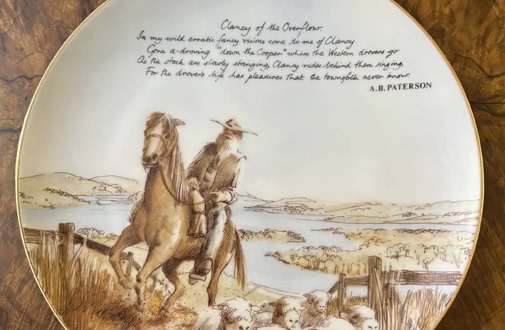 ‘Clancy of the Overflow’ plate by The Moliver Collection featuring a painting by Bill Leak, 1984.
The vision of life with “no time to waste” as something that precludes growth touches us as the expression of the old Australian Dream, so central to the ethos of The Bulletin writers of whom Paterson is the most buoyant and sleek and full of an optimism that parades the sanctity of the great drover in the face of “the cashbook and the journal”. Paterson is not a poet you can put next to Kipling with his dazzling rhetorical prowess and his ability to capture the complexities and the different colours and shapes of the empire that made him.
When we flick through Paterson’s ballads we are amused by these jocose poetic sketches. There is ‘The Man from Ironbark’ who is tricked by a city-slicker barber into thinking his throat has been cut, there’s ‘A Bush Christening’ where the priest names the child McGinty after a whiskey, and there’s the ghostly chorus of ‘The Geebung Polo Club’ which was once the name (or at any rate the alternative name) of the Auburn Hotel in leafy Hawthorn. These bits of inspired doggerel are a reminder of the ancient pleasure they provided in childhood, and they contain in their boisterous way the innocence of their expression.
Troopers as enemies and the ghosts that may be heard.
It is also characteristic of Paterson that he should have written ‘Waltzing Matilda’, the most famous bit of music ever to come from this land girt by sea. Slim Dusty’s version was broadcast from space and both is and isn’t what you would expect from an emerging nation so confident in the expression of a nascent nationalism. On the face of it ‘Waltzing Matilda’ sounds like Henry Lawson material, except for its haunting lilt and its bravura ambiguity. Paterson’s fiancée’s girlfriend Christina McPherson heard the melody—jaunty or poignant, depending on interpretation—and jotted it down and tinkled with it on the piano. She was not a musician, and the melodic line was subsequently cleaned up. It is extraordinary though that Paterson should have spun this story of the swagman and the jumbuck and the cry of “you’ll never catch me alive”:
Once a jolly swagman camped by a billabong Under the shade of a Coolibah tree And he sang as he watched and waited till his billy boiled You’ll come a waltzing Matilda, with me.
Troopers as enemies and the ghosts that may be heard. It is worth remembering Paterson could describe himself as a socialist, and the sense of indomitable resistance and egalitarian feeling could not be greater. Where else on Earth could the tale of a suicidal swagman dominate and hold sway as the national song?
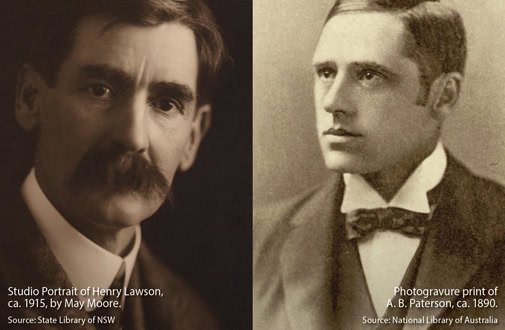
Henry Lawson and Banjo Paterson were aware of themselves as a kind of double act.
Henry Lawson is the complementary figure to Paterson, the bleak realist, the fiction maker who shows the toughness of life though it is also true that Lawson and Paterson were aware of themselves as a kind of double act. ‘The Union buries its dead’ is one of the great Lawson stories. The union wants to celebrate the dead young man, but many of them peel away thinking grog might be more of a respite. Then it turns out the dead man went by an alias, so he is all but lost to human memory. The tone is pitiless and has the kind of authority that makes you agree with the late Brian Matthews who said the best Lawson would bear comparison with anything.
As touched upon earlier there is The Bush Undertaker and the fumbling forlorn feeling for a form of words equal to the inescapability of death:
“Theer oughter be somethin’ sed,” muttered the old man; “‘tain’t right to put ’im under like a dog. There oughter to be some sort o’ sarmin’.” …
Once or twice he muttered the words, “I am the rassaraction.” … “Hashes ter hashes, dus ter dus, Brummy, – an’ – an’ in hopes of a great an’ gerlorious rassaraction!” … And the sun sank again on the grand Australian bush – the nurse and tutor of eccentric minds, the home of the weird, and of much that is different from things in other lands.
It is uncanny. The effort to recollect the words of the requiem: “I am the resurrection and the life. He who believes in me though he were dead yet shall he live”. The language is stripped of everything but the garbled memory of a form of words, and the effect is stark and forlorn and defiant.
The Drover’s Wife is the most celebrated Lawson story in this mode. A woman with two young boys and a dog called Alligator must battle with a snake. She is alone in a world of absolute isolation, her husband off droving. Right at the end, the snake dead, the cheeky young boy in an access of intense vehemence pledges his love for her in the face of everything he has endured:
The dirty-legged boy stands for a moment in his shirt, watching the fire. Presently he looks at her. He sees the tears in her eyes, and, suddenly throwing his arms round her neck, exclaims: “Mother, I won’t never go drovin’; blast me, if I do!”
A notable and recent adaptation of The Drover’s Wife is Leah Purcell’s, the Indigenous writer who—first as a play, then as a story, finally as a film—has re-appropriated the figure of the wife as a suffering heroic figure:
The lights snap up. Late afternoon… DROVER’S WIFE: Don’t you move, ya black bastard! He doesn’t.
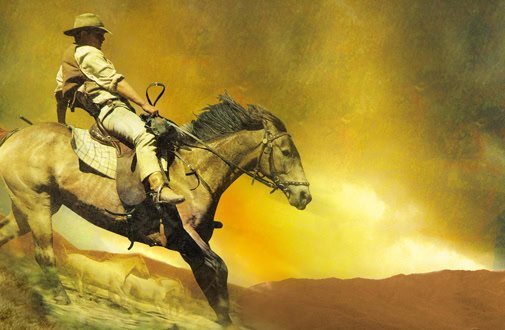 The Man From Snowy River movie promotional image.
Source: manfromsnowyriver.au
Leah Purcell has turned The Drover’s Wife into an Indigenous figure and reclaimed a heroine plucked from a canon of denigration. In Lawson an Indigenous man chops wood in such a way as to rip off the Drover’s wife and Purcell redresses this while appropriating the centrality and the suffering vivacity of the central figure. However, the most famous response full of sneaky humour and brilliant in its reconfiguration of a classic is Murray Bail’s The Drover’s Wife (1975): “The woman depicted is not ‘The Drover’s Wife’. She is my wife. We have not seen each other now … it must be getting on 30 years.”
Murray Bail takes the mickey out of Lawson’s stony elegiac story to present the mundane meanderings of someone—a suburban dentist, in fact—who cannot believe he has been usurped by a drover. It is a brilliant exercise in unbelief which is at the same time very funny. It is the classic expression of a refusal to see the drover’s wife as real because, of course, she is his wife, the suburban dentist’s and his wacko refusal to admit the integrity of the art, his failure at one level to accept the realism of Lawson’s art, is a wonderful act of animated deconstruction.
Peter Craven is one of Australia’s best-known literary critics and commentators, and writes regularly for The Spectator Australia and The Australian, among other publications. He founded the literary magazine Scripsi with Michael Heyward, and was founding editor of the Black Inc. Best Of annuals and of Quarterly Essay.
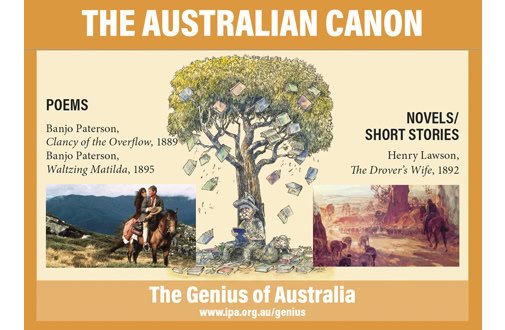
The IPA published its Australian Canon in the Spring 2021 edition of the IPA Review. It was produced as part of The Genius of Australia project, housed within the IPA’s Centre for the Australian Way of Life. More information can be found at www.australia.ipa.org.au
This article from the Spring 2024 edition of the IPA Review is written by literary critic PETER CRAVEN.
