
Caleb Bond:
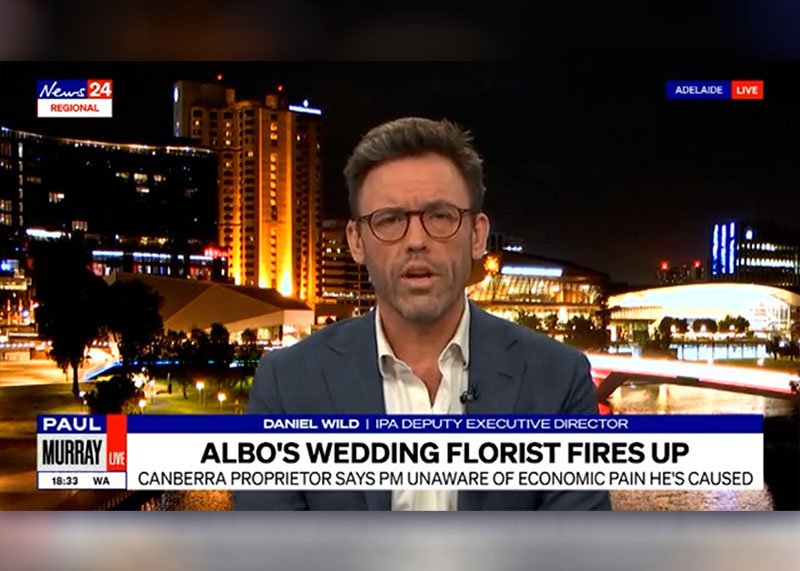
Caleb Bond in for Paul. Paul will be back. Whack. Whack. Back. I know, I’m sorry. I’ve been doing six-day weeks and mind’s going to mush or something. Paul will be back with you tomorrow night, which means I’ll be back on the late debate as well, which is exciting. We’ve got the band back together. Danika’s back, James, me. It’s going to be a hell of a night on News 24 tomorrow. But in the meantime, we’ve got the panel to get into. Joining me now, Deputy Executive Director at the Institute of Public Affairs, Daniel Wild and Chrysten Abraham, who is an independent candidate for Frankston in Victoria. Good to see you both this evening. Dan, I talked a little earlier about the prime minister’s wedding florist, who has come out and had a bit of a sledge at him. Now she’s not the first small business owner in the last couple of weeks to have a bone to pick with the Prime Minister, but Loulou Moxom, who once upon a time took the PM’s money now says it’s very hard to operate under the PM’s regime.
Daniel Wild :
Well, yeah, I mean, this is what we’re hearing from a lot of businesses, isn’t it, Caleb, particularly small businesses around the country. It’s just time and time again. There’s decisions taken by the government that show either a callous indifference towards small business or at worst hostility, an active hostility towards them. Now we know that there’s very little experience in this government in terms of a small business background. I think you struggle to find anyone in the government that has worked in small business for any amount of time. But also more broadly within Labour, there’s just not a culture of understanding or caring about small business because small businesses typically are not politically advantageous for Labour. What does Labour like?
Labour likes to have big consolidated institutions that they can control. They like to have a unionised workforce. They like to have collective bargaining. They like to have people that they can control. Whereas if you’re in small business, probably you’re fairly independently minded, you’ve probably got a go ahead to get ahead attitude. You’re probably pretty grounded in reality. You’re probably not going to be taking any nonsense from politicians or the aficionados in the public service because you’re actually living in the real economy. So small businesses typically are not the friend of left leaning government. So it’s not surprising that you have a lot of policies, whether it’s the surcharge policy, whether it’s energy prices going up or the levies or the red tape that comes out of the government, it’s hardly a surprise when you just look at the basic politics of it, I think.
Caleb Bond:
It’s a good point, Chrysten, that Dan raises. The lack of real world experience in politics these days, and it’s increasingly gone this way. And to be fair, it exists in the Coalition as well as in the Labour Party. I mean, the Labour Party, it’s you go through the union system or you work as a staffer and work your way up that way and the Coalition basically, place is populated by lots of ex-staffers, though there are more people at least in the Coalition who’ve had some business experience. But the lack of a real job, I mean, even the Prime Minister, Chrysten, he worked for a little bit of time as a bank teller, I think less than a year. And apart from that has always been in the political world. And so we are being run by people who just don’t really understand what’s happening in the real world.
Chrysten Abraham:
Absolutely. And I don’t know why we expect anything better from two people that really haven’t had jobs in the private sector, less than 12 months, I wouldn’t really consider experience to be able to run the country. But I would be heartbroken if one of my wedding vendors had told me I’d lost touch with the Australian people. I got married at the end of last year and they become such an integral part of your day. And the wedding industry got decimated through the pandemic and then you continue to see this Labour government decimate these businesses more. They’ve been keeping their head above water as much as they can. And yeah, it’s just a complete contempt for small businesses that I see. But back to the point, I don’t know what we expected from Jim Chalmers and Albo when they haven’t had real jobs.
Caleb Bond:
And you speak of this contempt, I played before Daniel Mulino this morning on Insiders saying that the government was aware in July that the ATO didn’t want to absorb the credit card surcharge when the ban came in. And they knew all this time and said nothing about it and then tried to tell us the cost of living measure. I mean, talk about contempt.
Daniel Wild :
Well, that’s right. I mean, it’s the politics of it. He was put out there by Jim Chalmers to try and sort of bear the brunt of the criticism that’s coming back. But the point that’s always been made, which I think is a really simple point, but an important point, Caleb, which is that, okay, you can get rid of the surcharge. You can say to a business, a small business, “You are not allowed to surcharge a credit card payment,” fine, but somebody has to pay. So either they don’t get it or they don’t care when it comes to that. Now they’re saying, “Oh, well, if the businesses don’t absorb it when the government has to absorb it and so forth.” But at the end of the day, someone has to pay for this. And this is something that was not put front and centre.
Now, if this is a cost of living measure, which is now what they’re trying to say, although they’re backtracking a bit, it just shows how detached they are from reality. Almost every single other policy they’ve put in place is making the cost of living worse, whether it’s to do with net-zero policies, increasing their energy bills, whether it’s to do with the rising taxes and charges, whether it’s to do with their failure to secure enough oil and diesel in order to keep prices down in the context of international destabilisation. So this is not a government that’s been focused on getting costs down. They pretend it’s about that when they want to do something that suits their politics. But ultimately, as we just talked about a moment ago, it’s all too often small businesses that are ones that cop it in the neck.
Caleb Bond:
Indeed. And we have a huge productivity problem, of course, in this country. We’re not actually getting better at anything. We’re not creating anything. The OECD has issued a big warning on this. And of course, former Coalition Finance Minister Mathias Cormann runs the show over there now, but he’s come out and said that there is no easy way to lower the cost of living. “You’ve either got to produce more or borrow more from your children.” And that is effectively what is happening, Chrysten. We are going deeper and deeper into debt. We’re seeing real wages go backwards. We’re seeing productivity stall. All of this is a recipe for, I was going to say our generation, but realistically it’ll be our kids and their kids who have to pay more and more and more because we just kept running up the bill today and we didn’t actually do anything about it.
Chrysten Abraham:
It’s completely accurate that we’re borrowing from our children’s future. Kids today are born with around $70,000 worth of debt attached to their head. So there was a time there where children were being born and there was no debt attached to their head. It’s becoming increasingly impossible to run business in general, whether it’s small or otherwise. We had a 169-year-old business here in Victoria that employed hundreds of people that had to shut their doors. And it just goes to show you that its productivity is based on government legislating and they’re doing it half planned. And that’s why they continue to put things out like the credit card surcharge and then have to back flip and change it because they’re not thinking it through. These are people’s lives, these are people’s businesses and they’re not taking that responsibility of office serious enough.
Caleb Bond:
Well, I remember Dan, the federal budget, you had Jim Chalmers and the Prime Minister talking about intergenerational equity. And we were told that all of this will be fixed by tax changes, negative gearing and capital gains, whatever. This is the real issue of intergenerational equity. I mean, what they are committing is intergenerational theft, but they won’t admit it.
Daniel Wild :
Yeah, you’re bang on with that, Caleb. I mean, this debt, as Chrysten pointed out, is a massive basically future tax on all children and grandchildren coming through. But the thing that really worries me is when you look at what’s happening to our economy, there is no plan for how to grow the economy. The government has a plan for how to redistribute wealth and income, but it has no plan to grow the actual economy to make everybody better off. And so we have a perfect storm that is now brewing. We have inflation that is high, at least compared to other comparable nations. We have the cash rate that is going up. We also have rising joblessness and slow economic growth. So this is a very bad situation. This is reminiscent of the stagflation that we had in the 1970s that ultimately led to the calamity in the late ’80s and early 1990s.
Now, the problem you’ve got here is you’ve got massive sort of demand being pumped up by this debt fueled government spending combined with mass migration, which is cranking up money into the economy. At the same time, as you just mentioned, productivity is flat or going backwards. Now, productivity measures our ability as an economy to produce wealth. So we’re getting worse at producing wealth at the same time as more people are coming in and the government is spending more. So prices are going up, but the total slice of the pie that people are getting is actually getting smaller. So we’re in a very bad economic circumstance, and this is not news to anyone at home, but when you look at the economic figures, unfortunately it looks like there’s a lot of dark days ahead for our economy.
Caleb Bond:
There’s no doubt about that. Now let’s change tack a little bit. Katie Zacharia, who was, I was going to say she’s the new press secretary for Donald Trump. Of course she’s not anymore. She’s on the way out. She had an absolute shocker last week, five days in the job, barely lasted a test match. And for anyone who’s forgotten, this is how it went.
Katie Zacharia:
He had a historic one-day war and now we have a booming economy and a great relationship with Venezuela. And something President Trump is delivering on just like he delivers on every promise. In addition to that, there is $54 billion.
Caleb Bond:
Oh, it’s so cringe worthy. The President I think worked out pretty quickly what was going on.
Donald Trump:
Katie’s been treated very badly by the media, very, very badly, very unfairly I think. And I just spoke to her about it. I said, “Katie, is this for you?” Because she’s been treated very rough and she’s a nice person, very nice person. I’ve watched her for years on television, but I said, “Is this for you, Katie? Because honestly, you don’t need this.”
Caleb Bond:
I think that was a little diplomatic, Chrysten. “Is this for you?” I think we got the answer.
Chrysten Abraham:
I think that’s the first time Trump has ever been diplomatic. I’ll be completely honest, I didn’t get to see it until today, but I had a lot of people out on the Hustings asking me and laughing about it saying, “Have you seen Trump’s new press secretary?” And apparently she got parachuted into the role and maybe is not qualified, but it’s probably a note for the major parties as well. Don’t parachute people into roles because it doesn’t work out.
Caleb Bond:
Actually, it’s a very good point actually, Chrysten. I mean, Daniel, I do feel a bit sorry for her in some ways because clearly she wasn’t ready for it. She looked like a deer in the headlights. But the bit that I don’t get is you’re in the United States and it’s a country of 350 odd million people or something. And that was who the President and his team chose to send out as their new press secretary.
Daniel Wild :
Yeah. I mean, who knows how they come up with these decisions? I do think it’s probably true that Trump watches television and he sees the ones he likes and he goes, “All right, you’ll do.” Sometimes it works, sometimes it doesn’t, but I also feel a bit sorry for her. I mean, that would be one of the toughest gigs going around because I mean, at least if you’re the guy in the chair, if you’re the President, well, you can speak on your own behalf. But when you’re the press secretary, you’ve kind of got to defend the indefensible and spin everything as hard as you can. It’s one of the toughest jobs out there. So clearly she wasn’t ready for it, wasn’t the right person. Maybe she’s better suited to something else and it’s probably the right decision of Trump’s to get someone else in there pretty quick.
Caleb Bond:
Would’ve though so. Hey, very quickly before we go, Chrysten, there’s been a new report from the Auditor General about firefighting in Victoria. There’s been a shortfall in funding for the ageing firefighting fleet. What’s going on?
Chrysten Abraham:
So I want to know where the money is going. They brought in a emergency services levy attacks in the name of firefighters, and after multiple freedom of information requests, no one knows where that money’s going because it’s not going to the firefighters. So the Fire Rescue Victoria asked for $160 million to keep their fleet up to standard, and that was half the investment that they needed, which is only 1.1% of the $15 billion of corruption here in Victoria. The UFU protesting outside the emergency services minister’s office here in Frankston, and these firefighters are meant to keep us safe and the government is no longer keeping them safe. And it’s just another example of the decay here in Victoria leading up to the November state election.
Caleb Bond:
Well, there’s plenty of that and we’ll be keeping an eye on it here. Chrysten, Daniel, good to see you both as always.
This transcript with Daniel Wild talking on Paul Murray Live – News24 from 18 October 2026 has been edited for clarity.
