
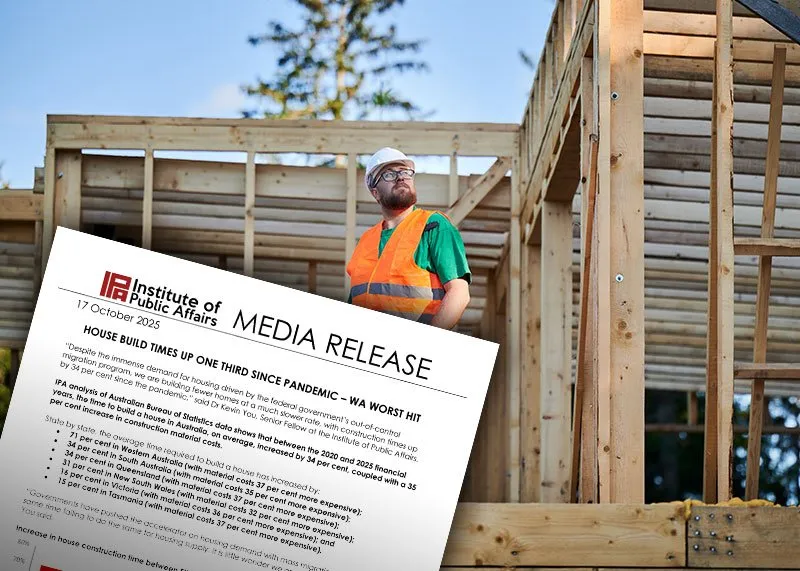
“Despite the immense demand for housing driven by the federal government’s out-of-control migration program, we are building fewer homes at a much slower rate, with construction times up by 34 per cent since the pandemic,” said Dr Kevin You, Senior Fellow at the Institute of Public Affairs.
IPA analysis of Australian Bureau of Statistics data shows that between the 2020 and 2025 financial years, the time to build a house in Australia, on average, increased by 34 per cent, coupled with a 35 per cent increase in construction material costs.
State by state, the average time required to build a house has increased by:
- 71 per cent in Western Australia (with material costs 37 per cent more expensive);
- 34 per cent in South Australia (with material costs 35 per cent more expensive);
- 34 per cent in Queensland (with material costs 37 per cent more expensive);
- 31 per cent in New South Wales (with material costs 32 per cent more expensive);
- 16 per cent in Victoria (with material costs 36 per cent more expensive); and
- 15 per cent in Tasmania (with material costs 37 per cent more expensive).
“Governments have pushed the accelerator on housing demand with mass migration, while at the same time failing to do the same for housing supply. It is little wonder we are in a housing crisis,” Dr You said.
Increase in house construction time between FY2020 and 2025 by state

The federal government’s National Housing Accord promised to construct an average of 20,000 new homes per month, to meet the goal of 1.2 million new well-located homes by June 2029.
IPA analysis shows that in the financial year ending June 2025 – the first year of the National Housing Accord – just 174,271 new homes were completed, more than 65,000 short of the interim Accord target.
“In the first year of the National Housing Accord, the number of homes completed was comparable to the number of homes completed 30 years ago in 1995, when the demand for housing was significantly lower than it is today,” Dr You said.
“The price of the average home has been rising fast and now exceeds $1 million. Young Australians are being locked out of the housing market, yet the only thing the federal government has had to offer is an empty target that has never been met once.”
IPA analysis of the latest ABS Producer Price Indexes for the reference period to June 2025 also show that the cost of housing material inputs rose by 35 per cent between 2020 and 2025.
Annualised house construction input cost and construction time indices

“Over the past decade, Australia has seen demand driven cost increases to construction material and labour, which has been caused by large, inefficient government projects, creating the perfect storm of rising prices and rents, particularly in the post-pandemic period,” Dr You said.
“All levels of government must do their part to fix this crisis. The federal government should immediately reduce migration to sustainable levels, while state and local governments must open up more land and cut red tape to speed housing construction.”
“Migration has and will always be a part of the Australian story, but the current rate is unsustainable. Mainstream Australians understand this, which is why they are growing more frustrated, with recent IPA polling finding 71 per cent want a temporary pause in migration until we can catch up,” Dr You said.
To download the IPA’s research click here.
