
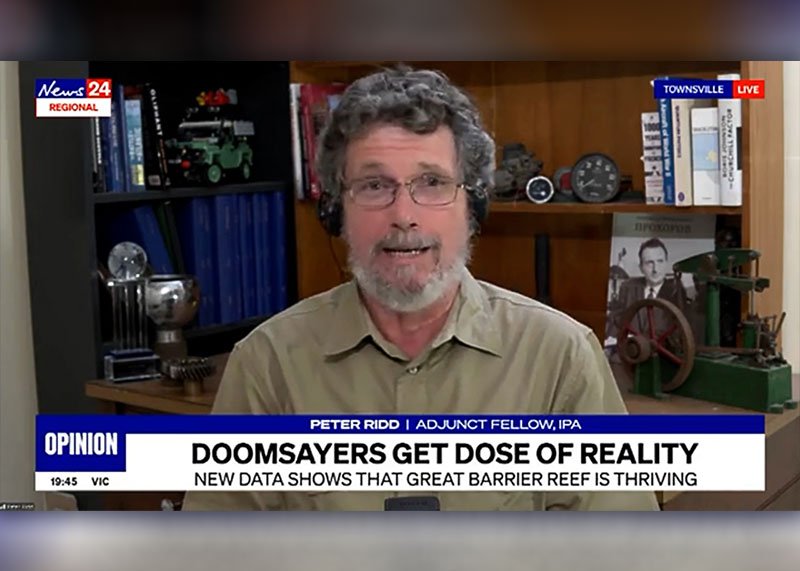
Jaimee Rogers:
Well, welcome back. The Great Barrier Reef has been at the centre of climate warnings for decades. We’ve heard repeatedly that mass bleaching events are devastating the reef and threatening its future. But the latest coral data tells a more complicated story. Coral cover has remained at historically high levels in recent years, despite repeated bleaching events, raising questions about the reef’s resilience and whether some of the rhetoric has matched the evidence.
Joining me now is adjunct fellow at the Institute of Public Affairs, Dr. Peter Ridd. Peter, we’ve been told constantly that the Great Barrier Reef is facing devastation, yet coral cover has been at historically high levels. How do you reconcile those two things?
Peter Ridd:
You can’t. It’s as simple as that, that the reef has supposedly been devastated, what, five or six times in the last decade from hot water bleaching, and we’ve ended up with record amounts of coral. You cannot reconcile that except by saying that clearly some of that information must be wrong.
Clearly, not much coral could have died in the last 10 years, but you can also go back almost 60 years that the Great Barrier Reef has supposedly only had a decade to live for the last 60 years. So it’s not a new phenomenon that essentially the science institutions have been exaggerating and are essentially untrustworthy.
Jaimee Rogers:
Well, let’s go to that about the science because governments spend hundreds of millions of dollars on reef science management, but do you think that there’s a conflict in a way when the institutions that are warning of this crisis are also the ones that are receiving funding to study and respond to that crisis?
Peter Ridd:
It’s a huge conflict of interest. It helps to drive the group think within those organisations. So they remove people who dissent and a combination of with the Great Barrier Reef also, you have a lot of the marine biologists who are emotionally attached to the reef. So when coral dies naturally, which it does sometimes in large quantities, but it recovers, you have this unholy alliance between scientists who are a little bit emotional, group think and a cold, hard financial imperative by the people high up in the organisations who want to make sure that that funding stream continues.
And the reef being constantly almost dead, but never quite dead because if they kill it completely, well, that’s the end of the funding. So, yes, there’s a huge conflict of interest and we need to do something about that to make, as Matt Canavan says, to make these science organisations accountable for what they say and do.
Jaimee Rogers:
And that’s led to you campaigning for the call of Check the Science. What would an independent science audit examine?
Peter Ridd:
Well, Check the Science, I’ve been working on Check the Science with the IPA at the research level for almost a decade, but my work with the Australian Environmental Foundation, we want science checking, not just for the Great Barrier Reef, but things like the closed down of the forestry industry, the Murray-Darling, the fishing. There’s a whole lot of things where we’ve got all these environmental regulations which are hammering farmers, which are based on science, which looks incredibly weak and is definitely unchecked.
So for example, a lot of these science organisations are able to almost extort/blackmail the government by saying, “Well, you’re going to have to hand over a lot of money to save the Great Barrier Reef or whatever it is.” So we need to check that science. So you do it bit by bit. We are interested in one little river in Queensland to start with to see whether it should have reef regulations attached to it.
But of course, ultimately, all the science on all these environmental regulations needs to have a thorough audit so that you can see whether the group think has taken ahold or whether there is a genuine environmental threat, which we really need to worry about.
Jaimee Rogers:
Well, Peter, I do really appreciate your time tonight because I have had a few parents reach out to me to say that their children have been coming home from school saying that the Great Barrier Reef is dying. So it’s nice that you can put an end to what they’re being taught there. So I appreciate your insights.
Peter Ridd:
Thanks very much.
This transcript with Dr Peter Ridd talking on The Jaimee Rogers Show – News24 from 6 September 2026 has been edited for clarity.
