
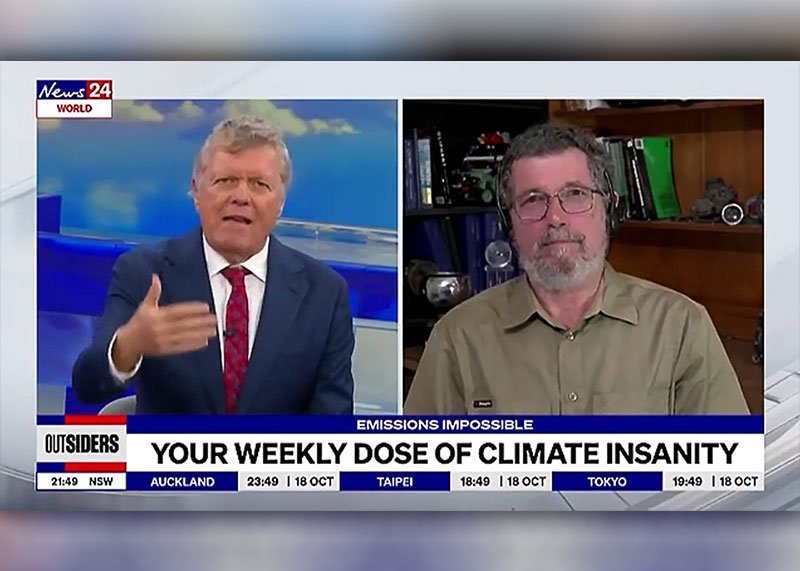
Rowan Dean:
Yes, the emission’s impossible. It’s our mission and we accept it gleefully to point out the madness of the net-zero insanity every week. Well, net-zero is built on the climate change cult, the theory that the science is settled. Well, of course the science is settled if the data is correct. This extraordinary story yesterday about the Bureau of Meteorology, something I’ve talked about many times, we’ve talked about on this show many times over the past 10 years. Have a listen to the Australians, Graham Lloyd, who broke this story yesterday.
Graham Lloyd:
An audit of BOM’s raw data, which it claims is a representation of what was originally written down, has found big problems. Large blocks of temperatures have been copied and pasted from one year into another, sometimes 40 years apart.
Rowan Dean:
So joining us is Peter Ridd, great friend from up there on the Great Barrier Reef, Peter. So Graham Lloyd’s thing, we don’t need to go into too much specific details, but basically Graham Lloyd has compared the handwritten data from the BOM, which is the Bureau of Meteorology. He specifically points to observatory in Sydney, but others as well, where they’ve gone back and compared the handwritten temperature data around New South Wales and Australia and compared it to what’s digitally online and the two don’t match. And in fact, they’ve discovered mass duplications, like a whole month from one year has been replicated or even the wrong seasons have been replicated. And they are saying statistically, this is just impossible. The Bureau of Meteorology to play devil’s advocate have said, no, no, no, no, there may be mistakes, but it’s generally okay. But the point is if data is not 100% correct, if it is compromised, Peter, what does this mean?
You’re the scientist, you work with data, you rely on data. Your entire life’s work of the Great Barrier Reef is all about data.
Peter Ridd:
It just shows a general complete lack of quality assurance in the Bureau of Meteorology, which is much wider. Now, what does it mean for the actual climate record? Well, they’ve adjusted a lot of the old temperatures downwards, which makes climate change look a little bit worse than it really is. But it’s the quality assurance thing. Now remember they’ve been told there’ve been problems over many years. People like Jennifer Marahassi, Bill Johnson, or even one of my own PhD students, John McLean, have been saying this and they say, “Oh, well, there’s small problems,” but how does this happen? How did this get through the trap? And remember, this is not just the Australian Bureau of Meteorology. Similar adjustments to the climate record being made in America. So for example, the incredibly famous dust bowls of the 1930s has been more or less obliterated. And then it goes actually even further than that.
If you then go to the climate science in general, there’s often no quality assurance. And this really matters, by the way, just right at the moment, there’s legal action being taken by some of the conservation groups against the West Australian gas field. They’re actually claiming that because of climate change, it’s going to kill, I don’t know, 30 million corals on the Great Barrier Reef every year or every time it bleaches, and therefore those gas fields must be closed down. So this general lack of quality assurance is an incredibly important problem for Australia. What it actually shows is we need to have somebody… We need a hundred scientists doing this quality assurance rather than these two gentlemen who’ve actually done it for free. The actual report was done by scientists for free. We need to pay this to be done and to make sure that the fundamental data and lots of other papers are actually reliable.
James Morrow:
What has been the reaction of the Bureau of Meteorology to these revelations that their own work has been fairly slip shot in that this is having, you would imagine, potentially billions of dollars of impact on the Australian economy as policymakers use this dodgy data to feed a narrative around climate change that isn’t true?
Peter Ridd:
It’s not good enough. They just say, “Okay, yeah, there were some mistakes, we’ll fix them.” But that’s not the point. You’ve got to ask, “How did this happen? How did these get through? How much wider is the problem?” Because it’s right through the scientific community. When you actually often point out problems in the scientific community, they’ll say, “Oh, well, it’s just a little problem.” But the bigger question is, well, how did that happen and was there a motivation behind that? And all these other questions. You’ve got to actually get to the root cause of the problem. And the bureau is not actually accepting that they have to do that. And neither are most of the other scientific organisations that are involved in climate science.
Rowan Dean:
Cara?
Caroline Marcus:
Peter, what makes me particularly cynical about the bureau’s response is some of the detail in this report. For example, this audit found that at the Sydney Observatory, maximum temperature adjustments were positive in every year between 1910 and 2020. So these changes were only one way to make it look like the maximums were higher. I mean, how do you interpret that?
Peter Ridd:
Well, there’s all sorts of ways you can interpret it and I won’t go into all the options, but at the bare minimum, you’ve got to ask the question, how did this happen? And by the way, that’s not all. There were many other very, very strange cut and paste things that went on with this data. So you can’t just say, oh, well, we’ll just fix them. You’ve got to start to ask why that has happened and how you can stop this happening in the future and whether it’s happened in a vast variety of other areas of climate change, which I can guarantee you it has.
Rowan Dean:
And I think Peter, the point is, so last week there was a Greens candidate down in Victoria who was saying, oh, it was 26 degrees in Victoria in October. I did a little video as if this was shocking and then went on to directly link that to climate change, the need for net-zero, the need for et cetera, et cetera, et cetera. It took me five minutes, Peter, to go back and discover back from 1902 to 1926, every other year in Victoria, there was at least a temperature of an upper limit of 26, sometimes 30, 31. So the point is that this data predicates the entire climate change ideology that the planet is getting hotter. Now, none of us were around a hundred years ago or not many. And so we rely on the data, Peter, if we’re going to be forming policy. If the data is wrong, then it’s likely the policy is wrong.
You’ve seen this on the Great Barrier Reef. What’s the latest now? We saw only a year or so ago that the data will change. Oh, now suddenly the Great Barrier Reef is looking a lot healthier. Where are we now, Peter?
Peter Ridd:
Well, it’s funny you say that. I mean, with the actual proper data on the Great Barrier, it’s at record amounts, but then there’s another organisation, if we’re going to talk about changing data, there’s an organisation called the Global Coral Reef Monitoring Network, which has changed the data, the historic coral reef data from 1980 to 2020 because it wasn’t frightening enough. And in the last report, they’ve actually changed this. So yet another organisation has turned out to be unreliable. Now our Bureau of Meteorology, we rely upon them to be trustworthy. We’ve got a big El Nino coming up. We could have all sorts of fires down in the South. Do you trust the Bureau of Meteorology to report this fairly? Will they mention, for example, if there is a huge dust storm that goes through Melbourne, that actually this has happened before in 1983 or that there’s been massive bushfires in 1939?
The problem is that because you see things like that for this from the Bureau of Meteorology essentially making you question their whole trustworthiness, well, I really don’t think you can have much faith in a great deal of what they say. And that’s a shame because the Bureau does such wonderful work with their weather radars and all the rest of it. And you’ve got this small group within the Bureau of Meteorology, their climate department, and well, I don’t trust them and I suggest that other people shouldn’t either.
Rowan Dean:
And I think this is the key point is that once trust is gone, it’s very hard to win it back. But more importantly, younger people who may not have experienced certain temperatures or a heat wave or a cold spell or a storm or a hurricane or whatever, they see something, they think it’s the first time they believe the argument that, oh, this has never happened before, which is why we must have accurate data from the past, as you know only full well. Peter Ridd, thanks as always for coming on and chatting to us on Outsiders. We’ll let you get back onto the Great Barrier Reef. Peter does a great job up there in Townsville. Coming up, what’s more on the show in a tick.
This transcript with Dr Peter Ridd talking on The Outsiders – News24 from 18 October 2026 has been edited for clarity.
