
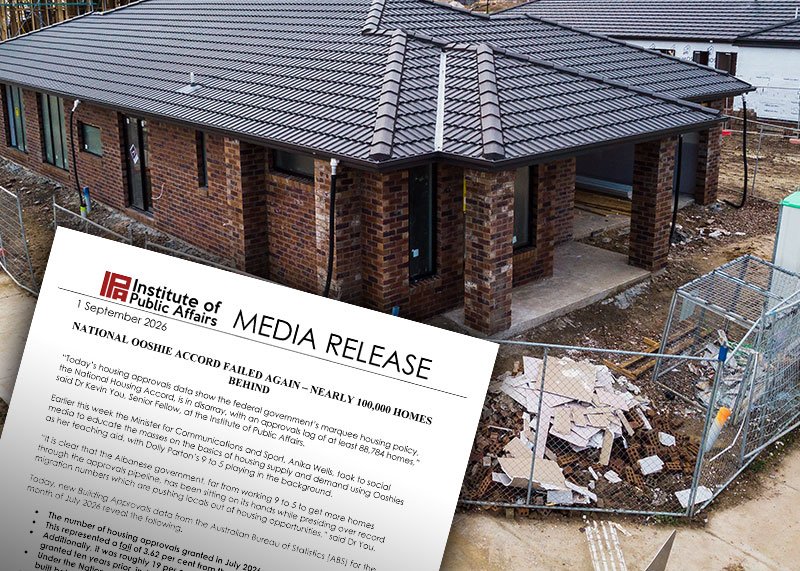
“Today’s housing approvals data show the federal government’s marquee housing policy, the National Housing Accord, is in disarray, with an approvals lag of at least 88,784 homes,” said Dr Kevin You, Senior Fellow, at the Institute of Public Affairs.
Earlier this week the Minister for Communications and Sport, Anika Wells, took to social media to educate the masses on the basics of housing supply and demand using Ooshies as her teaching aid, with Dolly Parton’s 9 to 5 playing in the background.
“It is clear that the Albanese government, far from working 9 to 5 to get more homes through the approvals pipeline, has been sitting on its hands while presiding over record migration numbers which are pushing locals out of housing opportunities,” said Dr You.
Today, new Building Approvals data from the Australian Bureau of Statistics (ABS) for the month of July 2026 reveal the following.
- The number of housing approvals granted in July 2026 was 17,687.
- This represented a fall of 3.62 per cent from the previous month.
- Additionally, it was roughly 19 per cent fewer than the number of housing approvals granted ten years prior, in July 2016 (at 21,736).
- Under the National Housing Accord’s target, half a million homes should have been built between July 2024 and July 2026 at an absolute minimum.
- The cumulative shortfall from the National Housing Accord’s minimum target to date is now at least 88,784.
“The government has obviously failed Australians when it comes to building new homes and addressing the housing crisis, and they keep lying to Australians about it. A simple apology at this stage would go a long way,” said Dr You.
“The government has failed to hit every one of its 25 minimum monthly targets to date. If these people were in business, they would have been sacked a long time ago. Instead, they keep getting kicked upstairs with more pay, fancier titles, and lamer social media posts.”

The IPA’s submission to the Productivity Commission’s inquiry into housing supply regulation can be accessed here.
Chart: Cumulative housing approvals shortfall from the National Housing Accord

