
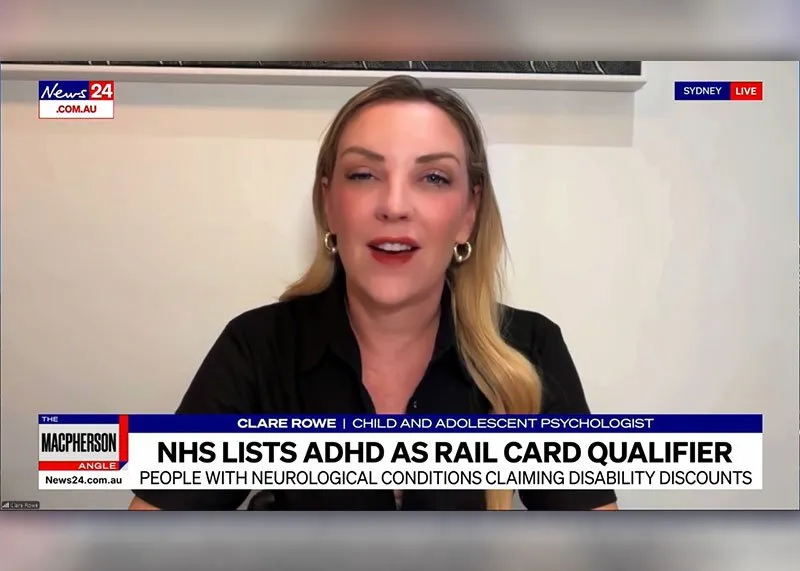
James Macpherson:
Joining me now is child and adolescent psychologist, Clare Rowe. Clare, welcome to the programme. What’s going on?
Clare Rowe:
Well, James, it’s great to be with you. Yeah, I think we’re witnessing a really significant cultural shift in how we understand mental health and disability. So as you pointed out, ADHD is a very legitimate neurodevelopmental condition and causes some people impairment significantly. But I think we’ve moved into this space where almost any difficulty around concentration, organisation, motivation is being interpreted as a potential symptom of ADHD.
And the problem is that these are also perfectly ordinary human experiences, right? We all struggle with attention sometimes. We all procrastinate, we all get overwhelmed. So what concerns me as a psychologist is that we are increasingly looking for a medical explanation for any difficulties that arise. And of course, once you attach those difficulties to a diagnosis and as you point out, financial incentives, it really does change the way that people see themselves and what they believe that they are capable of and what they expect from the world around them to accommodate them. And yeah, I think we’ve become very good at identifying and naming difficulties, great, but perhaps not so great at helping people overcome them.
James Macpherson:
Explain to me how it is that ADHD has become something to celebrate. I mean, when I was a kid, you didn’t celebrate a disability. What’s happened? How’s that come to pass?
Clare Rowe:
Well, look, I think there’s a couple of things happening here. First of all, we have worked very, very hard to remove stigma associated with mental health conditions around neurodevelopmental disorders, and that’s a positive development. But in some circles, we have gone dramatically in the other direction where, as you said, having a diagnosis is almost something to aspire to. And particularly around young people, diagnoses have become part of their identity. They’re discussed on social media, they’re incorporated into people’s online profiles. I’ve seen them written on CVs before. And yeah, they’re celebrated as a marker of uniqueness.
And I think there’s probably an explanation for that because humans really have a strong need to belong. They want to understand themselves. They want to feel that their experiences are recognised and a diagnosis in that way can do all three of those things. It offers an explanation for difficulties. It makes you feel special. It opens up a community. But we need to be very, very careful. There’s a very important difference between removing the shame associated with a diagnosis and encouraging people to build their entire identity around it. Particularly, I worry about this with kids and adolescents who are still forming their identity.
James Macpherson:
It’s such a great point. It’s one thing to remove stigma. It’s another thing to then say this is a good thing. As important as it is to treat people with genuine disabilities, how harmful is it to pamper people with no disability or with a condition that really isn’t that debilitating?
Clare Rowe:
Yeah, I think potentially it can be harmful. I think we want to help people develop confidence in their ability to manage their challenges. We call that a psychologist self-efficacy. It’s the belief that I can cope and I can learn and I can overcome difficulties even when something is very hard. And if we create environments where every single difficulty is accommodated and every challenge is removed, we’re constantly reminding people of their limitations. And so we risk undermining their confidence. And so not every ADHD person, in fact, I’d argue very little, need concessions to ride on the train. And in fact, you’re just reinforcing to them, as I said, their limitations and what they can’t do, which absolutely could be harmful.
James Macpherson:
We’ve only got about 30 seconds left, Clare, but do you have some compassion for parents trying to navigate all of this stuff? They’ve got kids who maybe aren’t doing so well at school. They’ve got people telling them they need to get diagnosis. I said 30 seconds is about 15 seconds, but it’s tough for parents.
Clare Rowe:
It’s really, really tough and it all comes back to no matter who does that assessment and diagnosis, I don’t mind if it’s a GP like we have in New South Wales, a paediatrician, a psychiatrist. It needs to be a thorough one and it needs to be looking at what else is going on that could be causing those symptoms and not just a checklist that leads to ADHD.
James Macpherson:
Very good point. Clare, always instructive to talk to you. Thanks so much.
This transcript of Clare Rowe speaking on The Macpherson Angle on News24 from 1 November 2026 has been edited for clarity.
