
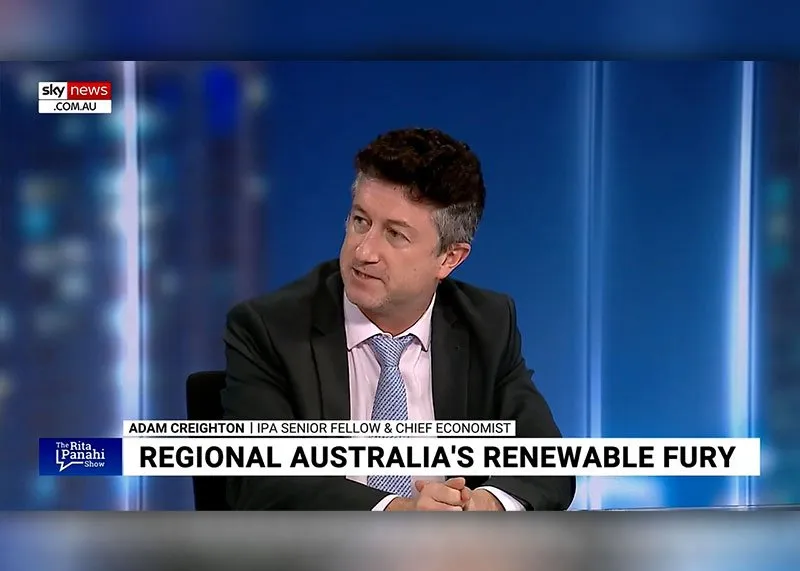
In this interview, Adam Creighton appeared on The Rita Panahi Show – Sky News Australia to discuss the IPA’s research on net zero.
All media appearances posted onto the IPA website are directly related to the promotion and dissemination of IPA research.
Below is a transcript of the interview.
Rita Panahi:
But first we’re learning more about what Victoria’s proposed treaty with its indigenous population will include, and the tip of the spear as The Age calls it will be a permanent indigenous voice called the Gellung Warl, which will be future-proofed against a changing government with an ongoing special appropriation cemented into the state budget. Joining me now for more on this is News Corp senior writer Patrick Carlyon and senior economist and research fellow at the Institute of Public Affairs, Adam Creighton. Patrick, how can it be future-proofed this indigenous voice against a liberal government if it’s not enshrined in the state constitution?
Patrick Carlyon:
Look, this has been a sleeper issue. It’s just sort of come about. There’s no appetite for it. We saw the voice voted down. And no one’s actually explained how it was going to work until now, until we saw this story today. And it is terrifying. I mean, this representation, they can sit down with the chief commissioner and police if they feel they need to. They can question any law they like, and I think the unintended consequences will be massive on this. And there is no support from the electorate in the first place.
Rita Panahi:
Well, this is an important point, Adam, and opposition leader Brad Battin has said that the state-based voice flies in the face of democracy. The majority of Victorians voted no in the referendum. And from what we are reading now, the state opposition could campaign on this win and not change this voice that nobody voted for.
Adam Creighton:
Yeah. Well, the government or the news report says that it’s going to be entrenched somehow, but I don’t think that’s actually true. I mean, it’s an iron law of British constitutional system that a parliament cannot bind its future self. So in other words, any parliament in the future can just pass a law that changes the previous law. So it’s not permanent. So that’s good news. And so it should give the opposition here something to run on at the next election that they may actually get some traction a bit.
Rita Panahi:
Have they been strong enough on that? Because they seem to be shying away from it, though they said they don’t support it, they haven’t ruled out getting rid of it, but I would’ve thought this is an issue that can seize upon and campaign on.
Adam Creighton:
Absolutely. Crime and that I think they should be really going hard on because they’re easy issues. And yeah, the opposition here is very weak. It’s not loud and proud with its views. At least that’s kind of my perception as a relatively new Victorian, it’s got different in New South Wales.
Rita Panahi:
Well, as a permanent Victorian, Patrick, you’d remember the last federal state election, the Liberals were pro-treaty-
Patrick Carlyon:
They were.
Rita Panahi:
… and only after the voice was rejected that they change their position quietly.
Adam Creighton:
Just the contempt for taxpayers money. I mean, the government here has spent $700 million-
Patrick Carlyon:
Wow.
Adam Creighton:
… on this treaty according to IPA research. I mean, that is just breathtaking amount for a government that has $150 billion-
Patrick Carlyon:
Have no money.
Adam Creighton:
… of debt.
Rita Panahi:
Yeah.
Adam Creighton:
So that’s another issue that the opposition could be attacking. But where are they on that?
Rita Panahi:
Absolutely. And the cost ongoing, Patrick, is significant too for this body.
Patrick Carlyon:
Oh, it’s massive. And as I keep saying, no one wants it. They should be pushing hard, the opposition, and there’s a lot of things they should be pushing hard. They don’t know what they think. They’re too scared to think.
Rita Panahi:
And there’s a question about whether even the indigenous population wants it because the numbers who are participating in this process is pretty low, the percentage are taking part in that democratic process. Now staying in Victoria, Premier Jacinta Allan copped a lashing from farmers during a speech she gave at the Bush Summit in Ballarat. Have a look.
Jacinta Allan:
Some of it is because of nature.
Crowd Protestor:
[inaudible 00:03:47].
[inaudible 00:03:47].
[inaudible 00:03:47] it goes to your government.
Jacinta Allan:
Some of it is because of nature. The bush gives you something you simply can’t find anywhere else, the fresh air, the quiet-
Crowd Protestor:
[inaudible 00:03:59].
[inaudible 00:04:01].
Crowd Protestor:
No one wants want you here. Go back behind the stage.
Jacinta Allan:
And that’s why also we’re supporting renewable energy projects as well that are driving investment.
Crowd Protestor:
Boo. Boo.
[inaudible 00:04:14].
Jacinta Allan:
And then finally two…
Rita Panahi:
Patrick, this new legislation that the Allan government has just passed. It’ll be coming to other labour states no doubt. The National Electricity Amendment Bill will allow VicGrid officials sweeping powers to forcibly enter farmland to construct their massive transmission lines for renewable power. That can use reasonable force, Patrick. That includes tearing down fences, breaking locks, calling in the cops.
Patrick Carlyon:
The cops can be called in. Farmers can be arrested. They can be fined. And you listen to the rhetoric from the angry farmers from the other day. They’re talking about their land being taken out from underneath them. There hasn’t been any communication on any level that actually has sated their very legitimate concerns, and this has been going on for five, six years. And to suddenly, okay, I’ll give Jacinta Allan credit for turning up, but besides that, that was always going to happen because this has been festering. And you can understand why. I mean, your castle is the most important thing, and these farmers have their castles being put under threat.
Rita Panahi:
Oh, it is shameful. I mean, she got booed at last year’s Bush Summit in Bendigo, her own seat. And again, Ballarat is federal Labour seat. And the Prime Minister also copped it. It wasn’t just a Victorian premier. The prime minister was run out of town and he copped plenty of boos before he left trailed by tractors.
Anthony Albanese:
And I’ll continue to engage, but I won’t bullshit people.
Crowd Protestor:
Boo.
Anthony Albanese:
I won’t say it hasn’t happened.
Crowd Protestor:
[inaudible 00:05:58].
Anthony Albanese:
It hasn’t happened because the market’s determined that it doesn’t stack up.
Crowd Protestor:
Okay. [inaudible 00:06:04] hear that.
Bush Summit Host:
Ladies and gentlemen, please.
Rita Panahi:
Oh, the booing went on after that. And yeah, there is this car being chased out of town by tractors. I’m laughing, Adam, but it’s not funny. The anger in the Bush, the anger in regional areas is real. They feel neglected, they feel they’re not being listened to, and I think they’re completely entitled to feel that way.
Adam Creighton:
Yeah, look, I think it’s a good point just on the hate out there because I think there’s real visceral hate for these politicians amongst these groups, and I think that’s very sad to see as an Australian. You probably haven’t seen that since the Vietnam War, the level of antagonism. But it is understandable because the laws that have been passed by Victoria, the arguments that the Prime Minister made, I mean, he said something that was just completely wrong. He said that basically any business can build a coal-fired power station, but there has absolutely nothing stopping it.
Rita Panahi:
Yes, he did say that.
Adam Creighton:
But of course, the retailers have to buy renewable energy. So that’s very misleading at best.
Rita Panahi:
Well, not only that, but all the state and federal taxes, any fossil fuels. And then if you actually do want to start a project, as we have seen, you’ve got all the red tape, the green tape, the black tape. We saw that gold mine in New South Wales almost past that process and then have Tanya Plibersek say, “No, sorry. There’s an indigenous group who says there’s a sensitivity here, so this billion dollar project’s gone.” I mean, how you could say that with a straight face is beyond me.
Adam Creighton:
Yeah. No, look, I think it’s just testament to how extreme the government’s agenda is that they have to pass these laws, they have to force things on people. And this is just the beginning. I mean, we still need to roll out many, many gigawatts of solar and wind, yet, it hasn’t even started yet. The heartbeat hasn’t even started, so it’s going to get worse, this sort of antagonism, I would say.
Rita Panahi:
Patrick, I know you spent a lot of time in regional Victoria and elsewhere. What’s the mood like out there? What do people talk to you about?
Patrick Carlyon:
Look, you can look at the stats. I mean, the support for renewables has dropped in, I think, in the last two years from 66 percent to 44 percent. I mean, the farmers are the front line. They’re going to cop all the grief of the transmission lines and so on. And they’re paying higher power bills themselves as we all are. So you’ve got to look at this net-zero fallacy and say, “Hang on, when is it going to start turning?” I’d like to think it is already, because it is unsustainable.
Adam Creighton:
It definitely is, I think.
Patrick Carlyon:
[inaudible 00:08:30] at the front line.
Adam Creighton:
Support for it, it’s very thin, I think. People don’t really understand. It just sounds nice, net-zero.
Patrick Carlyon:
Sure.
Adam Creighton:
Who wouldn’t want that?
Rita Panahi:
And even the names we give it, and we’re all guilty of using the term renewable power.
Adam Creighton:
Oh, it’s the [inaudible 00:08:40]. It’s intermittent.
Rita Panahi:
It’s really intermittent power.
Adam Creighton:
Or unreliables.
Rita Panahi:
Unreliable power.
Patrick Carlyon:
Unreliable.
Adam Creighton:
Unrealiable they should be called.
Rita Panahi:
Expensive renewable power. And on that point about, oh, anyone can just start a coal project. Well, no, they are doing that in China every week.
Adam Creighton:
Ah, yes, they are, but not here.
Rita Panahi:
But not here.
Adam Creighton:
And the banks won’t let it either.
Rita Panahi:
And the banks won’t give them money-
Patrick Carlyon:
That’s right.
Rita Panahi:
… to do it. Never mind all the red tape they would have to go through. But the market manipulation that exists in the renewable sector, the government subsidies, taxpayer funded subsidies, that is another issue that again isn’t properly understood by many of the public, Adam.
Adam Creighton:
Yeah, certainly that’s true. I mean, just on a net-zero, the federal government is spending $9 billion a year now, just cash on various subsidies. But of course that doesn’t include this thing called the capacity investment scheme, which is going to induce $73 billion of new wind and solar over the next say 10 years. And basically this involves giving, well, basically subsidies to foreign investors to build these wind turbines and solar farms. But the contracts are all secret, so we don’t actually know the extent of the subsidies-
Patrick Carlyon:
That’s right.
Adam Creighton:
… which is outrageous, really.
Rita Panahi:
Absolutely.
Adam Creighton:
Anyway, I think that will change in the future because people will demand to know.
Rita Panahi:
Now to the March for Australia, and we will have more on this very shortly with Avi Yemeni who was there on the ground covering the March. Thousands of Australians yesterday took part in a series of anti-immigration rallies across capital cities. There were violent clashes with pro-Palestinian protesters who have been marching every week since October 7. Now while the anti-mass immigration protests were largely peaceful, as always, the media jumped on the attempts of fringe groups to hijack the protests and a bit to label the rallies as hate marches. Adam, how do you see these protests? I saw very quickly the media narrative come out and demonise any person taking part as this as being aligned with neo-Nazis or white supremacists?
Adam Creighton:
Yeah, look, I mean, I think the march was perfectly justified. We’ve had the most rapid immigration in the world basically over the last few years. Extra 1.2 million people. Obviously, that puts huge pressure on infrastructure, on social cohesion. So these people have a fair point. And I think what’s really sad is that both major political parties, including the Liberal Party, they came out and condemned it. I mean, there’s a lot of votes here.
Patrick Carlyon:
Yeah, that’s right.
Adam Creighton:
There’s a lot of anger about this issue. In fact, I think more than 50% of Australians think there’s a problem now. So why wouldn’t you be trying to get some of those votes?
Rita Panahi:
Oh, Patrick, if we had a referendum on migration levels, if we actually had a referendum… And I think as an island nation, we could have a referendum about what is the optimum population, and then we could actually aim for that because we don’t have porous borders. But it’s an issue that both Labour and the Liberals do not want discussed because they know what the public sentiment is. People want to see less immigration, not more.
Patrick Carlyon:
That’s right. And look, I think Adam’s hit the nail on the head there. I mean, it’s the people who suffer for the lack of infrastructure. The Australians who are here, who are suddenly vulnerable to sort of the lack of housing and the lack of infrastructure. There is such a deep-seated frustration there. And the problem when you have neo-Nazis at these protests, it actually masks a very legitimate frustration, which is, should we be having as many people come in? Should it be less? And the major parties are too scared to talk about it. It is a real blind spot in the Australian sort of identity that we can’t actually have a grown-up conversation about.
Rita Panahi:
Yeah, I was not at all impressed yesterday to see James Patterson, someone who’s normally fairly sensible on Sky News, talking about undermining social cohesion.
Adam Creighton:
Really. But they’re undermining the social cohesion by doing the mass immigration in the first place.
Rita Panahi:
Absolutely. He was advising people not to take part. This was an interview that was conducted before the marches took place. And I don’t want to hear a politician say that. That is basically telling people to shut up and cooperate, don’t challenge the narrative. And as conservative politicians, as opposed to be providing an alternative, the very least they can do is listen to what these protesters are upset about.
Adam Creighton:
No, and the fact that they call these people extremists is just absurd. I mean, the extremists are the ones who are running the immigration policy. I mean, when Bob Hawke was Prime Minister, we had a hundred thousand net overseas migration a year, every year, and now it’s 450.
Rita Panahi:
Yep.
Adam Creighton:
That’s crazy [inaudible 00:13:00].
Rita Panahi:
The numbers in recent years.
Adam Creighton:
Historically, there’s few examples that exceed that in history. And of course, if you do that, and especially if the people who are coming are largely from different cultures, which is more and more the case, you have all sorts of problems. That’s just reality.
Patrick Carlyon:
We’re seeing it already. We’re seeing it already.
Adam Creighton:
Exactly.
Rita Panahi:
And we’ve seen this attempt to paint protesters as extremists before. We saw it with the anti-lockdown protesters. As long as there’s one or two bad apples in the crowd, then everyone’s an extremist, everyone deserves to be demonised. And we even saw it with the women’s protests, the women’s rights protesters. Because a few Nazis tried to hijack it, they were called hateful anti-trans protesters as opposed to women’s rights protests. Patrick Carlyon, Adam Creighton, thank you for your time tonight.
Adam Creighton:
Thanks, Rita.
This transcript with Adam Creighton talking on The Rita Panahi Show – Sky News Australia from 1 September 2025 has been edited for clarity.
