
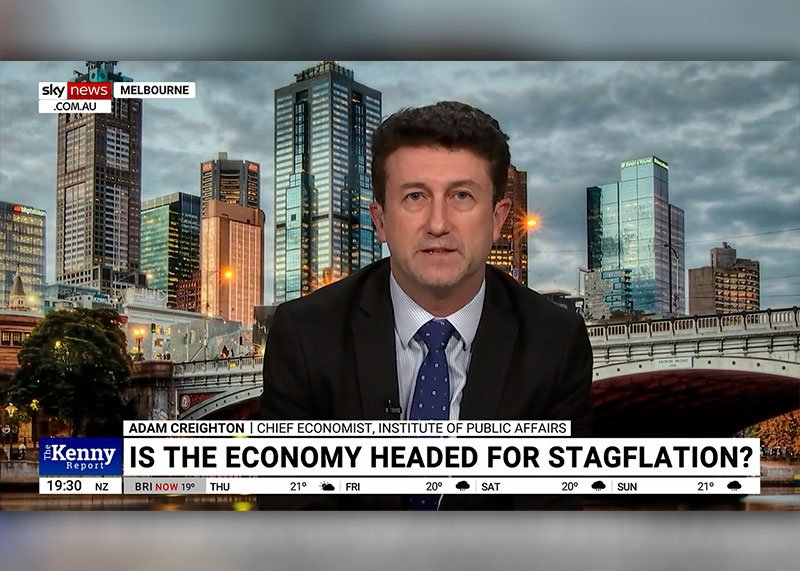
Jaimee Rogers:
Welcome back. Headline, inflation has fallen and the Treasurer is celebrating, but beneath the surface, the picture isn’t nearly as rosy. Australia’s underlying inflation is going up, raising fresh concerns about the direction of interest rates and even the prospect of stagflation. Well, at the same time, there’s growing criticism of the government’s housing policies with auction clearance rates falling and house prices beginning to soften.
Let’s bring in the Institute of Public Affairs Chief Economist, Adam Creighton. Adam, the government is being accused of sabotaging the housing market and this is off the back of auction clearance rates going down, prices are dropping. Housing Minister Clare O’Neil, she said that this is just a correction of the market. How much is the May budget in your mind responsible for the mess that we’re seeing now in the property market?
Adam Creighton:
Well, certainly, I would say to a great extent. The truth is the housing market was already softening before the budget came in, but that trend has accelerated I think the May figures, which I think we can attribute fairly to the May budget. Saw prices in Sydney and Melbourne at least down 1% for the month.
Now, of course, if that continues for 12 months, then that’s going to be more than 12% decline. And some analysts are saying that they expect more than that. I mean, the front page of the Fin Review yesterday had some suburbs in Sydney and Melbourne down 25%, 30% over the last three years already. And so you’d hate to be those people that bought there in 2023, 2022. They’re sitting on massive losses. And of course, think of the poor people that took advantage of the 5% deposit scheme last year. Many of them would now be underwater.
But it’s not just the federal government be worried. State treasuries should be concerned, because stamp duty revenues, which is the second or third-biggest revenue stream for most states are going to dry up significantly as the number of sales falls and the prices fall too.
Jaimee Rogers:
Well, inflation numbers were released yesterday and it did show that there was a drop from 4.2% down to 4%. But how concerned should we be about the underlying inflation going from 3.4% up to 3.6%?
Adam Creighton:
Well, very concerned, I would say, because Australia is pretty much the only developed country where the inflation rate is increasing. And I mean the underlying rate, which is the only rate, the 3.6% rate you just said then. That’s the rate the reserve bank looks at. That’s the rate where you exclude all the volatile items such as fuel recently, of course, because we had the excise cut. That’s what the RBA looks at and that’s increasing. So they’re in a very difficult position, because they probably should increase interest rates one more time if they were solely concerned about the rate of inflation. And there’s indeed a 30% chance that they will in August when they make their next decision, which would make four increases I think this year.
They may not do that, because by the time that comes around, you may see even sharper falls in house prices and then the RBA will be concerned about a loss of confidence and potential concerns about credit worthiness of financial institutions, et cetera. So look, it is concerning because there’s not many people out there except maybe for public sector union employees who are getting a 3.5% wage increase every year.
Jaimee Rogers:
Adam, we’re hearing the term stagflation being used quite a lot now. Can you just explain to us what exactly that is, but more so why this is such a big problem?
Adam Creighton:
Well, stagflation is a word that came from the 1970s experience when you had both rising unemployment and rising inflation at the same time. Now, the jobless rate here is relatively low, so I think it’s 4.4% or 4.2%. I think the new figure came out today. It’s historically fairly low, so I don’t think we have to worry about stagflation per se, but the concern is rising inflation.
And also, I would say that that jobless figure, 4.2%, the official figure, that’s a very misleading picture. There’s actually millions of people who are excluded from being technically unemployed because they simply haven’t looked for a job in the last week or they can’t start work in the next couple of weeks. When you add in all those other people, the jobless rate is more like 10%, 15%. That’s not the figure obviously the government likes to talk about, but that is the reality. There are millions of people out there who want to work who can’t, or indeed there’s people in work who want more hours, who can’t get more hours. So 4.2% is a very misleading figure.
Jaimee Rogers:
Yeah, it’s going to be an interesting one to watch with the economy. Adam Creighton, I will leave it there. Thanks so much.
This transcript of Adam Creighton on The Kenny Report Sky News Australia from 25 June 2026 has been edited for clarity.
