
We must sustain the growing momentum against green activist organisations if Australia is to reattain prosperity and encourage economic growth, writes IPA Research Fellow Saxon Davidson.
Extensive research, much of it undertaken by the IPA, has established beyond any doubt that red tape and environmental activism are preventing Australian industries from operating, jobs from being created, and export revenue from being earned. Given that two of the industries most hamstrung by bureaucracy and environmental ‘lawfare’ are regionally based—agriculture and the resources sector—red tape and activism are seriously harming our regional communities. This in itself is a disgrace, but it is also an act of madness as these are the very communities that deliver the revenue and royalties on which city-based populations, and the Canberra elite, rely.
It is time the Federal government put the national interest ahead of green activism, and let us power not only our future, but the world’s. The complex protection racket and financing with which green elites support activist organisations have enjoyed relative immunity since the introduction of the Environment Protection and Biodiversity Conservation Act 1999 (Cth) (the EPBC Act). This immunity enables them to engage in environmental lawfare, and has been further facilitated by the Climate Change Act 2022 (Cth).
However, since the government-funded Environmental Defenders Office (EDO) failed to cancel the Barossa Gas Project in the Federal Court in January, there has been growing public pressure for the government to put an end to this racket.
GREEN LAWFARE ATTACKING CRITICAL PROJECTS
Presently, a “person aggrieved” can challenge ministerial decisions on major projects under the Administrative Decisions (Judicial Review) Act 1975 (Cth) (ADJR Act) providing they are a person “whose interests are adversely affected” by a decision. However, section 487 of the EPBC Act extends the meaning of “person aggrieved” under the ADJR Act to include organisations or associations which are engaged in activities “for [the] protection or conservation of, or research into, the environment”.
Previous research by the IPA, Section 487: How activists use red tape to stop development and jobs, published in March 2020, found that between 2000 and 2020, legal activism by environmental groups in Australia put $65 billion worth of investment at risk by holding major projects up in court for a cumulative total of 10,100 days, equivalent to 28 years. Over the same period, 94 per cent of the legal challenges under Section 487 failed to substantially alter the conditions of a project.
The EDO’s legal arguments were savaged in court.
The activists know that the verdict is not what counts; it is the process—which kills jobs, opportunities, and growth. The stated aim of green activist groups is to use these legal procedures to conduct anti-development political campaigns, and they have aligned themselves with Indigenous activists so as to continue and diversify these lawfare attacks.
The EDO represented elders on the Tiwi Islands and in January, after the Barossa Gas Project had received conditional approval from the National Offshore Petroleum Safety and Environmental Management Authority to begin construction of a pipeline, claimed new evidence of cultural heritage had been discovered under the ocean where the pipeline was to be built. The activists claimed any construction that does not take this new evidence into consideration would be in violation of environmental regulations. In November 2023, the EDO was granted a court injunction just hours before construction of the pipeline was to begin. However, the legal arguments presented by the EDO were subsequently savaged in court by Justice Natalie Charlesworth, who concluded in her judgement that the EDO’s lawyers had engaged in “a form of subtle witness coaching”, had presented evidence that was “so lacking in integrity that no weight can be placed on them”, and had been caught out “distorting and misrepresenting what the Indigenous informant had said”.
The Federal Court’s emphatic verdict is a massive win for Australia and for the Northern Territory in particular. Economic analysis by the IPA shows that the Barossa Gas Project has the potential to deliver more than $8.8 billion in economic activity and more than 14,000 direct and indirect jobs, most of which will be filled by Territorians for many years to come.
Green activists would have to put their money where their mouth is.
Had the activists at the EDO managed to convince the Federal Court of its claims, all this would have been put at risk, with potentially disastrous implications for the Territory’s future prosperity. And this is the problem. Even when these baseless legal challenges fail, they serve their purpose by delaying critical projects, and in so doing undermine the projects’ viability—which is of course the activist organisations’ strategy.
Santos, the owner of the Barossa Gas Project, was given approval by the Federal Court to access all communications that the EDO had in relation to its failed claims in court. This provides a pathway for Santos to recoup costs from the EDO for the delay caused by their spurious claims—rather than the nominal plaintiffs in this case, namely the Tiwi Islanders.
Should Santos be able to recoup costs from the well-funded activist EDO, rather than the Tiwi Islanders, it would bring the green activist industry down a peg. The green activists would have to put their money where their mouth is, and would no longer be able to manipulate the legal system to delay and frustrate investors and, in the process, destroy Australian industries and jobs.
This consequence might already be taking effect, with the EDO, representing the Australian Conservation Foundation (ACF), dropping its case against Woodside’s Scarborough Gas Project in August 2024. This project has the potential to generate $25.1 billion in economic activity, and create 40,000 direct and indirect jobs. The ACF released a statement after the withdrawal of the case, asserting:
The reality is that Australia’s laws work in favour of fossil fuel interests. There is still no explicit requirement for climate damage to be considered under our key national nature law, the Environment Protection and Biodiversity Conservation Act. This means that, even today, major fossil fuel projects are being approved that will lock in huge volumes of carbon pollution well beyond 2050.This underlines the urgent need for stronger nature protection laws.
This is, of course, a clarion call to strengthen the ability of green activist groups to litigate against nation-building projects.
The world of policy-making is like physics in the sense that for every action, there is an opposite reaction. Trying to hold economic vandals responsible for their actions produces a reaction, which is to lobby the government into changing laws in order to legitimise and facilitate their actions.
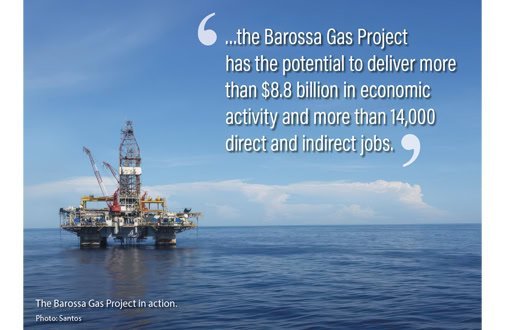 The Barossa Gas Project in action.
Photo: Santos
THE PROCESS IS THE PUNISHMENT
The EDO’s federal grant was placed under review shortly after the Barossa Gas case, and the Federal government conveniently found that the EDO was not in breach of its grant agreement. The EDO then went on to successfully cancel the McPhillamys Gold Project in Central West NSW in August 2024, outside of the court, by convincing Environment Minister Tanya Plibersek of potential cultural heritage desecration that may be caused by the project. This decision was made by Minister Plibersek through Section 10 of the Aboriginal and Torres Strait Islander Heritage Protection Act 1984 (Cth).
This means that the quality of the EDO’s arguments was never tested in the courts, unlike those used in the case of the Barossa Gas Project. This is particularly troubling, as there are significant questions around the EDO and its arguments in the McPhillamys case. First and foremost, the EDO was not representing the Orange Local Aboriginal Land Council (OLALC), which has legislative authority to protect Aboriginal culture and heritage in the relevant area under the Aboriginal Land Rights Act 1983 (NSW).
Radical groups should not be allowed to bypass properly constituted authorities, and manipulate the law, to put Australia’s sovereign capabilities—and our national prosperity—at risk. Repealing section 487 of the EPBC Act is a simple first step to solving this problem. However, a more substantial solution would be looking at how green groups secure their funding.
The election of the current Federal government in 2022 was a boon for this cottage industry of obstruction, with the EDO awarded $8 million in funding over four years. On top of this, the Federal government will furnish it with $2.6 million in annual, ongoing funding.
The Albanese government is not the only financiers of these economic vandals. Various State and Territory governments financially contribute to the EDO’s activities. In the previous five years, the EDO received $7 million from State and Territory governments combined. At last, the EDO’s egregious behaviour is being challenged. The first in Canberra to demonstrate any leadership on the issue was Opposition Leader Peter Dutton, who announced that should the Coalition form government the EDO would not receive federal funding. Dutton made the common sense point that he does not want “activists to hold sway over our industries and our economy”.

FOREIGN MONEY
The EDO is handsomely funded, with revenue of $13.3 million in the financial year ending 2023. The EDO receives funding revenue from international bodies, including the European Climate Foundation and the Oak Foundation. So, the Federal government is wilfully allowing foreign influencers to impair our sovereign capabilities, and is in lockstep with them.
It is important to bear in mind here that foreign financing of Australian political parties is illegal. Why then should a body like the EDO, with its plainly political purpose, be allowed to accept donations from foreign entities?
CLIMATE TRIGGER: DODGING A BULLET
A specific change these activist groups are attempting to make is adding a ‘climate trigger’ to the EPBC Act. A climate trigger refers to a mechanism whereby a certain level of annual carbon emissions from a given project would trigger the need for explicit Federal government approval. A climate trigger would provide extra cover for green groups to litigate against critical resource projects, using it as a basis for arguing that the approval of a project is invalid.
The Federal government is negotiating the passage of their ‘Nature Positive’ agenda through parliament and the Greens are making the climate trigger a key demand (the content of the Nature Positive Plan was discussed in the Winter 2024 issue of the IPA Review). However, after significant pressure from industry groups, and analysis by the IPA outlining the economic costs of a climate trigger, the Prime Minister and the Minister for the Environment ruled out introducing a climate trigger into the EPBC Act.
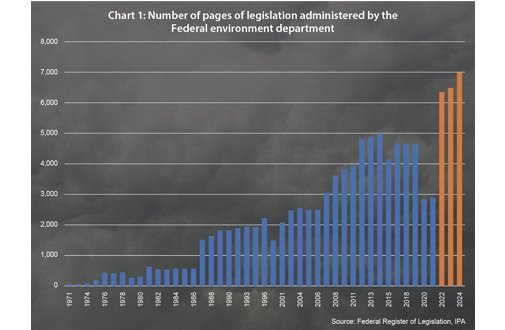
While the rejection of the climate trigger by the government is a positive development, it still does not reduce the regulatory burden that environment regulations place on Australian businesses. The Climate Change and Environment portfolio is the largest contributor to the soaring growth of regulation under this current government, with the number of regulators in the portfolio set to have increased by 76 per cent from 2023 levels to 2025. The Albanese government is not just expanding the number of green regulators; it is also driving and presiding over the fastest expansion of environmental laws and green tape since the environment department was established in 1971.
REIN IN HARMFUL ENVIRONMENTAL ACTIVISM
Diluting the power and influence of actors such as the EDO requires a comprehensive commitment to deregulation. It is not enough to just target the EDO and its behaviour; a responsible government—one committed to our most important industry and the hundreds of thousands of direct and indirect jobs it generates—would target the systemic issues which allow the EDO to operate as it currently does. This includes removing the duplication of environmental regulation, whereby Federal and State governments have responsibility for approving or disallowing resource projects, which effectively gives activist groups two ways by which to frustrate and delay a given project.
The proposed implementation of the Federal government’s Nature Positive agenda, which includes the introduction of a Federal EPA—even though every state and territory except for Queensland already has an EPA—would therefore be a boon for the activists.
Environmental regulation should be handed back to the states to remove such duplication. And devolution of environmental regulation to the states and territories also makes sense from a purely environmental perspective. One-size-fits-all regulation from Canberra is inappropriate, given how far removed that city and its elites are from the unique environmental circumstances of each state and territory.
Mainstream Australians deserve much better.
Consideration should also be given to the reintroduction of parliamentary repeal days, which were last seen during the Abbott government. The concerted removal of environmental regulation would strip activist groups of much of the ammunition they use to delay projects in multiple layers of the court system, and give regulatory relief to Australian businesses.
There should be an immediate investigation into international organisations and/or individuals funding Australian environmental groups who engage in lawfare. Allowing foreign donors to subsidise actions which put at risk the businesses and projects that fund Australians’ hospitals, schools, roads and infrastructure is not only counter-intuitive, it is obscene.
Mainstream Australians deserve much better. They do not deserve to have their hard-earned tax dollars diverted to groups, which are also propped up by domestic and foreign activists, that act against their interest.

This article from the Spring 2024 edition of the IPA Review is written by IPA Research Fellow Saxon Davidson.
