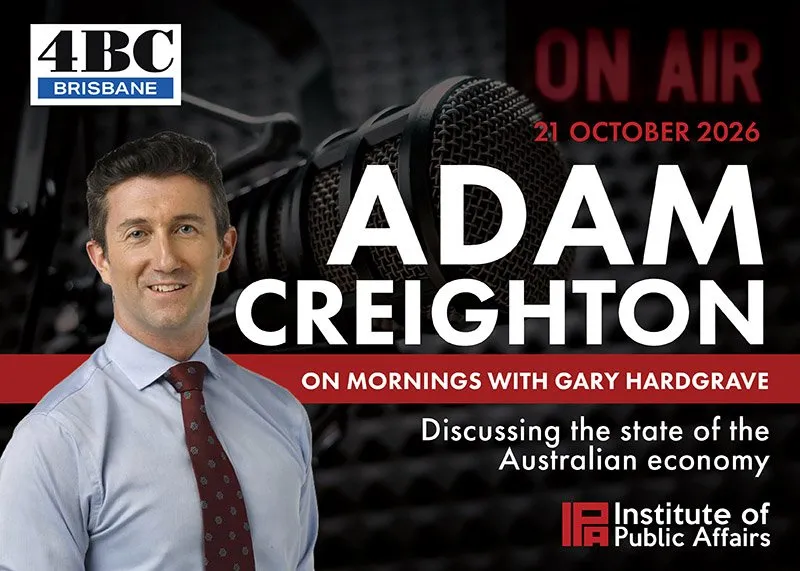
Gary Hardgrave:
Look, Australia’s standard of living is in serious decline. We need to have an honest conversation about it. We just do. We need politicians to stop with the puff read, to stop with the four word slogans. Let’s start dealing with the reality. We are suffering enormously. We’ve had decades, which a lot of people look back fondly on. The boomers. I was born in the late part of the baby boom period. But that post World War II golden age of prosperity, frankly, was not the default setting for Australia. It just wasn’t. There was this kind of amazing economic anomaly that we all would wish was back, but it’s not. The world has changed. Things have changed. But what’s worse is government has changed. Their attitude now is, if it moves, tax it. If it doesn’t move, kick it, then tax it. They’re constantly finding ways to get more income for government.
And all it’s doing is pushing private sector investment out. We’ve gambled our entire economic today and tomorrow on this nonsensical net-zero energy fantasy. It’s sent power prices skyrocketing, and it’s forcing it into an artificial energy poverty. And it looks dangerously, some are saying, like the 1930s. Like 1930 itself, the middle of the Great Depression. And the stock markets are just… They’re teetering. They’re right now teetering. It’s frightening stuff. And we need to be dealt with honestly. We can handle the truth. Where’s Jack Nicholson when you need him?
A government constantly borrowing money, filling up the debt burden for the next generation or two or three. And interest rates going up, they have to reissue the long-term bonds to basically mortgage our country to borrow big to look good now. So, how do we trim government spending? How do we actually get somewhere without everyone throwing the big hissy fit? Because politicians don’t want to look like good blokes. Let’s cut through all of the political puffery. Let’s look at the cold hard arithmetic.
This bloke has written for years about economics. He’s a great writer, but he’s a senior fellow chief economist at the Institute of Public Affairs, Adam Creighton, and he joins me. Adam, always good to talk to you.
Adam Creighton:
Likewise.
Gary Hardgrave:
The claim from Chris Wright, the US energy secretary, a bloke actually has some ideas about things. He reckons that we have spent, as a world, US, 10 trillion, with a T. There’s so many zeros in that. Hundreds and hundreds or thousands and thousands of millions of dollars. 10 trillion over the last two decades to try and prop up wind and solar, but they only make up 3% of the world’s energy mix. What the heck are we doing to ourselves?
Adam Creighton:
No, look, that’s an extraordinary statistic, isn’t it, that 3%? I heard your editorial earlier, it was very good. And you zoom into different countries, and they’ve spent proportionally even more, such as Germany and the UK. And honestly, Australia would be up there too. But the reality is fossil fuels still and always will, in my view for many, many decades to come, they will underpin our energy systems, and that’s just a fact of life. These wind and solar so-called farms are really just tokenistic virtue signalling that ultimately ruins the power grid, as we’re going to see more and more. We’ve seen a blackout in Spain, a severe one a couple of years ago. And we’re going to see that more and more.
And actually, just on the US, I literally landed this morning from Indianapolis. I was in Indiana, which is a fairly conservative Midwestern state. And I called it, in my monthly email to donors that I write, a story of hope because you had great political leadership that more than halved their debt, and now it’s less than a billion dollars. Right? Whereas, Victoria’s is 200 billion. And these are two states with about the same population, seven million each. And there’s a state with almost no wind and solar. In Indiana, they have 12 coal-fire power stations, whereas I think Victoria has three. And 50% of it is renewable. And their power prices are about 25% lower than in Victoria. And their tax rates are vastly lower too.
I did the calculation. The flat rate of state income tax in Indiana is 2.95%. There’s no payroll tax. So when you add the state income tax to the federal income taxes, a median worker is facing a marginal rate of about 25%. And that includes their social security insurance, which is their pension. Whereas, in Victoria that same worker is going to be facing 33% marginal rate and that excludes the 12% super contribution. So, on one level it’s depressing, but on the other, it’s a story of hope that if we had some decent leadership, we can be more like Indiana.
Gary Hardgrave:
Well, there’s a slogan here to be more like Indiana. Indiana wants me. There’s a whole bunch of musical themes you’re triggering in my head. But look, and it’s a good point you make, but smaller government, fewer taxes, better mix of migrants, cheaper power. I think they’re the four things that we need to get this show back on the road. Can we do it?
Adam Creighton:
Well, look, I don’t know. I hope we can. Australia is still a very rich country, and I think that breeds this complacency that we don’t need to worry that what happened to Argentina will never happen to us because we speak English and we’ve just always been rich. But I think this is very naive, right? Extremely naive. I think immigration has to change, as you suggest.
I think the number one thing is spending. That’s what has to come down, both at state level and the federal level. Here in Victoria, where I’ve been living now for one and a half years, you’ve got a state bureaucracy of 393,000 people if you include all of the public sector employment, and that’s up by about 60 or 70,000 people in just a few years. Right? And then you’ve got the highest tax state in Australia, whether you look at [inaudible 00:07:04] or whether you look at payroll tax. And then, at the same time you’ve got the highest debt. So, it’s a disastrous situation. But I did do some calculations recently for a presentation, and if the state here gets a government with balls, sorry to use-
Gary Hardgrave:
Testicular fortitude, I call it, Adam.
Adam Creighton:
Yeah, that’s right. But you’ve only got to cut spending by about 7%, just a one-off cut. Now, look, if you’re a private business or a household, cutting spending 7% is not very draconian. So, for governments it may be. But it’s not like you’ve got to cut spending by a third like President Milei did. You only have to cut it in Victoria by 7%, and then you’ll put the state on a trajectory to pay off all the debt. And the Commonwealth Grants Commission, which it compares all the states as you know, it said that cutting spending by 7% in Victoria would not even affect the quality of services, because it’s just spending too much. So, people shouldn’t in theory even notice a cut of 7% except for those bureaucrats that lost their jobs. But in a booming economy, they’ll find other jobs.
Gary Hardgrave:
I would’ve though so. But surely going for growth, it seems an easy line to drop. But I say we’ve got basically a trillion with a T, certainly 800 billion plus worth of minerals in the ground in the northwest minerals province, essentially around Mount Isa here in Queensland. There’s uranium, there’s that asset. If we started to deploy the full use of the kind of assets we’ve got, you’ll create jobs, create the need for new infrastructure, and actually build a longer term future. And would actually make it easier for us to borrow money if we had to smooth out the rough edges. So, why aren’t we going for growth, Adam? That’s what I don’t understand.
Adam Creighton:
Yeah. Well, look, we should be. And that’s what I say is the best way for Victoria to get out of its morass in Australia more generally. It’s much less painful to grow the economy properly. And I say properly because I don’t want more immigration. I want actual increases in GDP per capita. And, yes, you’re right, we have extraordinary mineral resources, but many of them are locked up by regulation and can’t be used. So, yeah, you mentioned uranium. Well, South Australia struggled for some time to find a private sector of its own. Of course it’s got wine, and that’s great, but it could also have a huge nuclear sector with all of the associated high-tech employees and businesses. But the federal regulation makes it illegal. And yet we still export uranium to other countries. So we’re happy for other countries to use it, but we’re not happy to use it ourselves.
And the South Australian premier, to his credit, he’s a Labour guy and he’s asked, “Can we please get rid of this stupid ban?” But federal Labour will not hear it. So, that’s one example. And then there’s plenty of gas in Victoria, which is all tied up and can’t be used. So, they’re building LNG gas terminals in Geelong to import LNG.
Gary Hardgrave:
The insanity of this has got so many elements to it. Australia’s also sitting on a big deposit of oil around our continental shelf, and even on our ground. It can be one. We can actually become a lot more energy independent than we are right now. If we get our coal resources used right, we reinvest in coal, look at nuclear in the longer term. There’s things we should be doing and government should be prioritising. Instead, they want to get people with shiny bottoms in fancy chairs in big buildings in all our capital cities.
Adam Creighton:
Yeah. Look, that’s the sad thing too. Just in Indiana, I realised that… I also spent a few days in Cincinnati, which is two hours away. And these are big regional cities with about two, three million people. So, smaller than Melbourne, but they each have big businesses, big private sector businesses. So there’s Eli Lilly, the huge pharma company, that’s headquartered in Indianapolis. And then Procter & Gamble has its headquarters in Cincinnati. And then I reflected back on Melbourne. Well, where is our organic private sector industry? It’s all basically industries that are dependent on government in Melbourne, whether it’s superannuation, that’s obviously the big one. Or the university system, obviously, that’s also dependent on government. They’re the big sectors in Melbourne. And that’s kind of pathetic, really, when your top sectors, they only exist because of government regulation.
Gary Hardgrave:
Yeah. Well, Queensland is often lampoon Victoria. But the reality is, and I’ll say this as a proud Queenslander, when Victoria does not work well, the rest of Australia suffers. We’ve got to get that state right. But smaller government’s so important.
Adam Creighton:
Look, it certainly is. And more power to you for your advocacy for that. Australia much needs it.
Gary Hardgrave:
All right, well done. Thank you. Adam Creighton from the Institute of Public Affairs. Economics guru, great writer. What do you think? 133-882. The comparative public policy to a place in the United States should not be ignored either. A different country, different systems, but one’s going ahead and we’re in decline.
This transcript with Adam Creighton talking on Mornings – 4GB from 21 October 2026 has been edited for clarity.