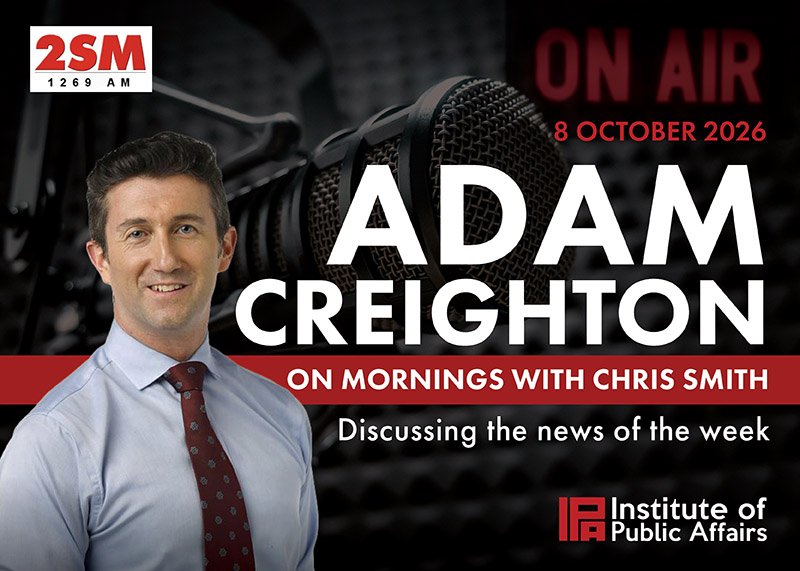
Chris Smith:
Adam Creighton is a senior fellow and chief economist with the Institute of Public Affairs, columnist with The Australian newspaper and their former Washington correspondent. Adam, good morning to you.
Adam Creighton:
Good morning, Chris. Great to be here.
Chris Smith:
Yeah, the High Court has just handed environmental activists a major win. I was just telling our listeners about it, and they’re already talking about the next coal and gas projects they can finish. The court has blocked the expansion of the Mount Pleasant coal mine in the Hunter Valley. Three of the five judges ruled the New South Wales Planning Authority failed to properly consider the greenhouse emissions created when the coal is exploited and burned elsewhere. I didn’t know the High Court was a high court for the globe.
Adam Creighton:
Yes, I know. Look, it’s strange because obviously High Courts, Supreme Courts, they can pick and choose what they hear, and they have heard this very obscure case and they’ve made life very difficult for the New South Wales government, which is going to have to pass emergency legislation to get this mine going or to re-approve the mine. This is a very academic debate about the wording of some laws in a New South Wales act that says that the commission that approved the mine, well, the high court says it didn’t pay significant attention to so-called scope three emissions, which are basically the emissions that happen outside Australia.
And the whole thing is just laughable really, because it’s a reminder of Australia’s hypocrisy, that we pay attention to our domestic emissions but we’re quite happy to export all of this gas and coal overseas, which of course does produce emissions, and I’m not saying there’s anything wrong with that, but it’s just hilarious that now, 98% of the emissions from this mine will actually occur overseas in Japan or India or wherever the coal is going, and somehow now this little state government commission has to take all those into account. I mean, it’s just absurd. And politically, it’s come a very bad time for the state government, I would say, in New South Wales, and also federally because it just makes them look really stupid.
Chris Smith:
Well, AEMO says that we’re going to have blackout problems in 2030. My energy experts tell me on this programme that it’s more like 2028 and they’re not taking into consideration projects that have actually started. They’re considering projects that have gone through the investment capacity scheme, so they’re only being reviewed. They’re not projects that are going to start. So my experts say we’re going to go into blackout territory 2028, and so the New South Wales government has to keep extending our major Lake Macquarie coal-fired power station in particular, maybe more to keep the lights on. What now?
Adam Creighton:
Yeah, look, that’s exactly true. New South Wales has already extended twice, I think, one of the coal mines up there, and they’re going to have to extend more of them-
Chris Smith:
Eraring.
Adam Creighton:
Yes, that’s right, Eraring. And that’s to Premier Minns’ credit actually. I mean, if you look down in Victoria, there’s just been complete ignorance of the looming disaster down here where you’ve got these three large coal mines. Yallourn is meant to be turned off I think next year, and it probably has to be because it hasn’t been maintained. It’s very old and it will be turned off, and yet everyone’s got their head in the sand. This is a plant that supplies 20% of the state’s electricity, and also, it must be said, looks after South Australia too because of the interconnected with Victoria, and they don’t have any coal over there anymore in South Australia. So I think there’s going to be a lot more focus on coal over the next three years, and I think more Australians will realise that that’s what is keeping the lights on at their place. Ultimately, it’s coal. So I think this decision’s good in the sense it’s focusing the minds of the public on the importance of coal and also the ludicrous fact that we have these absurd and very hypocritical rules about emissions.
Chris Smith:
Well, what about the economy though? What about the economy? $71.3 billion in revenue comes from the export of coal. $71.3 billion. If the plan is to not expand any more coal-fired power stations, and so by 2030, we’ll probably have none, where are we going to find the $71.3 billion from that pays for hospital schools and the NDIS?
Adam Creighton:
Yeah. Well look, that’s a very good question. The treasury in their forecast for our exports that were released earlier this year, when you might recall the government brought down even tougher emissions targets. I can’t quite remember the figure. I think 65% down by 2035 or something. 70 actually, I think it was 70% down, which of course won’t be achieved, but the treasury says that all of our coal exports and gas will be replaced by green hydrogen and various other nonsense which does not even exist, and yet it’s supposed to fill the gap within the next decade. I mean, it’s just ludicrous and laughable, and these power stations won’t be shut down. Because you’re seeing around the world right now, especially in Europe, you’re seeing a lot of riots, a lot of anger, and this is not about schools in France or elsewhere. It’s just about general fury in the public about the economic direction that their countries are taking and the fact that power prices keep going up and up and up, and that’s not going to stop.
Chris Smith:
What do you make of Chris Bowen’s sleepy, blacked out climate club in Tuvalu?
Adam Creighton:
Well look, that was very funny. I though it was also very funny that he refused to wear the foo, which is the traditional headgear. So obviously, he’s not in a very good mood because he quite rightly ascertained that if he did wear the foo, he’d be mocked mercilessly, so he didn’t wear it, but he’s just humiliated anyway. We’ve spent 20, $30 million, Australian taxpayers, on these stupid meetings, this pre-COP. I mean, it’s just such nonsense, and they’ve only got, I think two other world leaders have come from tiny little countries, I think in Africa, so you just wonder what the whole thing’s about. And then they’ve basically conceded it’s nonsense because the government’s now said, “Oh, it’s just about general Pacific, shoring up our allies,” so it’s basically just welfare, welfare to other countries.
Chris Smith:
And a $3 million check. And a $3 million check.
Adam Creighton:
Yes. Yeah, and it’s not going to achieve anything. There’s been a statement. Of course, there’s always statements and communiques saying we must urgently reduce emissions, but in case they haven’t noticed, there’s these data centres going up all around the world at a rapid pace which are chewing up huge amounts of power, which just only a few years ago weren’t even foreseen, so they’re not going to meet their targets. And I’m shocked that the government hasn’t already started to crab walk back from them, but no, they’re doubling down, and I guess that’s to shore up their left flank and hope that they get some Green preferences.
Chris Smith:
Oh, just appalling.
Adam Creighton:
It is, it is.
Chris Smith:
Driving us off the cliff. That’s exactly what’s happening.
Adam Creighton:
Yep.
Chris Smith:
Meanwhile, Australia’s economic settings are pulling in opposite directions. The RBA is hitting the brakes on inflation, but the federal government keeps its foot on the spending accelerator. Now, the S&P Global Ratings Agency says the RBA is trying to contain inflation, but while government spending is pushing in the other direction, they’ve got no chance. It’s right… Someone has to call this mob out because we keep hearing from the treasurer and we keep hearing from the prime minister porky’s about spending being cut back. You’re not cutting it back and you’re certainly not cutting it back enough.
Adam Creighton:
Yeah. Look, I mean, they like to go back and say, “Oh, well, the deficit’s a little bit smaller than was forecast seven years ago.” Well, I mean, who cares? I mean, that’s totally irrelevant. What matters is that there is a deficit, that it’s large, and this financial year, the headline deficit is forecast to be 60 something billion. Now, that headline figure, that includes all of the off-balance sheet nonsense that doesn’t make it into the so-called underlying cash balance figure. Sorry to confuse everyone with the language, but basically, they hide a lot of nonsense for climate and for cutting student loan values and all this sort of stuff in the off balance sheet stuff, but it’s still money, it’s still borrowing, it’s still going into the economy, so it’s having the same inflationary effect as all the other dollars that they spend. And I think the most important point is that you’ve got spending just by the federal government at [inaudible 00:08:12]. Its the highest it’s ever been except for the COVID years.
Chris Smith:
Just say that number again because you dropped out. We didn’t hear that number.
Adam Creighton:
Oh, sorry. No, the federal spending is at 26.95% of GDP, so basically 27. That’s just the federal government, not the states. So the federal government alone is spending more than one in $4 in this country, and it’s the highest share that it’s ever been except for briefly during COVID. And so not only is there a lot of government spending, but of course we all know that government spending tends to be very inefficient because it’s someone spending someone else’s money on someone else, and you never get a good result when that happens.
Chris Smith:
Well, there was a time when things were off the budget papers and they were called… Well, they’re off the budget papers because they are important investments. That suggests and alludes to the fact that the investments create profit, that create revenue, but none of this stuff creates revenue. It’s spending to change the temperature of the planet, which we cannot do.
Adam Creighton:
Yes. And look, the IPA’s done research showing that the federal government on all this net-zero stuff is spending $12 billion a year, and that’s very conservatively estimated on net-zero associated programmes, and that’s just the direct spending, not the second round effects of all the regulations and all the confusion it creates. That’s just $12 billion a year, and of course that’s all borrowed at, and let’s just add it, about five and a half percent now, because you’ve got bond yields all around the world surging. In fact, I’m just writing my column now for tomorrow about the looming government debt crisis, which is very scary actually. I mean, it’s happening now before our eyes in Japan, in France, in the United States. I mean, at these current new interest rates with five and a half percent, these debt burdens are simply not sustainable by these countries. They will not be able to pay the interest on them. France and Japan certainly won’t be able to, the US certainly won’t be able to.
And so I think our governments here, which do have less debt, but I mean, it’s still huge, they’ve got to be seriously thinking about cutting spending and shoring up their financial situations, because we’ll be judged to a higher standard than France and Japan because we’re smaller and further away, and we’re very exposed to one country, China.
Chris Smith:
Yeah. Well, at least they’re proving that in their efforts to create intergenerational equity, they’ve actually gone the opposite direction in creating intergenerational inequity, because our kids and their kids are going to be paying for this stuff.
Adam Creighton:
I know. Exactly, and that’s what Philip Lowe, the former RBA governor told me just last week on an interview with me. I mean, he was really furious now in his retired capacity about the lack of budget surpluses and also this nonsense about intergenerational equity. I mean, he made the point that you just made, that there’s this soaring debts at state and federal level, and of course, who’s going to pay all that back? It’s going to be the next generation that’s going to be lumber with this, so far from improving it for the younger ones, the government’s made it much worse.
Chris Smith:
Now listen, what’s wrong with the ATO and what is wrong with the small business minister that she can’t tell the ATO to pull their heads in? Right now, and I know from speaking to many small business people that they only get ahead at the moment because they can pay their ATO debts on their credit card. That is the only way they can plug the gap to get through to the next sector. Otherwise, they’ve got to close the doors. Now, the ATO is saying, “Oh, you can’t pay ATO debt on credit card. Sorry, that will start from December 1. Suck on that.” Are they serious?
Adam Creighton:
Yeah. Look, I think the Reserve Bank deserves the blame for this, to be honest, and it’s my former employer many years ago, and actually, I worked in the payments department when I was a graduate, that actually decided to allow surcharging, and now they’ve done the opposite and banned surcharging. In the space of 20 years, they’ve literally gone from one rule to the other. And on one level, I have some sympathy for government agencies not wanting to pay these fees because they’ve got to pass it on to taxpayers, I guess, but it’s the rule in the first place that’s the problem, and the RBA, I think, deserves more scrutiny on this. I mean, basically, what it means is that shops and businesses can no longer say, “All right, well, the customer’s going to have to pay the 1% that we have to pay the bank to accept this.” They’re not allowed to do that anymore, so there can be no surcharges.
And these cards do cost money to accept, I mean, especially the Diners Club and American Express. I mean, if you pay with those, the shop’s got to fork out about 3% of the purchase price. It’s huge. So it’s a very technical issue, and I blame the Reserve Bank for this. They’ve created all of this confusion and anger, which you’ve just pointed to, and they’ve closed off a valuable way of paying for many, many businesses to the tax office, and it’s going to be interesting to see what happens. I think the government’s told the tax office to change its mind, but I think legally, it can’t do that, so it’s going to be interesting to see what happens over the next couple of weeks with the standoff between the tax office and the government.
Chris Smith:
Madness. In every way, we’re dealing with madness.
Adam Creighton:
Yeah, it is. It is madness.
Chris Smith:
Okay. Adam, I’ve run out of time, but thank you very much for yours.
Adam Creighton:
Thanks for your time. [inaudible 00:13:33]. Thank you.
Chris Smith:
All right. We look forward to looking at your column tomorrow too, mate. Thank you.
Adam Creighton:
Indeed. Thank you very much.
Chris Smith:
Adam Creighton, senior fellow at the Institute of Public…
This transcript with Adam Creighton talking on Mornings – 2SM from 8 October 2026 has been edited for clarity.